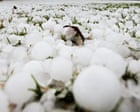
Media outlets are lazy. They see white blankets on the sand in Tunisia and Algeria and immediately reach for the "Winter Wonderland" headline. It is an aesthetic trap that masks a violent meteorological reality. Calling a massive hail deposit "snow-like" isn't just a harmless metaphor; it is a fundamental misunderstanding of atmospheric physics and a dangerous erasure of the damage these events inflict on North African infrastructure.
The recent "snowfall" in the Maghreb was nothing of the sort. It was a localized, high-intensity bombardment of ice pellets. If you want to understand why the Sahara is shivering, stop looking at the thermometer and start looking at the vertical velocity of the atmosphere.
The Thermodynamics of the Great Hail Hoax
The "lazy consensus" suggests that these events are proof of a cooling trend or a freak "once-in-a-century" anomaly. Neither is true. We are seeing the byproduct of a volatile atmosphere where heat—not cold—is the primary engine.
To get hail in the desert, you need three specific ingredients that have nothing to do with a cozy winter day:
- Extreme Convective Instability: The ground stays hot enough to launch moisture into the upper atmosphere at terminal velocity.
- A Deep Freezing Layer: A sharp, narrow band of sub-zero air sitting atop a furnace.
- High Liquid Water Content: Massive amounts of moisture being sucked off the Mediterranean and dumped into a system that cannot process it.
When you see white dunes in Gafsa or Tébessa, you aren't looking at gentle crystalline structures. You are looking at high-density ice spheres formed by intense updrafts that kept those stones suspended until they were too heavy for the air to hold.
Why the "Snow" Narrative Is Classist
When a suburb in Switzerland gets six inches of snow, it’s a postcard. When the interior of Tunisia gets six inches of hail, it is a catastrophe for the rural economy. By framing this as a "beautiful" or "unusual" weather event, Western media ignores the architectural and agricultural reality of the region.
Most residential structures in the Algerian highlands are built to shed heat, not to support the weight of thousands of tons of ice. Hail doesn't melt like snow; it packs into a dense, slushy concrete that blocks drainage systems and collapses corrugated roofing.
I have seen farmers in the region lose entire olive groves to these "picturesque" events. The hail strips the bark and kills the saplings. A "snowy" photo on Twitter doesn't capture the sound of a family's livelihood being shredded by ice in under twenty minutes. We need to stop romanticizing the symptoms of a broken jet stream.
The Jet Stream Is Drunk and It’s Not Going Home
The real story isn't the ice; it's the Rossby waves.
Standard meteorology suggests the jet stream should act like a tight rubber band around the pole. Instead, we are seeing "omega blocks" and deep meridional flows. The jet stream is looping so far south that it’s dragging polar air into the subtropics while pushing Saharan heat into the Arctic.
This isn't a "change" in weather; it’s a collapse of the traditional boundaries between climate zones.
The People Also Ask section of Google is usually filled with nonsense like "Is it snowing in the Sahara because of global cooling?" Let’s be blunt: No. It is snowing (or hailing) because the Arctic is warming faster than the rest of the planet, reducing the temperature gradient that keeps the jet stream stable. When that gradient fails, the weather "stagnates." Cold air spills south and stays there, trapped in a geographic bowl.
The Infrastructure Blind Spot
If you are a city planner in North Africa, you aren't planning for "snow." You are planning for water. But you’re planning for the wrong kind.
Most drainage calculations in the Maghreb are based on liquid precipitation. They don't account for "solid-state" rain. When a hail storm hits, the stones clog the inlets instantly. Then the rain follows. Since the drainage is plugged with ice, you get flash flooding in the middle of a "snowstorm."
We are applying 20th-century drainage logic to a 21st-century atmospheric reality.
I’ve worked with regional development groups that spent millions on drought resistance, only to have their projects wiped out by a single ice event. We are obsessed with the "warming" part of global warming and completely oblivious to the "volatility" part.
The Cost of Visual Misinformation
| Myth | Reality |
|---|---|
| It’s a "rare" event. | It’s a recurring pattern driven by Mediterranean sea-surface temps. |
| It’s harmless "snow." | It’s high-velocity ice that destroys non-reinforced structures. |
| It proves "cooling." | It’s a direct result of energy spikes in a warming atmosphere. |
Stop Looking for "Normal"
The most dangerous phrase in climate reporting is "returning to normal." There is no normal. The data shows that the frequency of these deep-trough events in North Africa has shifted. We are now in a period where the "unprecedented" is the baseline.
If you live in a region where it "never snows," you should be the most prepared for ice. The lack of historical precedent is exactly what makes these events lethal. You don't have the plows. You don't have the salt. You don't have the roof pitch.
The Mediterranean Heat Battery
The Mediterranean Sea is currently acting like a giant battery, storing record amounts of thermal energy. When a cold front dips south, it hits that wall of moisture-laden air like a freight train. The result is the atmospheric equivalent of an explosion.
That "snow" on the sand? That's the fallout.
We need to stop treating these events as curiosities for the evening news. They are warnings of a systemic shift in how moisture is distributed across the planet. The Sahara isn't becoming the Alps; it’s becoming a laboratory for high-energy weather extremes that defy classic categorization.
Next time you see a viral photo of a camel in the "snow," don't like it. Don't share it as a "miracle of nature." Recognize it for what it is: the visual representation of a climate system that has lost its equilibrium and is now venting energy in the most violent way possible.
The ice isn't a gift. It’s a debt. And the bill is coming due for every flat roof and olive branch in the Maghreb.
Build for the ice or get buried by it.