The headlines are screaming about a "fracture" in the North Atlantic Treaty Organization because a member state—let’s not pretend we don’t know who we’re talking about—refused to let U.S. bombers clip through their clouds on the way to Tehran. The pundits call it a crisis. The "experts" call it a blow to American hegemony.
They are all wrong.
What you are witnessing isn't a diplomatic failure. It is a highly choreographed performance of strategic theater. If you think a closed flight path stops a global superpower from delivering ordnance in the 21st century, you are still living in 1944.
The Logistics of the Lie
The "lazy consensus" suggests that when a NATO ally closes its airspace, it cripples the mission. This assumes that modern warfare relies on the shortest distance between two points. It doesn’t. It relies on redundancy and loitering capacity.
I’ve spent years watching defense contractors and logistics officers map out these "denial scenarios." When an ally says "no" publicly, they are often doing the U.S. a massive favor. They are preserving their own domestic stability and regional "neutrality" while the U.S. simply pivots to a different node in a global network of bases that is specifically designed for this exact friction.
Closing airspace is a PR move for the local electorate. It's a pressure valve. Behind the scenes, the "offending" nation is likely sharing SIGINT (Signals Intelligence) or providing refueling access at a "civilian" port that never makes the news.
The Sovereignty Delusion
Let’s dismantle the idea of national airspace sovereignty. In the age of hypersonics and orbital surveillance, "airspace" is a legal fiction maintained for the sake of insurance companies and commercial pilots.
When a state "closes" its sky to U.S. assets, they aren't erecting a physical wall. They are signaling a price hike. In the world of realpolitik, a "No" is actually a "Not for this price."
- The Transactional Reality: Every time a NATO member plays hardball, look at the next weapons procurement cycle. Suddenly, that country gets a "discount" on F-35 parts or a favorable trade deal on liquified natural gas.
- The Technical Workaround: If the U.S. really needs to be in that sky, they use platforms the host country can’t—or won’t—detect. If it isn't on the radar, did the violation even happen? In the intelligence community, we call this "consensual non-consent."
Why the "War with Iran" Narrative is Flawed
The competitor articles love to frame this as a precursor to a "Great War." They want you to believe we are on the edge of a global conflagration because a tanker had to fly around a peninsula.
This ignores the Offset Strategy.
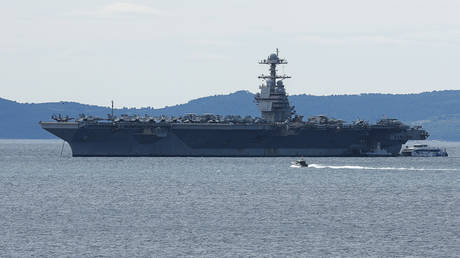
The U.S. military doesn't need a single NATO ally's permission to project power into the Middle East. With carrier strike groups (CSGs) and long-range standoff capabilities, the "airspace" of a Mediterranean or European ally is a convenience, not a requirement. By focusing on the "closure," the media misses the actual story: the shift from base-dependent warfare to distributed maritime operations.
The Cost of the "Contrarian" Stance
I will be the first to admit: this approach has a downside. By allowing allies to publicly snub the U.S., the perception of Western unity erodes. This emboldens adversaries like Russia or China to test the fences. They see a "No" and think the house is divided.
But for the U.S. military-industrial complex, this "division" is a feature, not a bug. It justifies increased spending on "autonomous long-range platforms" and "over-the-horizon capabilities."
If every ally said "Yes" every time, we wouldn't need a $800 billion defense budget. We’d just need a few runways. The friction creates the demand for the technology.
Stop Asking if NATO is Breaking
People keep asking: "Is this the end of the alliance?"
That is the wrong question. The alliance isn't a marriage; it’s a risk-management syndicate.
In a syndicate, members are allowed to opt out of specific "hits" to maintain their cover. If Turkey, Greece, or Italy blocks a flight path, they aren't leaving the club. They are managing their local risk profile.
The real question you should be asking is: Who profits from the detour?
When a flight path is redirected, fuel consumption spikes. Logistics contracts are rewritten. Private military contractors get called in to handle "alternative routing."
The Actionable Truth for Investors and Analysts
If you are tracking these movements to predict market shifts or geopolitical stability, stop looking at the maps.
- Follow the Fuel: Look at the refueling contracts in alternative hubs like Djibouti or Cyprus. That’s where the real movement is.
- Ignore the Headlines: A "closed airspace" headline is almost always a lagging indicator. By the time the press reports it, the military has already been using the "Plan B" route for three weeks.
- Watch the Debt: Countries that stand up to the U.S. on paper often have the most significant underlying dollar-denominated debt. The "defiance" is a poker chip used in restructuring talks.
The "closure" isn't a wall. It’s a toll booth.
The next time you see a map with a big red "X" over a NATO country, don't mourn the alliance. Check the stock price of the companies building the drones that don't need to land.
Sovereignty is a luxury for countries that don't have a superpower's credit card in their wallet. Everyone else is just haggling over the price of the transit.
Stop reading the play-by-play and start looking at the scoreboard. The game isn't about who flies where. It’s about who owns the sky enough to let others pretend they can close it.