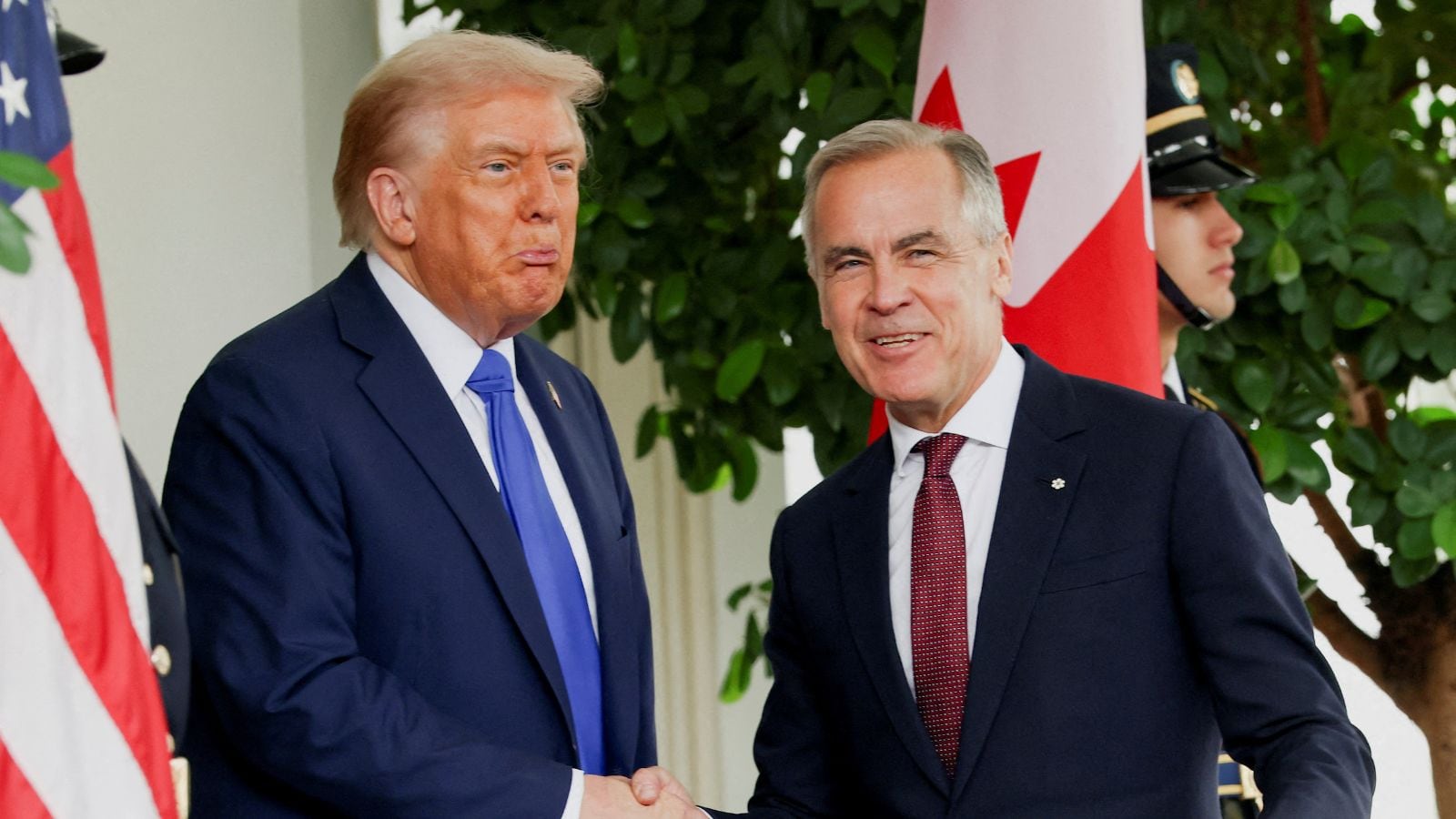
Bilateral commerce between Washington and Ottawa operates under conditions of chronic institutional friction, punctuated by repeated threats of punitive levies and mandatory six-year trade pact reviews. When political principals announce provisional accords while leaving operational specifics undefined, observers frequently misinterpret the ambiguity as diplomatic failure. In practice, this lack of textual clarity serves a precise function. It maintains strategic optionality for executive enforcement while keeping export-dependent economies under persistent regulatory pressure. Deconstructing this diplomatic maneuvering requires moving past surface-level announcements to examine the underlying cost functions, structural points of leverage, and enforcement mechanisms governing the modern North American economic corridor.
The Architecture of Leverage and Tariff Threats
The deployment of unilateral tariffs against a heavily integrated trading partner relies on a clear asymmetry in market exposure. More than seventy percent of Canadian exports head south across the border, concentrating macroeconomic vulnerability within a single geographic destination. Conversely, U.S. imports from Canada represent a smaller percentage of overall domestic consumption, though specific sectors like energy, automotive components, and primary metals exhibit high structural dependence.
When the White House introduces targeted levies on a fraction of bilateral export volume, such as the threatened measures targeting approximately twenty billion dollars of Canadian goods, the objective is not broad revenue generation. Rather, it functions as a regulatory shock designed to compel concessions on specific domestic policy irritants without forcing a complete renegotiation of the overarching trade architecture.
The mechanism operates through three distinct channels:
- Export Margin Compression: Imposing sudden duty rates on specific goods forces producers to either absorb the cost via reduced margins or raise end-user prices, destroying demand.
- Supply Chain Uncertainty: The threat alone introduces friction into cross-border logistics, prompting firms to hold excess inventory or re-evaluate long-term capital expenditure in the target jurisdiction.
- Political Feedback Loops: Export compression generates immediate domestic pressure within the targeted nation, forcing sub-national leaders and industry lobbies to lobby their federal government for compromise.
The Supply Management Deadlock
Agricultural market access remains the most intractable structural barrier in bilateral negotiations. The persistence of Canada's supply management system for dairy, poultry, and egg sectors creates a structural conflict with export-oriented American agricultural producers.
Washington targets this protectionist framework, arguing that tariff-rate quotas severely restrict market share for U.S. farmers. Ottawa defends the mechanism as vital for agricultural price stability and rural income preservation.
The mechanics of this deadlock involve fundamentally incompatible economic models. The U.S. model relies on scale, surplus production, and external market absorption. The Canadian model relies on production controls, import quotas, and guaranteed domestic pricing floors.
When political leaders claim that agricultural tariffs will be driven down to zero while domestic officials simultaneously assert that supply management is entirely non-negotiable, a logical contradiction emerges. Resolving this contradiction requires structural workarounds rather than direct deregulation. Negotiators typically resort to expanding minute tariff-rate quota percentages while keeping the core administrative machinery of supply management intact, satisfying political audiences in both capitals without altering the underlying domestic economic baseline.
The Expiration of Institutional Certainty
The structural stability of North American trade took a significant turn with the execution of the first six-year joint review of the trilateral trade agreement under Article 34.7. The decision by the United States to withhold a full sixteen-year extension transforms the trade corridor from a stable, predictable legal regime into an ongoing negotiation process.
Without long-term certainty, corporate investment models must account for regulatory decay. Long-cycle capital projects, particularly in energy infrastructure and automotive manufacturing, demand horizons exceeding a decade to achieve positive return on investment. Subjecting the trade framework to mandatory annual reviews creates a permanent state of conditional access.
This environment alters corporate behavior in measurable ways:
- Capital Stagnation: Firms delay cross-border facility expansions until regulatory stability is re-established.
- Onshoring Incentives: Continuous tariff volatility shifts the risk-reward calculation in favor of domestic production within the United States, aligning with explicit protectionist policy goals.
- Diversification Mandates: Canadian export strategy faces renewed pressure to diversify supply chains toward alternative global markets, attempting to structurally reduce reliance on the U.S. consumer base.
The Energy Integration Paradox
Energy trade operates outside standard manufacturing logic due to physical pipeline infrastructure and regional refining dependencies. Proposals to revive major transmission infrastructure like the Keystone XL pipeline illustrate the tension between geopolitical rhetoric and physical economic necessity.
Canadian crude supply is essential for specific U.S. refining complexes, particularly in the Midwest and Gulf Coast, which are optimized for heavy hydrocarbon inputs. Placing broad economic sanctions or prohibitive duties on energy imports creates immediate cost inflation for domestic U.S. fuel consumers. Consequently, energy trade is frequently ring-fenced or subjected to lower baseline tariffs compared to manufactured goods.
This creates an asymmetry where industrial exporters bear the brunt of trade friction while energy extractors maintain structural insulation, fracturing the unified front that business lobbies typically present during trade disputes.
Strategic Execution for Market Participants
Operating within a chronically unstable bilateral trade corridor requires shifting away from static compliance models toward dynamic risk mitigation. Organizations must decouple their operational planning from the shifting rhetoric of political announcements and anchor their decisions directly in regulatory mechanics and tariff schedules.
Supply chain architects should map component-level origins to verify compliance thresholds precisely down to the tariff line, avoiding broad assumptions about preferential duty status. Furthermore, firms must build financial buffers capable of absorbing short-term duty spikes during administrative transition periods.
The baseline assumption for cross-border commerce must be that structural friction is a permanent feature of the operating environment rather than a temporary anomaly. Capital allocation should prioritize operational flexibility, localized redundancy, and multi-jurisdictional optionality to withstand abrupt regulatory shifts.