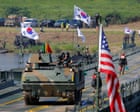
Strategic deterrence relies on predictability, continuous operational synchronization, and unambiguous signaling between coalition partners. When a major bilateral exercise schedule is unilaterally truncated midway through execution, the underlying security architecture undergoes a structural shift. The decision by Washington and Seoul to curtail the Ulchi Freedom Shield exercise by six days, driven by executive directives to court renewed bilateral talks with North Korea, exposes the inherent tension between presidential diplomacy and institutional military readiness. Analyzing this contraction requires examining the mechanics of joint command-post simulations, the economic and political cost functions of force posture adjustments, and the systemic consequences for peninsular stability.
The Operational Anatomy of Ulchi Freedom Shield
Ulchi Freedom Shield functions as the primary computer-simulated command-post exercise designed to test and validate the combined defense posture of United States Forces Korea and the Republic of Korea Armed Forces. The exercise structure is traditionally divided into distinct operational phases. Phase one prioritizes defensive operations, absorbing initial kinetic and asymmetric shocks, while phase two transitions to counteroffensive operations, rehearsing coordinated multi-domain counterattacks against opposing command structures.
By terminating the exercise on its fifth day rather than its scheduled completion, military planners were forced to completely scrap the second phase. This selective execution creates a critical operational blind spot. The defensive phase merely validates absorption capacity; the counteroffensive phase tests the complex orchestration of logistics, fires, and maneuver required to seize initiative. Eliminating the counteroffensive simulation removes the primary stress test for allied interoperability.
Military commanders rely on these repetitions to integrate lessons drawn from contemporary conflicts, including electronic warfare vulnerabilities, unmanned aerial system integration, and global positioning system disruptions. When training windows are halved, staff officers lose the iterative feedback loops necessary to adapt standard operating procedures to evolving tactical threats. The immediate cost savings of shortened deployments are inversely proportional to the long-term degradation of staff proficiency.
The Cost Function of Bilateral Force Posture
The rationale provided for scaling back the exercises invokes a explicit cost-benefit calculation centered on fiscal expenditure and diplomatic signaling. Large-scale military exercises generate direct financial outlays related to troop transport, fuel consumption, live-munition expenditure, and temporary facility utilization. Executive critiques frequently frame these expenses as an inefficient allocation of resources that yields negative diplomatic returns by provoking countermeasures from Pyongyang.
However, viewing joint exercises strictly as an avoidable overhead expense miscalculates the economics of deterrence. Deterrence is an upfront insurance premium designed to prevent high-impact catastrophic conflict. The marginal cost of executing a full-scale exercise is negligible compared to the economic fallout of miscalculated adversary aggression stemming from perceived alliance fatigue or resolve decay.
Furthermore, the abrupt nature of the reduction introduces administrative friction. Units deployed for field training exercises must recalibrate logistical supply chains, ammunition staging, and airspace management protocols on short notice. Frequent stop-and-start adjustments to exercise parameters train operational units to expect policy interruptions, lowering institutional readiness independent of actual troop numbers.
Diplomatic Signaling and Adversary Incentive Structures
Executive incentives for curtailing the exercises rest on the assumption that unilateral concessions alter the strategic calculus of North Korea's leadership, opening a viable pathway toward denuclearization talks or tension reduction. This approach treats military exercises primarily as a negotiable currency rather than an irreplaceable pillar of operational capability.
From the perspective of Pyongyang's incentive structure, partial reductions or delayed schedules rarely register as substantive goodwill gestures. Historical precedents indicate that North Korea views only the total cessation of combined exercises as an acceptable baseline. Consequently, truncated drills fail to elicit reciprocal concessions while simultaneously signaling hesitation to regional allies.
The friction is further compounded by broader geopolitical divergences, such as differing national priorities regarding secondary security theatres. When alliance cohesion is tested by extraneous policy demands, trust between military hierarchies diminishes. South Korean leadership faces an acute domestic dilemma: maintaining absolute alignment with Washington risks accusations of strategic subordination, while pursuing military independence risks fractures in the nuclear umbrella.
Systemic Vulnerabilities and Command Rotation Pressures
The most insidious consequence of irregular exercise schedules involves personnel turnover dynamics. Military commands operate on strict rotation cycles, with key staff officers and commanders cycling through regional posts every twelve to twenty-four months. Because individual leaders serve brief tenures, institutional memory depends entirely on standardized, recurring large-scale exercises to transfer complex joint operational procedures.
When exercises are cancelled, shortened, or heavily modified mid-stream, incoming leadership cohorts miss their primary vehicle for practical alliance integration. Over successive rotation cycles, this erosion of shared operational experience compounds into a systemic vulnerability. Staff officers become proficient in theoretical planning but untested in the synchronized execution of multi-domain defense operations under compressed timelines.
To mitigate the strategic decay induced by episodic political interruptions, allied defense planners must institutionalize decentralized, modular simulation protocols that insulate baseline readiness from executive-level diplomatic overtures. Establishing redundant training architectures ensures that political imperatives to secure high-level summits do not inadvertently dismantle the operational foundation required to secure the peninsula.