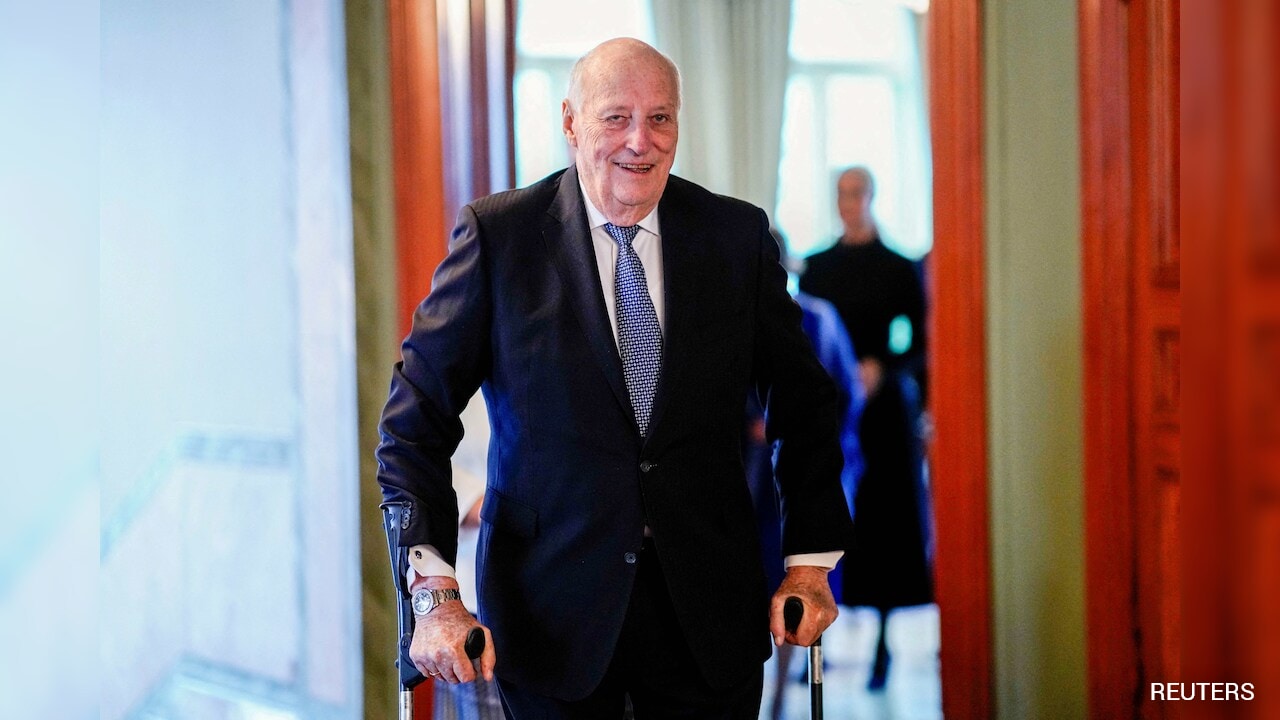
Hereditary institutions operating within advanced constitutional democracies maintain legitimacy exclusively through a delicate equilibrium between symbolic continuity and moral alignment with the populace. When King Harald V passed away at the age of eighty-nine, the immediate ascension of Crown Prince Haakon as King Haakon VIII did not merely shift executive leadership of the Royal House of Norway; it transferred a compounding structural deficit. Evaluating the trajectory of the Norwegian monarchy requires abandoning simplistic narratives of personal scandal and instead analyzing the institutional mechanics governing public trust, risk propagation, and the institutional cost function of modern hereditary states.
Institutional stability relies upon a predictable depreciation rate of public goodwill. For decades, King Harald V functioned as an institutional stabilizer, utilizing a folksy, accessible persona to offset the inherent democratic friction of an unelected head of state. Public approval ratings consistently hovered above eighty percent during the mid-2010s, sustained by deliberate alignment with progressive social values and collective national mourning protocols. However, dynastic systems lack institutional insulation against externalized individual conduct. When members of the extended royal household generate systemic reputational damage, the core enterprise absorbs the liability without possessing direct operational control over the actors.
The current systemic vulnerability stems from two distinct vectors of reputational erosion that materialized simultaneously. The first vector involves Crown Princess Mette-Marit’s documented correspondence with the late, convicted sex offender Jeffrey Epstein, which public polling indicates severely undermined her standing as a future queen consort. The second, more acute vector involves the legal proceedings and subsequent four-year prison sentence of Marius Borg Høiby—Mette-Marit’s son from a previous relationship—convicted on multiple counts including rape and domestic violence. Because hereditary systems function as extended familial brands, the structural firewall between private family behavior and public institutional output collapsed. Public support figures, which once enjoyed a comfortable supermajority, contracted sharply toward fifty-four percent following these disclosures, demonstrating how quickly baseline operational legitimacy can degrade.
King Haakon VIII assumes the throne under conditions diametrically opposed to those inherited by his predecessor. His strategic objective is the institutional stabilization of a brand experiencing high volatility. To understand how a constitutional monarchy mitigates such damage, one must dissect the three primary variables determining institutional survival: affective capital, behavioral transparency, and state utility.
Affective capital represents the accumulated emotional reserve a royal family holds with the citizenry. Decades of unblemished crisis management by Harald V created a deep reservoir of this capital. Yet, affective capital functions like a depreciating asset if not continuously replenished by positive civic engagement. The accession of Crown Princess Ingrid Alexandra as the new direct heir establishes a long-term generational pivot, yet the immediate burden falls entirely on the new monarch's capacity to decouple his reign from the actions of his household.
Behavioral transparency dictates how the palace responds to external shocks. Historically, European monarchies utilized silence or aloof distancing to manage controversies. That playbook accelerates institutional decay in a high-information ecosystem. Haakon’s public acknowledgments of the family's internal turbulence—balancing institutional duty with personal loyalty to his wife and stepson—represent an operational pivot toward managed vulnerability. While this strategy prevents total alienation of empathetic segments of the population, it simultaneously risks normalizing behaviors that conflict with the moral expectations of an egalitarian society.
State utility measures the tangible and intangible value the monarchy returns to the Norwegian state. Because formal political power rests entirely within the Storting and the executive government, the crown's utility is strictly communicative and diplomatic. If the cost of maintaining the institution—measured in taxpayer-funded upkeep, media distraction, and moral dissonance—begins to outweigh its utility as an international trade ambassador and national symbol, the constitutional contract faces existential renegotiation.
The structural remedy for Haakon VIII is not image rehabilitation through public relations campaigns, which historically yield diminishing returns during crises of ethics. The solution requires a strict operational restructuring of the royal house itself. Modernizing a monarchy under duress necessitates drawing clear administrative boundaries around who carries official responsibilities, funding privileges, and state-sanctioned titles. By establishing a leaner, more accountable operational core, the institution can isolate its core constitutional functions from peripheral liabilities.
The immediate forecast for the Norwegian crown depends on the elasticity of public patience. If the legal appeals surrounding the family yield further protracted negative exposure, the baseline support metric could breach the critical threshold where republican alternatives transition from academic discourse to active legislative agendas. King Haakon VIII must operate with the acute awareness that the historical margin for error is effectively zero, requiring structural reform to replace passive tradition as the primary guarantor of dynastic survival.