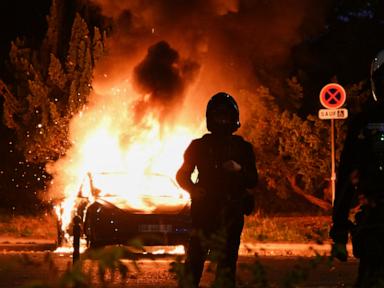
Mainstream media outlets love a burning trash can. It makes for incredible high-definition b-roll, easy moralizing, and simple narratives about civil unrest.
When major newsrooms run headlines about how French protest violence is easing while scattered riots hit Germany ahead of more scheduled action, they are selling you a comforting fiction. They want you to believe that European civil unrest is a localized, episodic weather event—a storm that blows through Paris, drops a few hailstones on Berlin, and eventually clears up so everyone can go back to drinking espresso and manufacturing luxury sedans. You might also find this connected article useful: The Geopolitical Arithmetic of Western Sahara UN Resolutions.
That is the lazy consensus. And it is dangerously wrong.
If you are measuring the stability of Europe by counting shattered storefront windows or tallying riot police deployments, you are looking at the smoke while ignoring the structural fire burning through the foundation. The easing of street violence in France is not a sign of pacification, and the scattered riots in Germany are not isolated copycat incidents. Both are symptoms of a terminal disconnect between European political institutions and the economic reality of the people funding them. As reported in latest articles by NPR, the effects are significant.
I have spent over a decade advising institutional capital and supply chain operators across the Eurozone. I have watched multinational firms blow tens of millions of euros on political risk assessments written by academics who have never left Brussels, only to get blindsided when a "peaceful" labor dispute paralyzes a continental logistics corridor for three weeks. We need to stop treating European protests like isolated street brawls and start analyzing them for what they actually are—a coordinated, structural repricing of the European social contract.
The Myth of the Easing French Storm
Let us dismantle the first half of the mainstream narrative. When headlines declare that French protest violence is "easing," they rely on a fundamental misunderstanding of how French labor and civil resistance operate.
To understand France, you have to distinguish between manifestations (organized, union-backed demonstrations) and émeutes (spontaneous, unorganized urban rioting). Mainstream coverage constantly conflates the two. When the tear gas clears in the banlieues or around the Place de la République, reporters pack up their cameras and declare a return to normalcy.
This is a fatal analytical error. In France, the disappearance of street violence almost always signals the transition from chaotic venting to organized economic asphyxiation.
Historically, the French state has a high tolerance for property damage. A burned-out bank branch or a smashed bus shelter is priced into the annual municipal budget. What the French state cannot survive is the quiet, methodical shutdown of energy infrastructure, rail networks, and port facilities by entrenched unions like the Confédération Générale du Travail (CGT).
When street clashes subside, the leverage actually shifts away from the government and toward the strikers. Riot police can clear a boulevard with water cannons and batons. Riot police cannot force a highly specialized refinery technician to turn a valve, nor can they drive a high-speed TGV train. By focusing on the reduction in street-level kinetic violence, observers miss the far more damaging escalation happening in the administrative and industrial backrooms. The quiet is not peace. It is a siege.
Why Germany’s Scattered Riots Are Actually More Terrifying
Now look across the Rhine. The conventional wisdom holds that Germany is the stable, consensus-driven anchor of Europe, and that scattered riots in German cities are merely spillover anomalies—youthful hooliganism or fringe radicalism that the Bundespolizei will swiftly contain.
If you believe that, you do not understand German political psychology.
France has a cultural immune system built for revolution. Strikes, blockades, and street clashes are baked into the French civic identity dating back to 1789. The institutions bend, absorb the shock, make a few theatrical concessions, and carry on.
Germany has no such shock absorbers. The post-war German state was explicitly engineered around Soziale Marktwirtschaft (the social market economy) and Tarifautonomie (collective bargaining autonomy). The entire system relies on strict adherence to institutional rules, predictable industrial peace, and the unspoken promise that if German workers accept wage restraint and high taxes, the state will guarantee cheap energy, world-class infrastructure, and export-driven prosperity.
That social contract is dead. Deindustrialization, driven by structural energy cost disadvantages and regulatory overreach, has gutted the German Mittelstand—the small and medium-sized enterprises that form the backbone of the economy.
Therefore, when you see "scattered riots" in Germany, you are witnessing a society whose institutional pressure-release valves have completely failed. Unlike France, where protest is an organized theatrical ritual, civil unrest in Germany signifies a profound breakdown in state legitimacy. A small riot in Frankfurt or Berlin carries ten times the systemic risk of a massive riot in Paris because the German system is brittle. It does not bend; it fractures.
Asking the Wrong Questions About European Unrest
If you look at what people are searching for regarding these events, the questions are entirely backward. Investors, travelers, and business leaders are asking: "When will the protests in France and Germany end?" and "Are European cities safe to visit right now?"
You are asking the wrong questions. Whether a specific boulevard in Lyon or Hamburg is safe on a Tuesday afternoon is irrelevant to the macro reality.
The real questions you should be asking are:
- How much fiscal capacity do Paris and Berlin have left to buy off their populations?
- What happens when European governments can no longer subsidize their way out of civil unrest?
For the last forty years, the standard European political playbook for stopping a riot was simple: print debt and hand out subsidies. Raise the minimum wage, cap energy prices, increase pension payouts, and pass the bill to future generations or the European Central Bank.
That playbook is now illegal under the EU's own reinstated fiscal rules and mathematically impossible given current sovereign debt-to-GDP ratios. France is staring down a massive deficit crisis with bond vigilantes circling its sovereign debt. Germany is trapped by its constitutional Schuldenbremse (debt brake) while its industrial base erodes.
When you ask when the protests will end, the brutally honest answer is that they will not end. They are transitioning from temporary demands for policy tweaks into permanent structural friction. The state has run out of money to bribe the streets into silence.
The Corporate Blind Spot in Risk Management
I have sat in boardrooms in London, New York, and Zurich watching executives treat European labor unrest like a weather forecast. They check the news, see that French violence is "easing," and immediately greenlight Q3 inventory shipments through Le Havre or expand manufacturing capacity in Baden-Württemberg.
They are walking into a trap. Modern supply chains are built on just-in-time efficiency, which means they have zero margin for error. You do not need a violent revolution to bankrupt a European logistics operation; you only need a 15% reduction in port throughput combined with rolling wildcat strikes on the Deutsche Bahn rail network.
To survive this environment, operators and investors must discard mainstream media narratives and adopt a contrarian operational framework:
- Ignore police blotters; track energy and rail metrics. Do not measure unrest by arrests or injuries. Measure it by electricity grid frequency, refinery utilization rates, and freight rail delays. If the streets are quiet while freight capacity drops by 20%, you are in the middle of a severe crisis.
- Decouple French and German risk models. Stop treating Western Europe as a monolithic bloc. Price French risk as high-frequency, low-impact volatility—loud, disruptive, and constant, yet fundamentally survivable. Price German risk as low-frequency, high-impact tail risk—quiet, rule-bound, and seemingly stable until the exact moment it suffers a catastrophic systemic failure.
- Audit your second-tier suppliers. Your primary vendor in Munich might have a solid union agreement and zero unrest. Their tier-two sub-component supplier in northern France or eastern Germany might be three weeks away from insolvency due to energy costs and wildcat blockades. Map the physical chokepoints, not the corporate headquarters.
The Downside of Betting Against the Status Quo
Let us be entirely candid about the flaw in this contrarian thesis. Positioning your capital, business, or strategy for prolonged structural friction in Europe carries a massive carrying cost.
European institutions are masters of the kick-the-can-down-the-road maneuver. They possess an unmatched bureaucratic ability to invent new financial acronyms, suspend their own fiscal rules during emergencies, and engineer eleventh-hour compromises that keep the lights on just long enough to prove doomsayers wrong. If you bet on an immediate, cinematic collapse of the Franco-German engine, you will lose your shirt while Brussels paper-pushers quietly bail out the system one more time.
The risk of my approach is over-preparing for a slow-motion bleed while the patient stubbornly refuses to die. You will pay higher insurance premiums, hold excess inventory, and miss out on short-term relief rallies every time a headline declares that the streets are calm.
The New Reality of the European Street
The mainstream press will continue to cover Europe like a sporting event, tallying broken windows in Berlin and declaring victory for the police when Paris goes quiet for forty-eight hours. Let them chase the spectacle.
The real story is written in bond yields, industrial output numbers, and the quiet desperation of governments that have promised more than their economies can produce. The easing of violence in France is merely a tactical pause before the next economic blockade. The scattered riots in Germany are the opening tremors of an industrial superpower realizing its golden age is over.
Stop watching the riot police. Start watching the balance sheets. The calm before the storm is not a reason to relax—it is your final warning to get out of the way.



