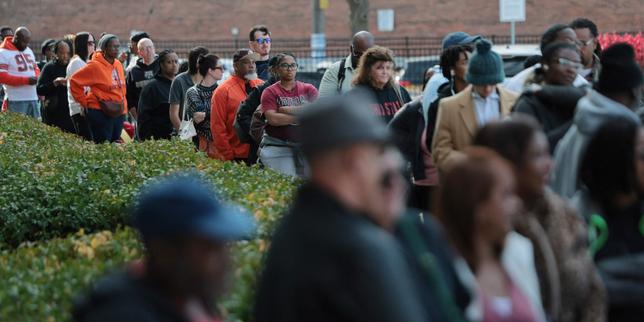
Thousands of opposition supporters flooded the streets to demand the removal of India’s Chief Election Commissioner, turning a routine procedural dispute into a full-blown legitimacy crisis for the world’s largest democracy. While surface-level photo essays capture the placards, the barricades, and the sheer crowd volume, they miss the structural mechanics driving the fury. The protests are not merely about a single official or a disputed state ballot. They represent the boiling point of a multi-year legal and political battle over how India appoints its electoral umpires, how Electronic Voting Machines are audited, and whether an institution designed to be fiercely independent has been quietly absorbed into the executive orbit.
Democracy relies on a simple, fragile bargain. The losers of an election must believe the count was fair enough to try again next time. Once that belief cracks, street mobilization replaces parliamentary debate. Don't miss our earlier coverage on this related article.
The Structural Shift Behind the Anger
To understand why crowds are marching against the head of the Election Commission of India, you have to look backward at the legal architecture governing Nirvachan Sadan, the commission's headquarters in New Delhi. For over seventy years, India operated without a specific parliamentary law detailing how Election Commissioners were chosen. Under Article 324 of the Indian Constitution, the President made the appointments on the advice of the Prime Minister, subject to any law enacted by Parliament. For decades, convention held that the senior-most Election Commissioner would automatically ascend to the role of Chief Election Commissioner, creating a predictable buffer against sudden political interference.
That unwritten consensus shattered in March 2023. The Supreme Court of India, responding to public interest litigation warning of executive overreach, stepped into the legislative vacuum. A five-judge Constitution Bench ruled that until Parliament passed a formal law, a high-powered committee comprising the Prime Minister, the Leader of the Opposition, and the Chief Justice of India would select the Chief Election Commissioner and fellow commissioners. To read more about the background here, NBC News offers an informative summary.
The relief among transparency advocates lasted less than ten months.
In December 2023, the ruling government passed the Chief Election Commissioner and Other Election Commissioners Act. The legislation formally replaced the Chief Justice of India on the selection panel with a Union Cabinet Minister nominated by the Prime Minister. In mathematical and political terms, that single substitution changed everything. A three-member committee containing the Prime Minister and one of his own cabinet ministers guarantees a permanent two-to-one majority for the sitting government. The Leader of the Opposition remains in the room, reduced to registering formal dissents that carry zero veto power.
Opposition leaders argue this legal maneuver transformed the Election Commission of India from an independent constitutional referee into an executive department. When thousands gather in the streets chanting against the election chief, they are reacting to the predictable outcome of that statutory math. Even if an official acts entirely within the rulebook, the perception of structural bias poisons every controversial decision—from how election schedules are staggered across multi-phase polling to which campaign speeches draw formal reprimands and which are ignored.
Why Photo Essays Miss the Operational Reality
Visual coverage of political rallies naturally gravitates toward spectacle. A wide-angle shot of party flags waving against riot shields tells a dramatic story, yet it flattens a complex administrative conflict into simple partisan theater. Watch the ground closely, and three distinct operational grievances emerge from the crowds.
The Battle Over Electoral Rolls and Voter Deletions
Long before a single ballot is cast, elections can be won or lost on the voter list. Opposition parties have repeatedly flagged sudden, large-scale deletions and additions in electoral rolls across key battleground states. In a hypothetical constituency where the winning margin in the previous cycle was 4,000 votes, the unexplained removal of 12,000 voters from neighborhoods leaning toward a specific demographic alters the mathematical baseline before campaigning even begins.
Election officials maintain that regular revision drives are essential to purge duplicate entries, deceased voters, and migrated residents. They point out that Booth Level Officers work alongside political party agents during summary revisions. However, when the timeline between the publication of final rolls and the announcement of polling dates shrinks, opposition parties lack the ground infrastructure to audit millions of names manually. The perception takes hold that administrative cleanup is operating as targeted disenfranchisement.
The EVM and VVPAT Transparency Deadlock
India’s Electronic Voting Machines are standalone, non-networked units praised by engineers for preventing traditional booth capturing and ballot stuffing. Yet the political trust deficit surrounding these machines has grown wider with every election cycle. The flashpoint is not necessarily whether the machines can be hacked remotely—most technical experts agree their air-gapped design makes wireless tampering virtually impossible—but rather the verification process surrounding the Voter Verifiable Paper Audit Trail, or VVPAT.
Currently, VVPAT slips are counted in only five randomly selected polling stations per assembly segment. Opposition parties and civil society groups have demanded either a 100 percent count of paper slips or handing the printed slip directly to the voter to deposit into a separate ballot box. The Election Commission has resisted, citing the massive logistical delay of manually counting hundreds of millions of paper slips, which could push election results back by days and invite human counting errors. In April 2024, the Supreme Court rejected pleas for full VVPAT verification, affirming the integrity of the current protocol. Legal finality, however, has not produced political acceptance. On the streets, the refusal to expand paper audits is framed as institutional stonewalling.
Asymmetric Enforcement of the Model Code of Conduct
During an election cycle, the Model Code of Conduct gives the Election Commission sweeping moral and administrative authority to police hate speech, abuse of state machinery, and religious polarization by candidates. Historically, sharp censures and temporary campaign bans from the commission forced even senior cabinet ministers to tread carefully.
In recent cycles, critics have documented a stark asymmetry in how the code is enforced. Complaints filed by opposition alliances against top ruling party campaigners often linger in administrative review for weeks, sometimes until polling in the relevant phase has already concluded. Conversely, notices to opposition figures frequently arrive within twenty-four hours. When an umpire blows the whistle consistently on only one side of the pitch, the crowd stops blaming the players and turns on the referee.
The Counter-Argument From Inside Nirvachan Sadan
To treat the street protests as pure proof of institutional collapse ignores the monumental logistical reality of running elections in India. Veteran administrators who have served inside the commission point out that critics frequently weaponize selective anecdotes while overlooking the scale of the operation.
Consider the sheer numbers involved in an Indian general or state election cycle:
- Over 970 million registered voters spread across wildly varying terrain, from Himalayan outposts to island territories.
- More than 1 million polling stations staffed by roughly 15 million polling personnel and security forces.
- Strict statutory deadlines requiring the entire electoral exercise to conclude before the outgoing legislature’s term expires.
From the perspective of election administrators, opposition parties often invoke the integrity of the Election Commission only when internal polling predicts defeat. The exact same electoral machinery, using the exact same EVMs and electoral rolls, has repeatedly delivered sweeping victories to opposition parties in state assemblies across southern, eastern, and northern India. When opposition coalitions win states like Karnataka, Tamil Nadu, West Bengal, or Jharkhand, complaints regarding the election chief’s neutrality vanish overnight. When they lose in the Hindi heartland or Maharashtra, the commission immediately becomes an existential threat to democracy.
Furthermore, defenders of the December 2023 appointment law argue that Parliament simply exercised its explicit constitutional authority under Article 324. In almost every major parliamentary democracy, executive leaders play the decisive role in appointing senior administrative officials. Having the Chief Justice of India sit on an executive selection committee created its own constitutional friction, as the judiciary would inevitably be called upon to adjudicate legal challenges against the very officials the Chief Justice helped appoint.
Both arguments carry weight, which is precisely why the standoff has proven so intractable. The commission’s operational competence in moving millions of ballot units across a subcontinent remains unmatched globally. Yet operational competence cannot substitute for perceived neutrality when the rules of appointment itself appear tilted.
Historical Precedents and the Cost of Lost Neutrality
India has been down a similar road before, though the mechanics were different. In the early 1990s, the Election Commission was widely viewed as a compliant appendage of the ruling establishment, routinely deferring to governments on polling dates and turning a blind eye to muscle power and state-sponsored campaign abuse.
That dynamic changed abruptly when T.N. Seshan took office as Chief Election Commissioner in December 1990. Seshan used the dormant constitutional powers of Article 324 to aggressively discipline political parties, enforce campaign spending limits, introduce mandatory voter ID cards, and postpone elections where law and order had collapsed. Politicians across the spectrum despised him, yet public trust in the commission soared because Seshan’s friction was aimed equally at every party in power.
The lesson from the Seshan era is unambiguous. The institutional strength of the Election Commission does not come from polite consensus with the government of the day; it comes from visible, uncompromising friction with power. When an election chief avoids confrontation with the ruling executive to preserve administrative harmony, the public reads that restraint as capitulation.
Look closely at the demographics of the current protests. Alongside seasoned party workers, civic groups, student unions, and constitutional lawyers are increasingly visible. For these cohorts, the demand for the election chief’s resignation is a proxy battle over institutional checks and balances. Across India’s governance ecosystem—from investigative agencies to public broadcasters—critics see a pattern of autonomous bodies aligning with executive priorities. Because the Election Commission is the final gatekeeper guaranteeing peaceful transfers of power, any perceived erosion in its independence triggers an immediate, visceral reaction on the streets.
What Happens When Street Pressure Collides With Constitutional Immunity
Here lies the ultimate institutional catch-22. Even if protests swell from thousands to hundreds of thousands, street mobilization cannot legally remove a Chief Election Commissioner.
Under Article 324(5) of the Indian Constitution, the Chief Election Commissioner enjoys the exact same security of tenure as a Judge of the Supreme Court. They cannot be dismissed by the Prime Minister or the President on a whim. Removal requires an impeachment-style motion passed by both Houses of Parliament with a special majority—a two-thirds majority of members present and voting, alongside an absolute majority of the total membership of each House—on proven grounds of misbehavior or incapacity.
No Chief Election Commissioner in Indian history has ever been impeached. In a parliament where the ruling coalition controls the legislative floor, an opposition-led removal motion is dead on arrival.
Yet political survival inside Nirvachan Sadan does not equate to institutional health. An election chief insulated by constitutional tenure can remain in office for their full six-year term while presiding over a steady collapse in public confidence. When major political parties refuse to accept the legitimacy of electoral outcomes, governance slows to a crawl. Every parliamentary session dissolves into walkouts, every state election triggers waves of litigation, and public discourse fractures into competing realities where one side sees a mandate and the other sees a rigged process.
Restoring credibility will not come from police barricades outside protest zones or defensive press releases listing past awards for electoral management. It requires tangible structural concessions that strip away the appearance of executive control. Publishing raw, constituency-level turnout data immediately at the close of polling—rather than days later—would eliminate wild speculation over unexplained surges in final vote tallies. Expanding random VVPAT audits from five booths per assembly segment to a statistically bulletproof sample size would neutralize conspiracy theories without paralyzing the counting process. And revisiting the appointment committee structure to restore genuine consensus would remove the original sin that sparked the crisis in the first place.
Until the referee is visibly independent of the team captains, the crowd will keep storming the field.