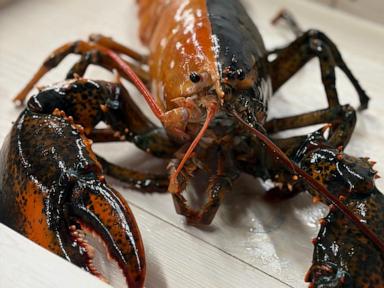
The local news cycle loves a "one-in-a-million" lobster story. You’ve seen the template. A fisherman pulls up a trap off Cape Cod or the coast of Maine. Inside sits a crustacean that looks like it was painted by a hyperactive toddler—half orange, half black, perfectly split down the middle. The fisherman, struck by a sudden wave of altruism, "donates" the creature to a local aquarium. The public cheers. The aquarium gets a PR boost.
It is a heartwarming narrative. It is also a massive misunderstanding of marine biology and the economics of conservation.
While the media fawns over these genetic glitches, they ignore a cold reality. We are obsessed with the aesthetics of the ocean while ignoring its mechanics. A two-colored lobster isn't a miracle. It’s a biological clerical error that tells us almost nothing about the health of our oceans, yet we treat it with more reverence than the systemic collapse of the very ecosystems that produced it.
The Mathematical Fallacy of One in Thirty Million
The "rarity" of a split-colored lobster is the first thing everyone gets wrong. You’ll see the statistic cited everywhere: "One in 30 million." It sounds impossible. It sounds like winning the Powerball.
But here is the math the headlines won't do for you. In a typical year, the North American lobster industry hauls in roughly 150 million pounds of lobster. If the average lobster weighs between 1.25 and 1.5 pounds, we are looking at over 100 million individual lobsters being handled by humans annually.
Mathematically, you should see three or four of these "miracles" every single season. When you factor in blue lobsters (1 in 2 million) and yellow lobsters (1 in 30 million), the docks are practically a neon light show of genetic anomalies. They aren't rare because they don't exist; they are "rare" because the media chooses when to pay attention.
The fixation on these outliers is a distraction. We treat the ocean like a carnival sideshow. If it’s shiny or weird, we care. If it’s a standard-issue Homarus americanus—the backbone of a multi-billion dollar industry and a keystone species for the Gulf of Maine—we just want to know how much the butter sauce costs.
Genetic Glitches Are Not Conservation Victories
The impulse to "save" these lobsters by putting them in a tank is deeply flawed.
When a fisherman "donates" a two-colored lobster to an aquarium, we frame it as a rescue mission. From what? The lobster was already caught. It was already safe from predators. By placing it in a 500-gallon display tank, we aren't "conserving" anything. We are effectively putting a biological mistake in a glass cage for our own amusement.
Biologically, these split-colored lobsters are often gynandromorphs—they possess both male and female characteristics, split right down the midline. In the wild, their survival rate is lower because their bright coloration makes them an easy target for predators. Nature usually culls these defects. By "saving" them, we aren't helping the species; we are preserving a freak of nature that would have been a quick snack for a cod 200 years ago.
If we actually cared about the lobster population, we would focus on the rising water temperatures in the Southern New England shelf. We would focus on the shell disease that is moving north as the Atlantic warms. But those problems don't have a cool, two-tone photo op attached to them.
The Aquarium PR Machine
Aquariums are businesses. Let’s stop pretending they are strictly cathedrals of science.
When an aquarium accepts a rare lobster, they know exactly what they are doing. It’s a low-cost, high-yield marketing asset. They get a week of local TV coverage, thousands of social media shares, and a spike in foot traffic from families who want to see the "Halloween Lobster."
Does the lobster learn anything? No. Does the public learn about the nitrogen runoff issues or the complexities of trap-tagging regulations? No. They look at a blue or split-colored shell, say "That’s neat," and move on to the gift shop.
I’ve seen this cycle repeat for decades. We prioritize the "weird" over the "essential." We spend thousands of dollars maintaining a tank for a single genetic outlier while the actual research into lobster larvae recruitment—the stuff that actually ensures there will be a fishing industry in twenty years—struggles for pennies.
Why We Should Just Eat Them
This is the part that makes people uncomfortable: We should stop donating these lobsters and start eating them.
The obsession with sparing the "pretty" lobsters creates a bizarre moral hierarchy. Why is a brown lobster destined for the pot, but a blue one is "too special" to die? They taste exactly the same. Once you boil them, the heat breaks down the protein bonds (crustacyanin) that hold the pigments, and they all turn the same shade of red.
By sparing the rare ones, we are practicing a form of unintentional selective breeding in reverse. We are removing the standard, healthy genetic stock from the ocean and leaving... well, nothing, because we aren't actually putting the rare ones back either. We are just hoarding them in displays.
If a fisherman catches a split-colored lobster, he should sell it to the highest bidder at a charity auction. Use the $5,000 some eccentric foodie will pay for a "designer" dinner and fund actual oceanic research. Buy some satellite tags. Fund a study on whale-safe gear. Do something that actually impacts the ocean instead of letting a mutant rot in a tank until it dies of old age and is quietly replaced by the next "miracle" find.
The Myth of the "One in a Million" Catch
People often ask: "Isn't it important to inspire children with these rare finds?"
No. It’s important to teach children how the world actually works. Teaching a child that a lobster is only valuable if it’s a different color is the opposite of environmental literacy. It’s "Pokémon-ifying" nature. It teaches them that the ocean is a collection of rare items to be gathered, rather than a complex, interconnected system that requires boring, unglamorous protection.
The "People Also Ask" sections of search engines are filled with queries like:
- How rare is a blue lobster?
- Can you eat a two-colored lobster?
- What causes a split-colored lobster?
The answers they get are usually fluff pieces designed to make them feel good about a fisherman’s "kindness." The honest answer is that these lobsters are biological accidents caused by a cellular division error in the embryonic stage. It is a mistake. It is not a sign from the universe. It is not a "gift" from the sea. It is a malfunction.
Stop Falling for the Narrative
Next time you see a headline about a rare lobster being "saved" by an aquarium, look past the photo.
Ask yourself why we are celebrating the capture of a single, defective animal while ignoring the fact that the Gulf of Maine is warming faster than 99% of the world's oceans. Ask yourself why we care more about a shell's color than the fact that the lobster industry is facing an existential crisis due to changing migration patterns.
We have turned marine biology into a beauty pageant. We are distracted by the shiny things while the foundation of the house is on fire.
If you want to save the lobsters, stop worrying about the one that looks like a 1920s harlequin suit. Worry about the millions of boring, brown ones that keep the ecosystem alive. They aren't going to get a segment on the evening news, and they aren't going to be "rescued" by an aquarium.
They are just going to disappear while we are busy staring at the freak show.
The ocean doesn't need your wonder at its mistakes; it needs your respect for its regulars. Stop donating the anomalies. Eat the "miracle" and use the money to fix the mess we've made of their home.
The lobster doesn't care if it's blue, yellow, or split down the middle. It just wants to breathe. And right now, we’re too busy taking its picture to notice it’s suffocating.