The metal shutter of a Roman gelateria slams down at two in the afternoon with a sound like a gunshot. It is not closing for a siesta. It is closing because the air inside has become identical to the air outside, and the air outside is currently forty-two degrees Celsius.
Across Southern Europe, a strange, heavy silence has taken hold. We are used to thinking of summer in the Mediterranean as a symphony of clinking glasses, crashing waves, and the low hum of Vespas cutting through cobblestone alleys. But when the red heat alerts hit France, Italy, and Spain simultaneously, the music stops. The streets do not empty gradually; they clear out all at once, as if a sudden rainstorm had arrived. Only this storm is invisible, dry, and terrifyingly still.
To understand what is happening right now across the European continent, you have to look past the meteorological charts and the shifting jet streams. You have to look at the asphalt.
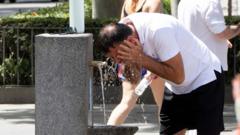
In Madrid, the tarmac softens underfoot, taking on the consistency of dense chewing gum. In the classic holiday destinations of the French Riviera, the sea breeze—usually a welcome relief—feels less like a breath of fresh air and more like someone is holding a hairdryer directly to your face. The numbers on the weather apps read 40C, 43C, 45C. But numbers are abstract. They do not capture the specific panicky instinct that kicks in when you inhale and realize the air is hotter than your own blood.
The Phantom Threshold
There is a psychological shift that occurs when a continent crosses the forty-degree mark. It is the moment heat stops being an ambient condition and becomes a physical presence. It feels like an uninvited guest who has walked into every room, sat down in every chair, and refused to leave.
Consider a hypothetical, yet entirely representative, day for someone like Matteo. He is a sixty-eight-year-old kiosk vendor in Florence. For thirty years, Matteo has sold newspapers and postcards from a small iron structure near the Piazza della Signoria. He knows how to handle summer. He drinks his espresso black, carries a plastic bottle of tap water, and keeps a small electric fan running on his counter.
But a red alert change everything.
The iron walls of his kiosk begin to act like an oven. By noon, the fan is simply moving hot air around a tight space, accelerating dehydration. Matteo’s blood pressure drops as his body desperately tries to cool itself by pumping blood to the skin, away from his vital organs. His heart beats faster. His reactions slow down. He forgets the price of a souvenir magnet.
This is the hidden danger of the current European heatwave. It does not always announce itself with dramatic collapses on the street. It builds quietly inside the bodies of the vulnerable, accumulating stress minute by minute, hour by hour.
When the health ministries of Spain and Italy issue their highest level of warnings, they are not telling people to wear sunscreen. They are signaling that the human body’s natural cooling mechanisms—primarily the evaporation of sweat—are reaching their mathematical limits. When humidity combines with extreme heat, the air can no longer absorb moisture from our skin. We lose the ability to cool down. We cook from the inside.
Moving the Ancient Stones
Europe is beautiful because it is old. The narrow streets of Seville, the stone farmhouses of Provence, the ancient apartments of Milan—these places were built to last centuries. They were designed to trap cool air in the winter and provide shade in the summer.
But they were not built for this.
The historic centers of Southern European cities are essentially giant heat sinks. Stone, brick, and concrete absorb the relentless radiation of the sun all day long. When the sun finally drops below the horizon, these materials do not instantly cool. They begin to radiate that stored heat back out into the night air.
This creates what meteorologists call the urban heat island effect, but what locals know as a sleepless nightmare.
Walk through a residential neighborhood in Madrid at midnight during a red alert. The air temperature is still hovering around thirty-two degrees. The walls of the buildings feel warm to the touch, like a radiator left on in July. Inside apartments without air conditioning, the air becomes stagnant. Sleep becomes impossible. Without the nighttime recovery period, the human body enters the second day of a heatwave already exhausted, its reserves depleted.
The infrastructure itself is straining under the weight of a changing climate. Power grids in Italy and Spain are facing historic demands as millions of air conditioning units click on simultaneously. In past years, this sudden spike in electricity consumption has triggered localized blackouts, cutting off the literal lifelines of the elderly and infirm.
When the power fails in a modern high-rise during a forty-degree day, the building transforms into a vertical greenhouse within hours.
The Invisible Migration
There is a quiet migration happening across the continent right now. It is a flight toward shade, water, and altitude.
Tourists who saved for years to see the Colosseum or walk the steps of the Sacré-Cœur are finding themselves trapped in hotel rooms, staring at four walls while the air conditioner rattles on high. The traditional sightseeing holiday has been replaced by a tactical game of survival. You map your day not by landmarks, but by pharmacies with strong climate control and supermarkets with open-fronted dairy aisles.
The financial toll of these alerts is immense, though it rarely makes the front page of the major newspapers. Crop yields across the valleys of the Po River are scorching. Grapes in the vineyards of La Rioja are ripening too fast, threatening the delicate balance of sugars and acids that definition centuries of winemaking tradition. Construction work stops by law in parts of Spain after mid-day, freezing the economy in place because a human being cannot safely swing a hammer when the ambient temperature matches a fever.
We are watching a collision between human culture and planetary reality. The Mediterranean lifestyle—built around outdoor socialization, vibrant public squares, and late-night dining—is being forced indoors. The piazza is empty. The terrace is abandoned. The life of the city has moved into the fluorescent glare of shopping malls and subterranean subway stations.
The Weight of the Air
It is easy to look at the current headlines and see them as a temporary inconvenience, a bad week in a beautiful place. But anyone who has watched the progression of European summers over the last decade knows that the exceptions are becoming the rule. The red alerts are no longer anomalous spikes; they are the architectural framework of the new normal.
The real terror of a forty-degree forecast is not the heat itself, but the realization of our own fragility. We like to think of our cities as permanent shields against the natural world. We believe that our stone walls, our glass towers, and our engineering can isolate us from the elements.
But a prolonged heatwave strips away that illusion. It exposes the fact that we are, fundamentally, biological entities tied to a specific, narrow bandwidth of temperature. When that bandwidth shifts, everything we have built begins to warp and crack.
The sun sets eventually, of course. In the late evening, a deep purple hue falls over the rooftops of Madrid. A few residents venture out onto their balconies, looking down at the empty streets below, waiting for a breeze that never quite arrives. There is no relief in the darkness, only a waiting game. They are waiting for the sun to rise again tomorrow, bringing with it the exact same relentless weight, the exact same heavy silence, and the exact same question that no one quite knows how to answer: how much more of this can the stone take?