The air on the Ithaca campus always carries a distinct chill by late autumn, but the frost settling over the Arts Quad on that particular November morning felt heavier. It was a weight born not of meteorology, but of silence. Not the quiet of a sleeping town, but the suffocating hush that follows a collective realization: the fortress walls are made of paper.
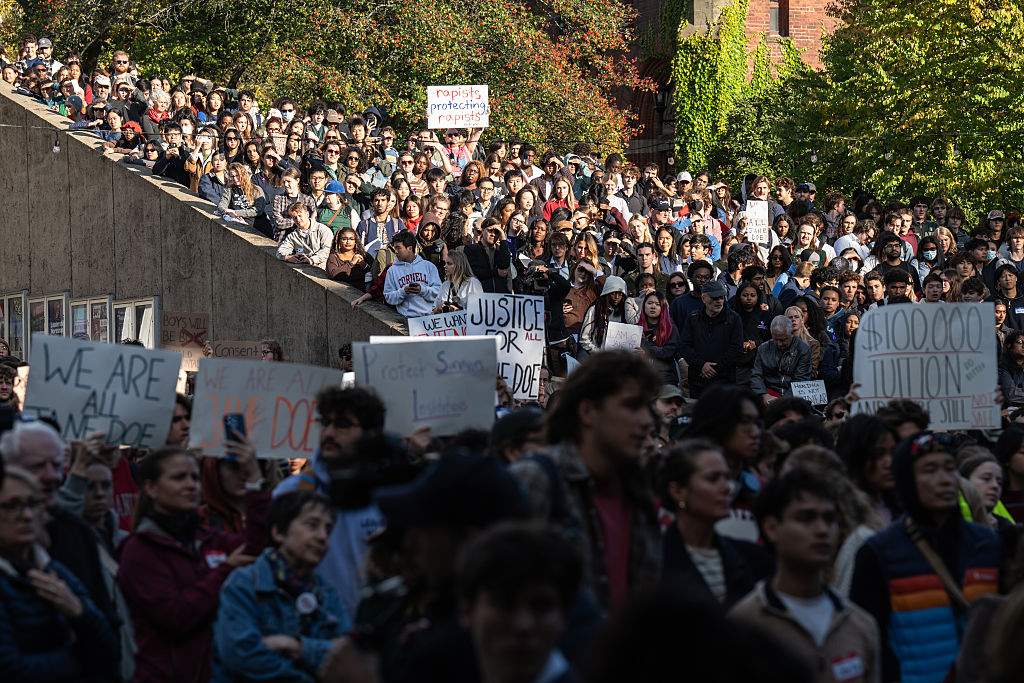
Walk down East Avenue on any ordinary Tuesday, and you hear the clatter of backpacks, the hum of discourse over organic coffee, the perpetual, nervous energy of minds racing to conquer the next problem set. But on this morning, the chatter had dissolved. In its place stood bodies. Hundreds of them. Blockading walkways. Holding hand-drawn cardboard signs that trembled slightly in the wind.
They were not shouting slogans for a distant political candidate or debating economic policy. They were screaming for safety. They were demanding to know why the institution they trusted with their futures had responded to reports of gang rape with institutional inertia.
To understand the fury packed into those placards, you have to look past the stone archways and ivy-covered brick of Cornell University. You have to look at the anatomy of trust.
When a young adult leaves home for a university like Cornell, an invisible contract is signed. Parents hand over their children with a silent prayer. Students pack their bags believing that within these historic confines, they are protected by a force greater than themselves—a disciplined, responsive apparatus dedicated to justice, inquiry, and care.
When that apparatus stumbles, the fall is catastrophic.
Consider the sequence of events that brought hundreds of students to a standstill. Allegations surfaced regarding a gang sexual assault tied to a campus fraternity. These were not whispers in a dormitory hallway; these were specific, harrowing accounts that demanded immediate, transparent intervention.
What did the machinery of the administration produce? Statements. Procedural reviews. Cautious language carefully crafted by risk-mitigation attorneys. Bureaucratic latency disguised as due process.
To an administrator sitting in a warm office behind a mahogany desk, procedure is a shield. To a student walking home alone past the gorges after a late-night library session, procedure feels like abandonment.
The protests began small, as they almost always do. A few students gathering on the steps, sharing whispers of frustration. Then came the amplification. Social media feeds flooded with calls to action. The realization spread like wildfire through the student body: if the university could look away from this, whose safety actually mattered?
By the time the main demonstration crystallized, the atmosphere was thick with a grief that had curdled into anger.
I remember what it feels like to stand in a crowd like that. The physical sensation is unmistakable. Your chest tightens. The noise of the city or the campus fades into a low, generic hum, punctured only by the voice of a speaker through a megaphone or the rustle of placards. You look to your left and your right, locking eyes with strangers who are suddenly your closest allies. You realize that you are all carrying the exact same fear—the terrifying knowledge that the people running the show might value their endowment and their brand reputation far more than your bodily integrity.
Fear is a powerful motivator. But collective fear, organized and directed, becomes a formidable political force.
The student organizers took the microphone not to vent aimlessly, but to lay bare a structural failure. They pointed out how reporting mechanisms often act as funnels designed to deter victims rather than support them. They detailed the agonizing delays in communication from university leadership. Every day of silence from Cornell’s upper administration was interpreted—correctly or incorrectly—as an act of complicity.
Institutions hate scandal. They manage it. They contain it. They treat human trauma as a public relations crisis to be solved through strategic silence and measured messaging.
Yet, human trauma refuses to be managed by a PR firm.
When victims are reduced to data points in a risk assessment, the community fractures. Students stopped viewing university officials as mentors and began viewing them as adversaries. The ivy lost its charm. The historic bell tower chimed out melodies that suddenly felt hollow, almost mocking against the backdrop of institutional failure.
Change rarely happens because people in power suddenly develop a moral awakening. Change happens because the cost of maintaining the status quo becomes higher than the cost of breaking it.
As the protest swelled, blocking traffic and drawing national media attention, the university’s calculus shifted. The luxury of delay evaporated. Emergency statements were issued at hours when executives usually sleep. Promises of independent investigations were hastily announced. Meetings with student leaders were scheduled, desperate attempts to de-escalate a fire that leadership had initially dismissed as a manageable spark.
Yet, winning a concession on paper is not the same as healing a community.
You cannot simply draft a new policy manual and expect the trauma of betrayal to vanish. Trust, once shattered, does not reassemble itself neatly just because an interim dean issues a conciliatory press release. The students who slept outside administrative buildings, the survivors who relived their worst nightmares on a public stage, the friends who stood shoulder-to-shoulder in the biting cold—they carry a permanent mark.
They learned a lesson that no syllabus could ever teach. They learned that protection is not a given. They learned that safety must be demanded, fought for, and defended against the very entities built to house them.
The sun eventually set behind the hills surrounding Cayuga Lake, casting long, bruised shadows across the campus. The megaphones were packed away. The cardboard signs were collected and placed into recycling bins. The protesters trudged back to their dorms, exhausted, bone-chilled, and fundamentally changed.
In the administration building, the lights remained on late into the evening. Shadowy figures walked down long hallways, reviewing legal counsel, counting the cost, wondering how things got this far out of hand.
Outside, the water of the lake remained dark and deep, mirroring the vast, unmeasured distance between those who make the rules and those who have to live with the consequences.