Dust settles differently on things that were loved.
Ask anyone who has ever cleaned out the closet of someone who died too young. You do not find a neat biography stacked on the shelves. You find receipts for dry cleaning that was never picked up, half-used tubes of lipstick rolled into the corners of vanity drawers, and folded scraps of paper tucked inside the spines of books that were never meant for a biographer’s eyes. For sixty years, the world convinced itself it knew everything there was to know about Norma Jeane Mortenson, the orphan girl from Los Angeles who remade herself into Marilyn Monroe and burned so bright she blinded an entire century. We thought we had cataloged every frame of film, every breathy syllable, every tragic headline from August 1962.
We were wrong.
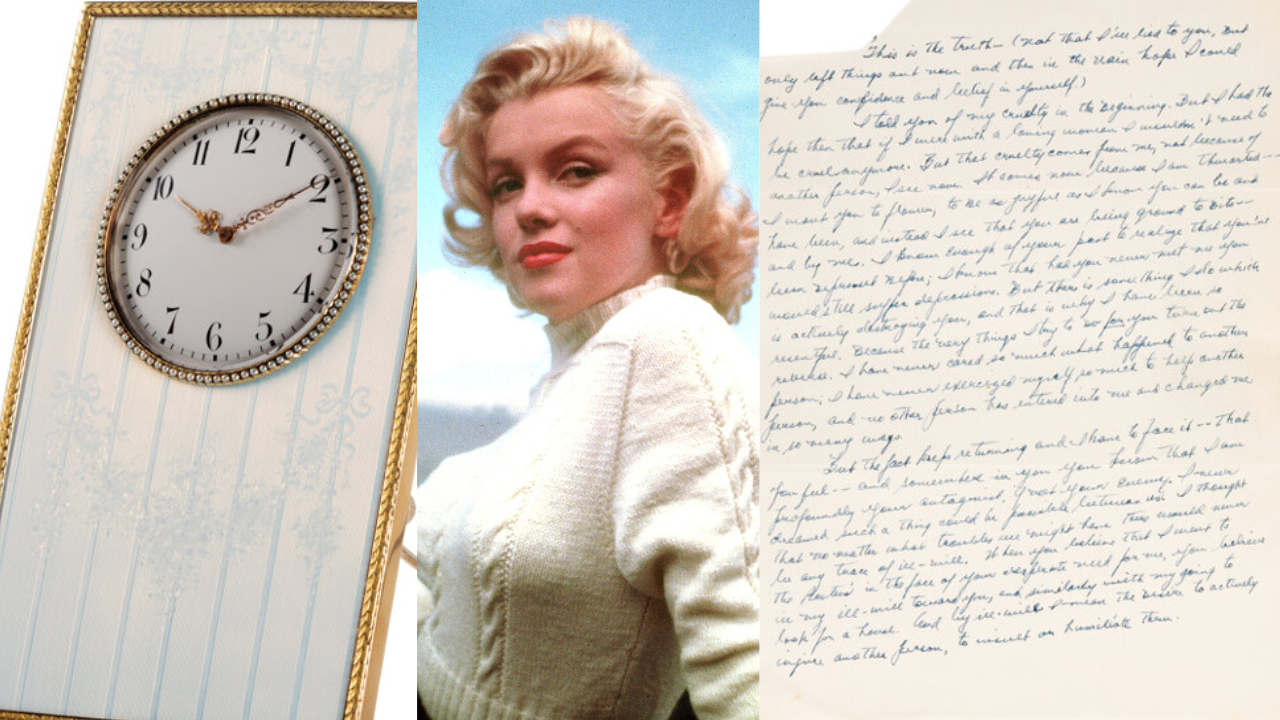
When a cache of Marilyn Monroe’s hidden letters, private notebooks, and personal belongings finally surfaces after six decades, the tremor is not just felt by auctioneers in Beverly Hills or film historians in New York. It hits anyone who has ever felt misunderstood by the people who claim to know them best. Because what emerges from those cardboard boxes and locked trunks is not merely memorabilia. It is an unedited rebuttal to sixty years of projection.
The Ghost in the Filing Cabinet
Picture a hypothetical archivist—let us call her Clara—working in a climate-controlled storage room in Manhattan on a Tuesday afternoon in autumn. She wears white cotton gloves. She has spent twenty years handling the paper remains of dead politicians and forgotten industrialists, so her pulse rarely quickens over ink and pulp. Then she lifts the lid off an unremarkable carton that has sat untouched since the Kennedy administration, passed quietly from an estate executor to a private collector who kept the doors bolted for half a century.
Inside, there is no platinum wig. There is no billowing white subway dress.
Instead, Clara finds a spiral-bound notebook with a creased cover, a stack of prescription bottles with faded pharmacy labels, a handful of telegrams, and a letter written on hotel stationery in sloping, urgent cursive. As she reads the first three lines, the air in the room seems to drop ten degrees. The voice on the page does not coo. It does not giggle. It is sharp, self-deprecating, fiercely intelligent, and terrifyingly lonely.
This is the exact sensation that accompanies the real-world emergence of Monroe’s long-hidden personal archives—collections like the famed "Lost Archives" tied to her acting mentor Lee Strasberg, the private correspondence preserved by her business manager Inez Melson, and the intimate notes kept by confidants who refused to cash in during the tabloid frenzy of the 1960s and 1970s. For decades, these artifacts remained locked in vaults, attics, and bank deposit boxes, shielded by legal battles, fierce loyalty, or simple fear of what the public would do with the truth.
Silence.
That was the default setting for the real woman behind the myth. While studios, biographers, and conspiracy theorists spent six decades arguing over how she died, the actual evidence of how she lived—her grocery lists, her furious margin notes on Stanislavski’s acting theory, her tender letters to friends in crisis—sat in the dark.
Why We Prefer the Myth Over the Woman
To understand why these emerging belongings feel so unsettling, you have to admit something uncomfortable about human nature. We like our icons flat. A two-dimensional goddess is easy to hang on a dorm room wall, print on a coffee mug, or reduce to a cautionary tale about Hollywood excess. A complicated, contradictory, bookish woman who read James Joyce’s Ulysses in the back of a limousine while battling crushing insomnia and clinical depression ruins the symmetry of the tragedy.
Consider what happens when a museum or auction house places one of Monroe’s private letters next to one of her studio publicity stills. In the photograph, her eyes are half-closed, her lips parted, every millimeter calculated by studio lighting directors to project effortless availability. Two inches to the left, under museum glass, lies a handwritten note she drafted at three in the morning on stationery from the Beverly Hills Hotel. In it, she crosses out words, agonizes over a single line of dialogue from an Arthur Miller script, and admits she feels like an impostor who might be found out before sunrise.
Which one is real? Both, of course. Yet for sixty years, the photograph had a megaphone and the letter had a gag.
I have spent years researching and writing about cultural memory, and if there is one pattern that never fails, it is this: the louder a celebrity’s public image becomes, the more aggressively history erases their private interior life. Think of a hologram. From the front, you see a complete, shimmering figure. Step three inches to the side, and the image vanishes into thin air. Monroe spent her entire adult life trapped inside a hologram built by 20th Century Fox, and after her death in August 1962, the studio, the press, and the public kept the projector running nonstop.
Her hidden belongings act like a sudden floodlight flipped on in a dark theater. They destroy the illusion of depth by giving us the real thing.
Inside the Boxes What Actually Survived
When people hear that Marilyn Monroe’s hidden letters and personal items have resurfaced, their minds immediately jump to scandal. They want secret love letters from presidents. They want smoking guns about her final night in Brentwood.
What actually emerges from these collections is far more devastating than gossip.
Take her books and reading notes. Across the private collections that have slowly come to light over the decades, one recurring shock for newcomers is the sheer volume of literature Monroe owned and annotated. She did not merely collect hardcovers to look smart for photographers; she argued with them in the margins. Her personal library contained over four hundred volumes—everything from Fyodor Dostoevsky and Walt Whitman to Sigmund Freud, Carl Sandburg, and Arthur Rimbaud. In her copy of The Little Prince, or beside passages on psychoanalysis, her pencil marks reveal a mind hungry for frameworks that could explain her own fractured childhood in foster homes and orphanages.
Then there are the mundane objects that carry unbearable emotional weight.
- A battered address book with names crossed out in thick ink, mapping the shrinking circle of people she felt she could trust as fame closed in around her.
- Handwritten kitchen recipes—including a famously intricate stuffing recipe scribbled on loose paper—that remind you she cooked for friends, worried about whether guests had enough to eat, and longed for an ordinary domestic life she never quite knew how to sustain.
- Financial ledgers and tax receipts showing her fierce, often lonely battle to run Marilyn Monroe Productions, the independent company she formed in 1955 after walking out on Fox to demand better scripts and fair pay.
- Unmailed letters and journal fragments written during her stays at the Payne Whitney Psychiatric Clinic in 1961, where she described feeling trapped behind locked doors while nurses peered at her through a small glass window in the wall.
Look closely at that last detail. In February 1961, the most famous woman on earth was locked in a padded psychiatric ward against her will, stripped of her shoelaces and belt, screaming that she was not crazy—she was just exhausted and heartbroken after her divorce from Arthur Miller. She wrote a harrowing, lucid letter to her psychiatrist, Dr. Ralph Greenson, detailing the horror of being treated like an animal in a cage until her ex-husband Joe DiMaggio flew to New York and threatened to tear the hospital down if they did not release her.
When you read those words in her own handwriting—the pressure of the nib digging into the paper, the sudden shifts from tidy script to jagged, frantic strokes—the glamorous mythology evaporates. You are not looking at a movie star. You are looking at a terrified human being fighting for her own agency.
The Invisible Stakes of Six Decades of Silence
Why did it take sixty years for so much of this material to surface? And why does it matter right now, more than half a century after her funeral at Westwood Village Memorial Park?
The delay itself tells a story about power and ownership. When Monroe died intestate—or rather, with a brief will that left the bulk of her personal effects to her acting coach Lee Strasberg—she inadvertently locked her private self inside a vault. Strasberg kept her belongings stored away in New York for twenty years until his own death in 1982, after which they passed to his widow, Anna Strasberg. Other fragments remained with her half-sister Berniece Baker Miracle, her business manager Inez Melson, her photographer Milton Greene, and her longtime confidants Norman and Hedda Rosten.
For decades, those personal effects sat in storage facilities, attics, and safes. Some custodians protected them out of love, refusing to let tabloid editors pick over the bones of a friend. Others held onto them through bitter probate litigation that dragged on for years, turning a woman’s intimate diary entries into contested estate assets.
Here is the invisible stake that most news reports miss: when a person’s private papers stay hidden for sixty years, an entire generation grows up believing a lie.
By the time these letters and belongings reach the public, the people who knew her firsthand are mostly gone. The narrative has already hardened into concrete. Millions of people have already decided she was a helpless victim, or a manipulative seductress, or a tragic dimwit who stumbled into fame by accident. Reintroducing her own voice sixty years late is like trying to correct a front-page retraction on page forty-two of a newspaper nobody reads anymore.
Yet, when those letters finally hit the light, they perform a quiet miracle. They force us to renegotiate our relationship with the past.
Consider a hypothetical young woman—say, a twenty-two-year-old aspiring actress named Maya—scrolling through her phone on a crowded subway train in Chicago. She has a poster of Marilyn Monroe above her bed, bought mostly because she liked the vintage aesthetic. One evening, she stumbles across a high-resolution scan of one of Monroe’s newly surfaced notebooks. She zooms in on a page where Monroe writes about walking onto a film set paralyzed by stage fright, vomiting in her dressing room before a scene, and forcing herself to smile the second the director yells action.
Suddenly, the poster on Maya’s wall changes. Marilyn is no longer an unreachable goddess from another planet. She is an older sister who survived the exact same panic attack in 1956.
The Architecture of a Double Life
If you have ever maintained a polished professional persona while quietly falling apart behind closed doors, you already understand the central tension of Monroe’s hidden archives. You do not need a degree in film history to recognize the handwriting of someone working twice as hard as everyone else just to appear effortless.
In psychology, researchers often talk about self-monitoring—the exhausting mental gymnastics required to constantly adjust your voice, posture, and facial expressions to satisfy the room you are standing in. Monroe turned self-monitoring into an Olympic sport. She famously told friends that "Marilyn" was something she put on like a coat. When she walked down a street in Manhattan wearing a headscarf and no makeup, nobody recognized her. Then she would turn to a companion, shift her posture by half an inch, part her lips, and ask, "Do you want to see me become her?" Instantly, heads would snap around on the sidewalk.
Her hidden belongings are the blueprints of that transformation.
Among the items that have emerged from private collections are her annotated scripts from Some Like It Hot and The Misfits, alongside makeup charts, clothing sketches, and letters to dressmakers. Look at the meticulousness on display. She argued over the exact shade of ivory silk for a gown. She penciled psychological subtext into the margins of comedic lines that were supposed to be throwaways. She corresponded with studio executives in crisp, strategic prose when fighting for director approval or script revisions.
Does this sound like the scatterbrained blonde of Hollywood legend? Not remotely.
The tragedy captured in those boxes is not that she lacked intelligence or discipline. It is that she possessed far too much of both for the narrow box 1950s Hollywood built for her. She wanted to play Grushenka in The Brothers Karamazov. The studio wanted her to wiggle down a train platform in a tight skirt. Her private letters are full of that friction—the sound of a sharp mind scraping endlessly against low expectations.
What Happens When Private Grief Becomes Public Property
There is, however, an ethical shadow hanging over every newly discovered trunk of Marilyn Monroe’s belongings, and pretending otherwise would be dishonest.
I find myself torn every time another batch of her private effects goes under the hammer at Julien’s Auctions or Christie’s. On one hand, seeing her unfiltered words restores her humanity and dismantles lazy stereotypes. On the other hand, there is something deeply unsettling about strangers bidding tens of thousands of dollars on a woman’s psychiatric notes, prescription bottles, and unmailed confessions—items she deliberately kept hidden from the world while she was alive.
Think about your own nightstand drawer or the locked notes app on your phone. Imagine someone auctioning those fragments to the highest bidder sixty years after your death, framing your lowest moments behind museum glass so tourists can lean in and marvel at your pain.
Vulnerability.
Monroe had almost none of it left to spare by 1962. In her final years, she complained bitterly to friends about feeling like an object passed around from hand to hand, owned by everyone except herself. When her hidden letters emerge today, we become witnesses to a strange paradox: the very act of exposing her private secrets is both a rescue mission and a final intrusion.
We have to ask ourselves how we are reading these documents. Are we leaning over the glass to rubberneck at a celebrity’s breakdown, or are we actually listening to what she tried to tell us while she was still breathing?
The Letter That Refuses to Fade
In one of the most haunting fragments preserved from her private papers, Monroe reflected on the loneliness of being surrounded by millions of admirers who loved a phantom while ignoring the person standing in front of them. She wrote about the strange sensation of feeling invisible in a crowd, of wanting desperately to be understood not as a symbol, not as a commodity, not as a headline, but simply as a human being trying to find her footing in a cold world.
Sixty years is a long time for a voice to wait in the dark.
Empires rise and fall in sixty years. Technologies vanish. Whole generations live out their lives and turn to dust. Yet ink on cotton paper has a stubborn way of outlasting the noise built around it. Long after the flashbulbs of 1950s premieres have burned out, long after the studio executives who underpaid her and the gossip columnists who hounded her have been forgotten, those quiet, crooked lines of handwriting remain.
Picture that cardboard box sitting on a table under a single lamp, its tape sliced open after six decades of silence. Inside lies a folded sheet of hotel stationery, the crease worn soft by the fingers of a woman who sat awake at three in the morning trying to write herself into existence. You unfold the paper, smooth the edges flat against the wood, and for the first time in sixty years, the room goes quiet enough to hear her speak.