Fog clings low to the limestone walls of Gloucestershire before dawn, turning stone cottages into gray silhouettes and muffling the sound of sheep shifting in wet pastures. Walk half a mile down a narrow country lane outside the market town of Fairford, however, and the pastoral stillness gives way to double perimeter fencing, infrared cameras, and ten thousand feet of reinforced concrete built to launch heavy strategic bombers across oceans.
That collision of rural quiet and global military power is why a single question can ignite a transatlantic firestorm overnight. When headlines and social media threads began asking whether President Donald Trump had revealed a secret US-UK operation tied to an incident at RAF Fairford, the debate split immediately along familiar lines. Online political critics, intelligence commentators, and opposition observers pointed to Trump's unscripted public remarks as evidence that sensitive operational details involving Anglo-American security had slipped into public view. At the same time, defense analysts, former national security officials, and supporters of the administration countered that public speculation misread both how joint British-American airbases operate and how presidential authority over classified information works in practice.
Strip away the partisan noise, and you find a story far more human—and far more consequential—than a passing news cycle. Behind every rumor of a blown secret sits a real runway, real aircrews walking across slick tarmac at three in the morning, and an eighty-year-old intelligence bargain whose survival depends on a fragile commodity called trust.
Two Flags Over a Ten-Thousand-Foot Strip
To understand why any incident at RAF Fairford carries immediate political voltage, you have to understand the peculiar legal and physical reality of the base itself.
Fairford was born out of wartime urgency in 1944, carved out of English farmland to launch Allied troop transports and gliders toward Normandy during D-Day. Eight decades later, the base remains sovereign British territory owned by the Ministry of Defence, yet its day-to-day rhythm is driven largely by the United States Air Force's 501st Combat Support Wing and the 420th Air Base Squadron. Its runway—measuring 10,000 feet long and capable of handling the heaviest aircraft in the Western arsenal—makes it Washington's premier forward operating location for heavy bombers in Europe.
Think of RAF Fairford as a shared safe-deposit vault inside a quiet village bank. Two partners hold separate keys, they arrive through different doors, and they agree never to discuss what is inside the boxes—yet every neighbor sitting at the cafe across the street can hear the heavy steel door swing open whenever an armored truck pulls up to the curb.
Secrecy at a place like Fairford is never absolute. It is layered.
Plane-spotters routinely park along the grass verges outside the perimeter fence with long telephoto lenses, posting live updates the moment a B-52H Stratofortress, a B-1B Lancer, a B-2 Spirit stealth bomber, or a high-altitude U-2 reconnaissance aircraft touches down in the Cotswolds. Those deployments are publicly announced under routine Bomber Task Force rotations. What stays locked inside the vault is everything underneath the skin of the mission: the exact electronic-warfare pods bolted beneath the wings, the satellite data links feeding targeting coordinates into the cockpit, the rules of engagement governing airspace defense, and the diplomatic clearances negotiated quietly between Whitehall and the Pentagon.
For British governments of every political stripe, that boundary has always been politically delicate. Ever since the Cold War and the 1986 American airstrikes on Libya launched from British soil, Downing Street has faced intense parliamentary scrutiny over how much control London retains when American aircraft operate out of English bases. When a US president speaks broadly about joint operations or security incidents tied to one of those airfields, British ministers are suddenly forced to answer questions in the House of Commons about operations they may neither confirm nor deny.
Midnight Radar and the Drone Mystery
Part of the confusion surrounding "an RAF Fairford incident" stems from the fact that modern military incidents rarely look like cinema. There are no flaming wreckage fields on the evening news, no dramatic press briefings on the tarmac. Often, an incident begins as an anomaly on a radar screen at midnight.
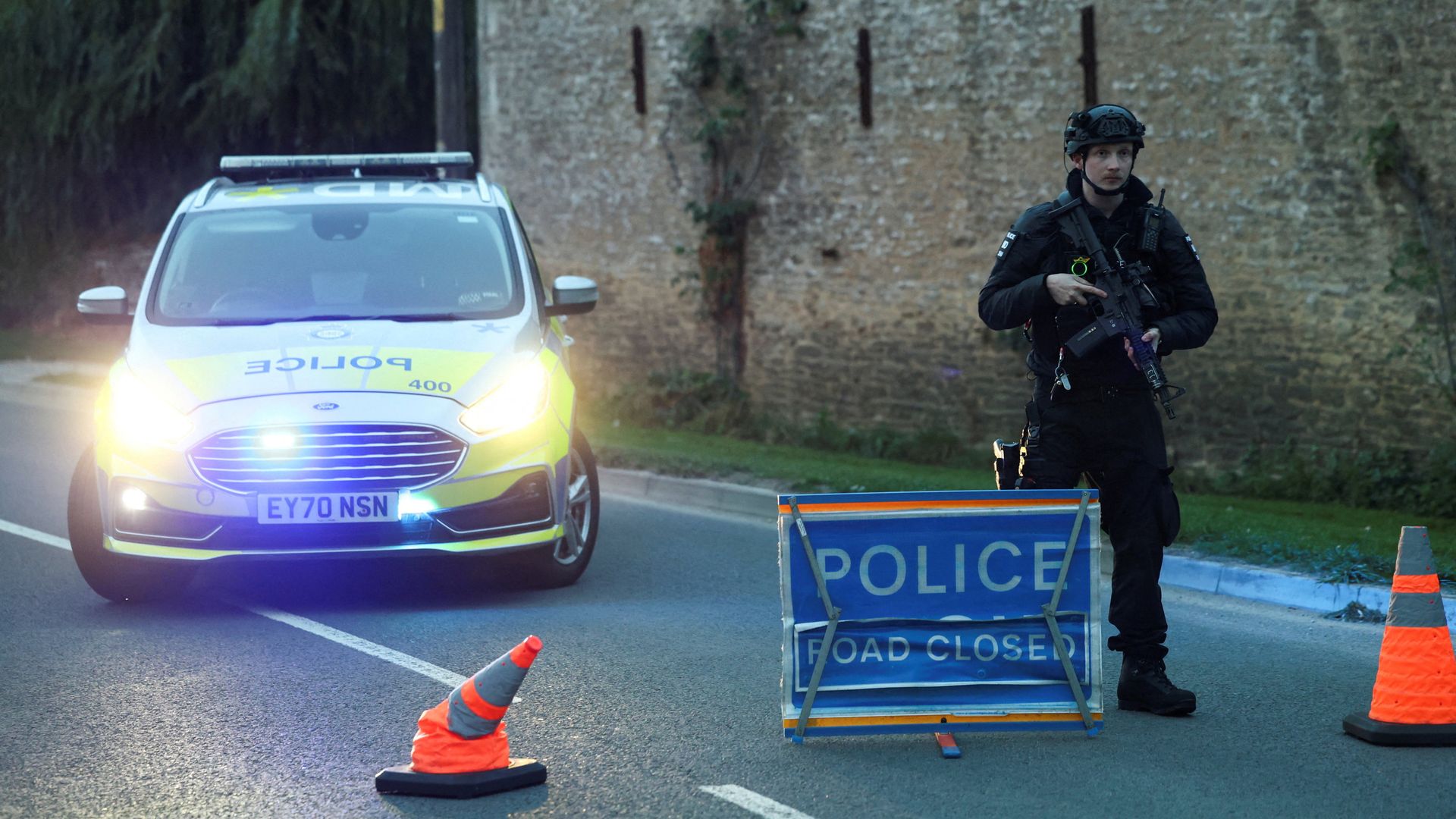
In November 2024, that exact kind of quiet crisis unfolded across eastern and southern England when unidentified small unmanned aerial systems repeatedly breached restricted airspace over US-operated bases, including RAF Lakenheath, RAF Mildenhall, RAF Feltwell, and RAF Fairford. British Ministry of Defence personnel deployed specialist counter-drone units alongside American security forces, while military officials on both sides of the Atlantic declined to disclose who was flying the drones, how they were tracked, or what electronic countermeasures were used to disrupt them.
Silence.
To an ordinary citizen scrolling through headlines, official silence feels like evasion. To an airbase commander, silence is armor.
To see why, step inside a hypothetical scenario grounded in standard joint-base security procedures. Imagine a fictional night-shift watch officer—let us call him Squadron Leader Davies—sitting inside a windowless operations cell at Fairford while rain lashes the concrete outside. On a wall-mounted display, a tiny radar track drifts across the northern perimeter fence at four hundred feet, hovering near an apron where strategic aircraft sit fueled and guarded.
Davies has three phones on his desk and less than ninety seconds to make a call that ripples across two governments. One line connects to Royal Air Force force-protection teams on the ground; a second links to US Air Force command channels; a third reaches national intelligence watch centers that monitor signals across Western Europe. If Davies activates a classified radio-frequency jammer or an experimental sensor array to bring that drone down, every electronic pulse his equipment emits can be recorded by whoever launched the aircraft.
Admitting in public what happened that night—or even confirming that a specialized joint US-UK counter-surveillance team ran a covert response out of Gloucestershire—hands an adversary a blueprint of your defenses. You might as well mail them the schematic of your lock.
When the Commander-in-Chief Speaks Without a Script
That instinct toward tight operational silence collides head-on with the communication style of Donald Trump, creating the recurring friction that fuels headlines about alleged leaks.
When critics, former intelligence officers, and defense commentators raise alarms over Trump's remarks about military or intelligence operations, their concern rarely centers on formal declassification paperwork. Instead, they focus on the unpredictability of unscripted speech. In traditional national security protocol, every word uttered by a president or prime minister about a joint allied facility is vetted by intelligence agencies and diplomatic lawyers so that neither partner accidentally exposes "sources and methods"—the technical tools and human networks used to gather information.
Critics point to documented precedent to explain their unease. In August 2019, during his first term, Trump tweeted a remarkably sharp photograph of a damaged Iranian rocket launch site at Semnan, triggering intense debate among intelligence veterans and imagery analysts who noted that the image's resolution revealed the previously classified capabilities of an American reconnaissance satellite. To detractors, episodes like that illustrate a pattern in which spontaneous political commentary overrides the disciplined restraint expected of leaders entrusted with allied secrets.
Supporters, constitutional scholars, and former administration officials tell a fundamentally different story.
Under the United States Constitution and established executive branch doctrine, the president is not a mid-level clerk bound by non-disclosure agreements; the president sits at the apex of the classification system with broad authority to decide what information serves the public interest or strategic deterrence. From the perspective of Trump's defenders, candid public references to American and allied capabilities are not careless slips at all—they are deliberate warnings aimed at adversaries who assume Washington is paralyzed by bureaucratic caution. In their view, telling the world that US and British forces are working seamlessly behind closed doors—or hinting at capabilities opponents cannot see—projects strength and discourages further probing of allied bases.
Between those two camps sits a quieter reality that seasoned defense reporters recognize immediately. In the echo chamber of modern political media, a broad, boastful phrase from a political leader about "incredible operations" or "things nobody knows about" frequently gets translated by viral headlines into proof of a specific, exposed secret mission. Yet when you examine the actual transcripts alongside official defense statements, a sweeping political claim often confirms no unit name, no technical capability, and no classified operational plan at all. It hovers in the gray zone between rhetorical bravado and genuine disclosure, leaving observers on both sides convinced they heard what they expected to hear.
The Quiet Price of Transatlantic Trust
Still, in the intelligence world, perception carries its own weight. Even when no technical manual is compromised, the mere suspicion that political rhetoric might outpace diplomatic coordination sends subtle shockwaves through the Five Eyes alliance—the post-World War II intelligence-sharing partnership linking the United States, the United Kingdom, Canada, Australia, and New Zealand.
Consider another clearly hypothetical perspective to feel how this plays out behind closed doors. Picture a veteran British intelligence liaison in Whitehall—let us call her Eleanor—who has spent twenty-five years drafting briefing papers for prime ministers and defense secretaries. Her entire career rests on an unwritten promise: when British technicians collect signals intelligence from a listening post in Cyprus or track an intrusion over Gloucestershire, and share that raw data with Washington, the findings will stay inside secure channels until both capitals agree to speak.
Trust between intelligence services is built in drops and lost in buckets.
If officials in London begin to worry that sensitive joint operations at RAF Fairford could become talking points in an unscripted press exchange across the Atlantic, they do not stage a public protest or tear up treaties. The adjustment is far quieter and far more damaging. A sensitive detail gets held back from a morning briefing. A joint operational plan gets written in vaguer language. A British commander pauses before routing raw sensor data into a shared American server, waiting for ministerial sign-off that used to be automatic.
At the same time, excessive secrecy carries an equal and opposite hazard. When governments wrap every security incident at a public airfield in total silence, they create an information vacuum that social media speculation rushes to fill. Ordinary citizens living near these bases—people who watch military transports bank over their rooftops every week—are left wondering whether an unexplained alert involved a hobbyist's quadcopter, a foreign reconnaissance probe, or a covert strike rehearsal.
I will admit something that commentators rarely confess when dissecting national security stories: from outside the perimeter wire, certainty is almost always out of reach. Anyone claiming with absolute confidence that a single presidential remark blew a covert US-UK mission—or conversely, insisting that nothing sensitive was ever at risk—is claiming access to classified rooms none of us can enter. The very rules written to protect aircrews and intelligence sources also prevent the public from seeing the full ledger in real time.
Fog Over the Cotswold Wall
By mid-morning in Gloucestershire, the sun usually burns through the river mist, turning the limestone cottages along Fairford's High Street warm honey-gold. Children walk past the medieval church with its famous stained-glass windows, delivery vans rattle over the River Coln, and a handful of retired aviation enthusiasts pack up their folding chairs along the grass verge outside the airfield fence, thermoses empty after hours of waiting for a heavy bomber that never taxied out.
Nothing in the village looks like the front line of a geopolitical argument.
Yet three thousand miles away in Washington, and seventy miles east in Whitehall, every word spoken about that ten-thousand-foot strip of concrete is weighed like gold dust on a jeweler's scale. Politicians use it to score points, analysts use it to read strategic intent, and adversaries listen closely for any crack between the two flags flying side by side above the main gate.
Inside the perimeter wire, the flight line crew does not get to choose the headlines, the politics, or the microphones. They simply check the rivets on the wing, verify the encryption keys in the cockpit, and watch the gray English sky for whatever comes over the fence next.