The screen glows in the dark of a quiet living room. It is that specific, clinical blue light that has come to define modern American life—the flickering heartbeat of a nation that no longer sleeps because it is too busy watching its own reflection fracture. Somewhere in the middle of the night, a post goes live. It isn’t a policy proposal or a call for unity. It is a burst of raw, unvarnished profanity from a former president, a digital shout into the void of Truth Social that carries the weight of a sledgehammer.
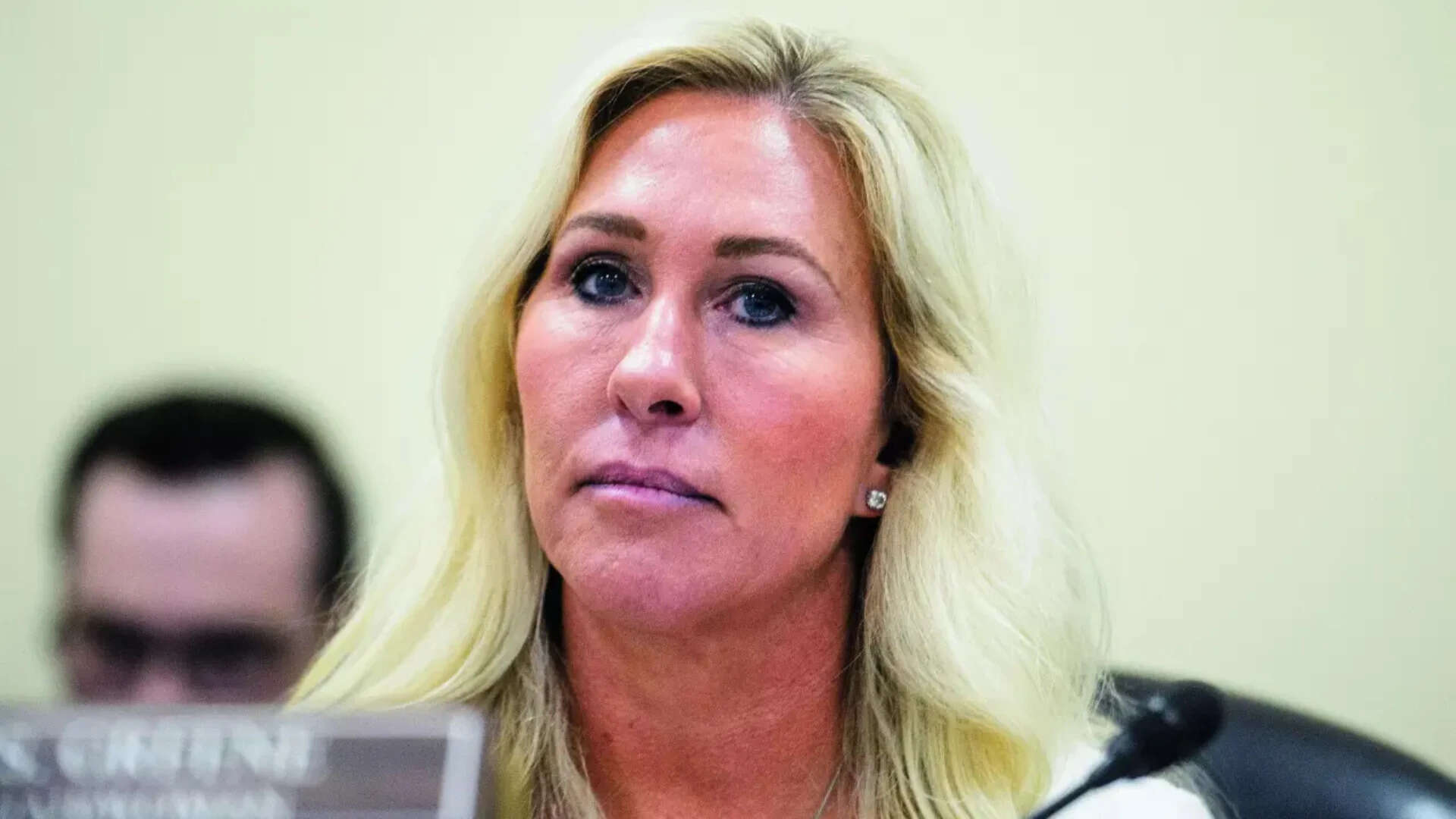
Donald Trump’s words ripple across the digital pond, but it isn't the splash that matters. It’s the echo. Specifically, the 276-word echo from Marjorie Taylor Greene.
When Greene responded by calling the situation "evil," she wasn't just reacting to a post. She was performing a ritual. To understand why this matters, we have to look past the political theater and into the mechanics of human loyalty, the strange way we use morality to shield the people we’ve chosen to follow, and the cost of a public discourse that has traded nuance for fire and brimstone.
The Anatomy of the Outburst
The initial post from Trump was a jagged piece of prose. It relied on a specific kind of vulgarity—the kind designed to shock the polite and thrill the faithful. In a traditional political era, such a post would be a career-ender, a "Dewey Defeats Truman" moment of self-immolation. But we are not in a traditional era. We are in the age of the visceral.
Greene’s response did not focus on the vulgarity itself. Instead, she pivoted. She took the 276 words at her disposal and wove a narrative of persecution. In her telling, the profanity wasn’t a lapse in judgment; it was a symptom of a man pushed to the brink by a system she characterizes as inherently corrupt.
Consider a hypothetical voter named Elias. Elias works a shift at a plant in Ohio. He doesn't care much for swearing, but he cares a lot about feeling forgotten. When he sees Greene’s defense, he doesn't see a Congresswoman excusing bad language. He sees a defender of the "bullied." The profanity becomes a badge of authenticity, a sign that the leader is as angry as Elias is. This is the alchemy of modern populism: turning dross into gold by claiming the fire is the only thing that can burn away the lies.
The Language of the Divine
There is a reason Greene used the word "evil." It is a word that belongs to the pulpit, not the podium. By shifting the conversation from "is this appropriate?" to "is this a battle between good and evil?", she removes the possibility of a middle ground.
When we use the language of theology to describe the actions of politicians, we stop being citizens and start being congregants. You cannot negotiate with "evil." You cannot find a bipartisan solution to "evil." You can only defeat it.
Greene’s 276 words functioned as a boundary marker. They told her audience exactly where the line was drawn. If you were offended by the profanity, you weren't just a critic; you were part of the "evil" system trying to suppress a "truth-teller." It is a brilliant, if terrifying, rhetorical strategy. It turns every flaw into a feature and every critic into a villain.
The Invisible Stakes of the Digital Square
The real tragedy isn't the vulgarity. It’s the noise.
Think about the sheer volume of information hitting the average person every day. We are drowning in a sea of data, most of it designed to make us feel something—anything—so we keep clicking. In this environment, the loudest voice wins. The most extreme take gets the most shares.
When Greene reacts with such intensity, she is feeding the algorithm. The algorithm doesn't care if the content is "evil" or "good." It only cares that you are looking. And while we are looking at the 276-word reaction to a profane post, we aren't looking at the crumbling bridges in our own towns. We aren't looking at the rising cost of healthcare or the quiet desperation of a generation that can't afford to buy a home.
The noise is the point.
A Culture of Constant Crisis
Living in a state of perpetual moral outrage is exhausting. It does something to the human psyche. It narrows our vision until all we can see is the enemy.
Imagine two neighbors, Sarah and Jim. Ten years ago, they might have disagreed about tax rates while sharing a beer over a lawnmower repair. Today, Sarah sees Jim’s social media feed, filled with the language of "evil" and "corruption," and she doesn't see a neighbor anymore. She sees a threat. Jim looks at Sarah’s silence and sees complicity in a system he’s been told is out to destroy him.
Greene’s defense of Trump’s post reinforces this wall. It tells the Sarahs and Jims of the world that there is no common language left. There is only the profane and those who defend it, and those who use "evil" as a shield.
The Weight of 276 Words
It seems like a small thing—a few paragraphs typed into a phone. But these words are the bricks in a wall that is getting higher every day.
Greene’s reaction was not a spontaneous outburst. It was a calculated move in a long game of identity politics. By framing the former president’s outbursts as the necessary venting of a persecuted martyr, she ensures that the base remains tethered to the man, not the message. The man becomes the message.
This is the hidden cost of the narrative. When we lose the ability to say, "I support this person, but that was a mistake," we lose our agency. We become part of a collective that must defend everything, no matter how indefensible, because to admit a single flaw is to let the "evil" side win.
The Mirror in the Screen
At the end of the day, we have to ask ourselves why we are so captivated by this. Why does a 276-word reaction to a social media post garner more attention than a white paper on economic reform?
It’s because we are addicted to the drama. We have traded the slow, boring work of democracy for the high-octane thrills of a moral crusade. Greene understands this. Trump understands this. They are giving the public exactly what it has been trained to crave: a clear enemy and a righteous cause.
But righteous causes usually require sacrifice. In this case, the sacrifice is our collective peace of mind. It is our ability to see the humanity in those we disagree with. It is the very fabric of a society that requires a certain level of decorum to function.
The screen continues to glow. Another post goes up. Another reaction is drafted. The cycle repeats, faster and faster, until the words themselves lose meaning and all that remains is the heat. We are standing in the middle of a burning room, arguing about the color of the flames, while the roof begins to groan under the weight of our own certainty.
Somewhere, in a house like yours, a light stays on far too late. A thumb scrolls. A heart rate climbs. The "evil" is always out there, somewhere else, on the other side of the screen, never in the mirror.
The blue light never fades. It only grows colder.