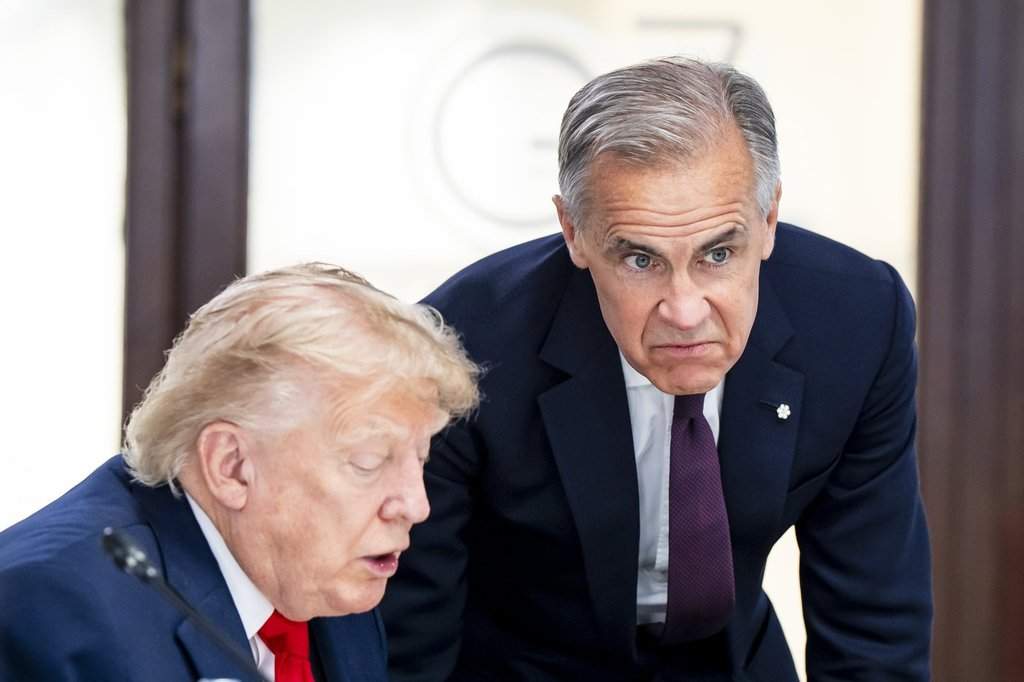
Handshakes in Shenzhen don't magically erase 50 percent tariffs. When Prime Minister Mark Carney and President Donald Trump met for nearly 20 minutes on the sidelines of the Asia-Pacific Economic Cooperation (APEC) summit on November 18, headlines immediately framed it as a breakthrough. Both sides confirmed that negotiators are working toward an agreement over the coming weeks.
Stop right there. If you think Ottawa and Washington are about to sign a sweeping, old-school free trade pact before New Year's Day, you're misreading the room.
What's actually on the table right now isn't a grand reconciliation. It's an emergency triage mission.
The Real Stakes Behind the Coming Weeks
Canadian negotiators, led by chief trade negotiator Janice Charette, aren't chasing a ceremonial ribbon-cutting. They're racing a six-week clock to stop catastrophic damage to core domestic industries.
Since August 2026, Ottawa has been staring down punitive 50 percent U.S. tariffs on a broad swath of Canadian exports, alongside punishing sectoral duties hammering steel, aluminum, forestry, and automobiles. Worse yet, Trump threatened via social media in August to hike tariffs on Canadian vehicles and auto parts to 50 percent starting January 1, 2027. Even though Washington hasn't filed formal paperwork for that January hike yet, nobody in Ottawa is treating it as an empty bluff.
So when U.S. Trade Representative Jamieson Greer tells reporters "we are close" to landing a deal, or when Carney's office says both leaders agreed to stay in close contact to boost affordability and protect jobs, translate that diplomatic speak. Ottawa wants an interim relief agreement before December 31. They want the August 50 percent levies rolled back, the 25 percent auto tariff addressed, and the January 1 threat taken off the table.
Meanwhile, Trump is playing an entirely different game. Just days after the Shenzhen meeting, he complained publicly about the U.S. trade deficit with Canada—pegging it at "about $80 billion," a notch closer to the actual 2025 goods deficit of $48 billion than his usual $200 billion talking point—and quipped, "I said, when it's down to zero, come over and let's start talking".
That gap tells you everything you need to know about why these talks are dragging.
Why Autos Are the Make-or-Break Sticking Point
If you want to understand why talks collapsed back in August and why they remain jammed today, look at the assembly lines in Ontario and Michigan.
According to sources briefed by Ottawa on Janice Charette's updates to a federal advisory committee, the single biggest obstacle preventing an agreement is the 25 percent U.S. tariff on Canadian automobiles. North American auto manufacturing wasn't built as two separate national industries. Parts cross the Detroit-Windsor corridor half a dozen times before a finished vehicle rolls off a lot. Slapping a 25 percent duty—let alone a 50 percent one—doesn't just hurt Canadian plants. It gums up the entire continental supply chain.
Here's where Carney threw a curveball that rattled Washington. Ahead of the APEC summit, while speaking to reporters in Cambodia, Carney flatly stated that if Canadian auto workers aren't fully utilized within an integrated North American market, Canada will look elsewhere—including working with Chinese automakers.
"It's not leverage. But action, reaction," Carney said. "Canada is going to move forward either way".
Honestly, it was a gutsy move. Whether you view it as smart hardball or dangerous brinkmanship—and opposition voices on Parliament Hill immediately warned against "playing chicken" with an administration holding massive economic leverage—it signaled that Ottawa refuses to sit quietly while its manufacturing base gets squeezed.
Ottawa's Parallel Track Is Changing the Math
Most coverage of the Canada-U.S. trade talks misses the biggest structural shift happening in Ottawa right now. Carney isn't treating trade diversification as a backup plan. As he put it earlier this year, diversifying away from American dependence has been Plan A from day one.
Look at what happened during the very same week Carney sat down with Trump in China:
- China Tariff Reset: At the New York Times 2026 DealBook Summit on November 18, Carney revealed that Ottawa struck an arrangement with Beijing that slashed tariffs and resolved over 90 percent of bilateral trade irritants. His assessment of Chinese negotiators compared to their American counterparts was blunt—he described the Beijing talks as "professional," "linear," and "rational".
- ASEAN and Philippines Pacts: Just days earlier on November 15, Carney brokered free trade agreements with the Philippines and the broader ASEAN bloc.
- India on the Horizon: Ottawa is reportedly on the cusp of finalizing a free trade deal with India within the next three months, alongside active negotiations toward a trade arrangement with Taiwan.
- Internal Trade Barriers Gone: Domestically, the federal government eliminated remaining federal barriers to internal Canadian trade, trying to turn ten provincial economies into one unified market.
Carney summed up his posture at DealBook in eleven words: "We would like to do the deal. But if the U.S. doesn't want to do the deal, we're busy".
Think about how radical that is for a Canadian prime minister. For decades, every economic policy in Ottawa revolved around preserving friction-free access to the United States. Now, Carney is openly telling global executives that the era of steady North American integration is over.
What Canadians and Businesses Actually Expect
Public sentiment reflects this sober reality. A poll published on November 21 found that 86 percent of respondents don't believe Canada and the U.S. will reach a trade agreement before 2027.
People aren't cynical without reason. They've watched talks stall, restart, and stall again since the spring of 2025. Even when Jamieson Greer insists that overall bilateral trade remains "a more positive story, I think, than people realize"—and it's true that massive volumes of goods still move under existing Canada-United States-Mexico Agreement (CUSMA) rules—exporters caught in the crosshairs of sectoral tariffs are bleeding cash.
Meanwhile, recent Canadian retail sales data came in softer than economists projected, proving that prolonged uncertainty is already cooling household spending. Ottawa has tried to cushion the blow with tax cuts on income, housing, and gas—worth up to $1,890 per family—alongside federal financing to keep major employers from laying off workers. That buys time, not permanence.
The Core Friction Points Still Unresolved
Before any ink dries in the coming weeks, negotiators have to bridge three stubborn divides:
- Tariff Relief vs. Deficit Reduction: Ottawa needs immediate relief from the 50 percent August tariffs and the 25 percent auto duty. Trump wants measurable reductions in the U.S. goods trade deficit, which is structurally driven by American demand for Canadian crude oil, electricity, and raw materials—things the U.S. economy actually needs.
- Sovereignty and Cultural Carve-Outs: In its official readout of the Shenzhen meeting, the Prime Minister's Office pointedly emphasized that any deal must "fully respect Canada's languages, culture, and sovereignty". That's direct pushback against past American rhetoric questioning Canadian sovereignty and recurring U.S. demands targeting supply management, digital services, and Canadian content rules.
- Enforcement and Predictability: Canadian businesses are hesitant to invest around a handshake deal if tariffs can be reimposed overnight via social media. As Carney noted, business confidence requires policy decisions "that will stick"—action rather than mere intent.
How to Position Yourself Over the Next Six Weeks
If you run a cross-border business, manage supply chains, or invest in North American equities, sitting back and waiting for a press conference in Washington or Ottawa is a mistake. Treat the coming weeks as a risk-management window rather than a guaranteed resolution.
- Audit your tariff exposure before January 1: Map out every SKU, component, or raw material crossing the border. Identify which items currently fall under CUSMA rules of origin versus those exposed to the August 50 percent list or potential January 1 auto-sector hikes.
- Model a two-track Q1 2027 budget: Build one operating scenario where an interim deal freezes new tariffs and rolls back half the August penalties, and a second stress-test scenario where current duties remain locked in through spring 2027.
- Look closely at Ottawa's new trade corridors: If your business relies on export growth, examine the tariff reductions coming online through Canada's new ASEAN, Philippines, and China arrangements, as well as the upcoming India framework. Federal retooling grants and export financing are actively flowing to companies willing to pivot beyond the U.S. market.
- Watch the Federal Register, not social media: Presidential remarks move markets for an afternoon, but formal tariff changes require official notice. Track actual U.S. Trade Representative filings and Canada Gazette notices over the next six weeks to separate negotiating theater from binding law.