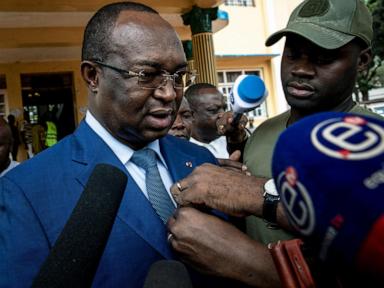
The headlines are predictable. An opposition leader in the Central African Republic (CAR) has his travel documents seized at the airport, and the international press immediately fires up the "death of democracy" siren. They paint a picture of a binary struggle: a thuggish regime versus a silenced martyr. It is a tired script. It is lazy. Most importantly, it ignores the actual mechanics of power in Bangui.
The seizure of a passport is rarely about preventing travel. In the age of digital influence and satellite phones, physical presence is a legacy metric. If you want to shut someone down, you freeze their assets or kill their signal. When a government takes a passport in broad daylight at an international terminal, they aren't trying to stop a flight. They are staging a play.
The Myth of the Silenced Dissident
The prevailing narrative suggests that by stripping a politician of their travel documents, the state successfully curtails their influence. This is a fundamental misunderstanding of modern African geopolitics. Power in CAR does not reside in the ability to fly to Paris or Brussels for a gala. It resides in the ability to mobilize local constituencies and navigate the complex web of regional security interests.
Taking a passport is a gift to an opposition figure. It provides them with the one thing every politician craves: victimhood equity. It validates their relevance. If the government didn't fear you, they would let you leave and hope you never came back. By forcing you to stay, they signal to the world—and more importantly, to your base—that you are a credible threat.
I have watched dozens of these "crises" unfold across the continent. The sequence is always the same. The seizure happens. The tweets go out. The state media issues a vague statement about "national security" or "ongoing investigations." The international community issues a boilerplate condemnation. Everyone gets what they want. The government looks tough to its hardliners; the opposition leader gets a bump in the polls and a fresh round of donor interest.
Why We Ask the Wrong Questions
The media asks: "Is this a violation of human rights?"
The answer is technically yes, but it is the least interesting thing about the event.
The better question is: "What was this person planning to do outside the country that made the risk of a PR disaster worthwhile for the state?"
In the Central African Republic, the "outside" usually means one of three things:
- Meeting with regional power brokers in Chad or Rwanda.
- Shoring up support with former colonial patrons.
- Accessing offshore capital to fund a campaign (or a rebellion).
When the state intercepts a passport, they are blocking a specific transaction, not a human being. They are disrupting a supply chain of political influence. To view this through the lens of "freedom of movement" is to apply a Western liberal framework to a situation that is purely about tactical resource denial.
The Sovereignty Trap
We need to talk about the "Lazy Consensus" regarding African sovereignty. There is a tendency among analysts to treat CAR as a failing state where rules are broken on a whim. This ignores the internal logic of the regime. The administration in Bangui is currently navigating a high-stakes transition away from traditional French influence toward new security architectures involving Wagner Group remnants and Russian interests.
In this environment, "law" is used as a kinetic weapon. The seizure of a passport isn't a breakdown of the system; it is the system working exactly as designed. The legal code is a toolbox for the executive branch to manage internal friction.
Imagine a scenario where a CEO finds out their CFO is planning to jump ship to a competitor with a hard drive full of trade secrets. The CEO doesn't wait for a HR tribunal. They lock the badge and call security. In the high-stakes world of CAR politics, the "trade secrets" are the shifting allegiances of armed groups and the "competitor" is anyone who might offer a better deal than the current presidency.
The International Community's Performative Outrage
Organizations like the UN or Human Rights Watch operate on the assumption that shaming a government will lead to a change in behavior. This assumes the government cares about its reputation in the West more than it cares about its survival at home.
In CAR, the calculation is different. The current leadership has seen that international condemnation rarely carries teeth. As long as the gold and diamonds keep flowing and the capital remains relatively secure, a few angry press releases from New York are a small price to pay for neutralizing a domestic rival.
The opposition knows this too. They don't expect the UN to get their passport back. They want the UN to record the event so they can use it as leverage in future negotiations. It is a cynical, circular economy of grievance.
The Hard Truth About Opposition Politics
Let's be brutal. If your entire political platform can be dismantled because you can't get on a plane to Douala, you weren't much of a leader to begin with.
True political power in a place as fractured as CAR is built on the ground. It is built in the markets, the barracks, and the rural provinces. If you are more comfortable in the departure lounge of M'Poko International Airport than you are in the streets of the 3rd Arrondissement, you are a consultant, not a revolutionary.
The obsession with travel documents reveals the "diaspora bias" of CAR’s elite. Many of these leaders spent the conflict years in Europe. They view the ability to exit as a fundamental safety valve. When the government closes that valve, it isn't just a legal issue; it's an existential one. It forces them to actually live in the reality they claim to want to lead.
The Strategic Failure of the Seizure
While I am dismantling the opposition's victim narrative, I must also point out that the government is playing a dangerous game. Forcing your rivals to stay in the country is a tactical error of the highest order.
History shows that exiled leaders become irrelevant. They lose touch with the base. They become "coffee shop revolutionaries" in Paris. By seizing a passport, the CAR government is effectively forcing its most dangerous critics to remain inside the tent. They are keeping the fire inside the house.
If the administration were smarter, they wouldn't take the passport. They would upgrade the opposition leader to first class, drive them to the airport, and make sure they had a long-term visa for somewhere very far away.
The Reality of the "Investigation"
Whenever a passport is taken, the justification is almost always a "pending investigation." In CAR, an investigation is a legal purgatory. It has no start date and no end date. It is a way to maintain "conditional liberty."
This is the ultimate counter-intuitive truth: The state doesn't want to arrest these people. An arrest creates a martyr and a focal point for protests. A "pending investigation" creates a ghost. It keeps the politician in a state of perpetual uncertainty, unable to plan, unable to travel, and unable to act, yet without the clear-cut status of a political prisoner that would trigger harsher international sanctions.
It is a masterful use of bureaucracy as a gag order.
Stop Looking at the Passport
If you want to understand what is happening in Bangui, stop looking at the blue booklet in the policeman's hand. Look at the mining concessions being signed in the hinterlands. Look at the troop movements on the border with Chad. Look at the currency fluctuations.
The passport story is a shiny object designed to distract you from the fact that the actual map of power in the Central African Republic is being redrawn, and it has nothing to do with who can or cannot fly to a conference in Lisbon.
The next time you see a headline about an opposition leader’s travel ban, realize you are watching a rehearsal. The government is testing its grip. The opposition is testing its reach. And the public is, as usual, just the audience for a play where the ending was written long before the curtain rose.
Don't cry for the traveler. Cry for the people who don't even have a passport to be seized.