Cold air always hits Seoul differently in December. It does not merely chill your skin; it sharpens the edges of every streetlamp, turns breath into brief ghosts above the Han River, and makes the asphalt outside the National Assembly feel like iron under your boots.
For most people living through the winter of 2024, that December cold became permanently fused with a single, surreal memory. Smartphones buzzed late at night. Broadcast anchors stared down camera lenses with stiff shoulders and tight jaws. Words that belonged to dusty history textbooks—emergency decrees, troop deployments, the sudden suspension of political life—spilled out of living room televisions while children slept down the hall.
History, when it knocks at midnight, rarely wears a polite face.
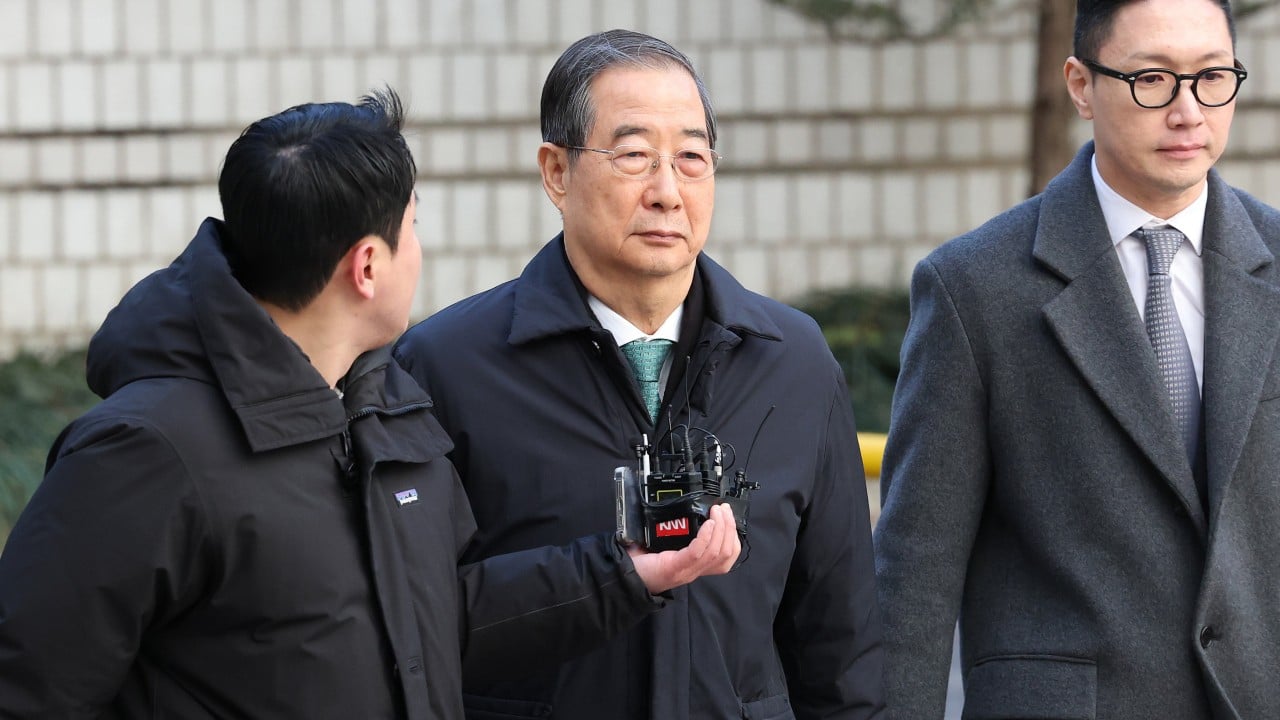
Years later, the headlines look deceptively clinical. A dry legal bulletin flashes across news tickers, announcing that a South Korean court has ordered a retrial of former Prime Minister Han in connection with the 2024 martial law case. On paper, it reads like procedural housekeeping—an appellate adjustment, a remand, another turning gear inside a massive judicial machine.
Strip away the legalese, though, and something far heavier sits beneath that ruling. A retrial is not merely a second look at old paperwork. It is a society refusing to let a fractured night fade into convenient amnesia. It is a nation asking where obedience ends, where complicity begins, and what happens to ordinary citizens when the highest offices in the land treat constitutional guardrails like optional suggestions.
The Weight of a Signature in a Quiet Room
Imagine a hypothetical scene inside a government office at 11:00 PM on a freezing Tuesday. Nothing about this specific room is drawn from leaked transcripts; treat it instead as a lens through which to see the human mechanics of state power.
A fluorescent bulb hums overhead. On a polished mahogany desk sits a folder stamped with urgency. Across the table stands a career public servant—someone who has spent decades mastering the art of institutional stability, someone whose entire professional identity rests on keeping the machinery running smoothly while politicians come and go. Outside, armored vehicles are already idling near government complexes, though the public does not yet know why. Inside, a pen hovers two inches above paper.
That pause—that microscopic hesitation between receiving an extraordinary order and carrying it out—is the exact territory South Korea’s courts are now forced to map millimeter by millimeter.
When former Prime Minister Han stood at the center of the fallout from the December 2024 martial law declaration, the legal questions were never just about one man’s personal ambition or political survival. The Prime Minister in South Korea occupies a uniquely treacherous constitutional space. Unlike systems where the head of government commands absolute executive authority, South Korea’s Prime Minister acts as the president’s chief administrative lieutenant—the bridge between executive command and the sprawling cabinet ministries that actually run the country.
To understand why a retrial matters so deeply, you have to understand that bridge. A declaration of martial law does not execute itself through magic. Orders must be relayed. Cabinet meetings must be convened or bypassed. Ministries must be instructed. Silence, in moments of constitutional rupture, functions just like an endorsement.
Lower court proceedings initially wrestled with how to weigh those actions against criminal statutes governing insurrection, abuse of authority, and dereliction of duty. Did the former Prime Minister actively facilitate an unlawful suspension of democratic order, or was he trapped inside a rapidly unfolding crisis triggered from above? Did procedural flaws in how cabinet deliberations were handled cross the threshold from political failure into criminal liability?
An appellate ruling ordering a retrial tells us that the first legal draft failed to capture the full architecture of that night. The judges looked at the record and decided that crucial questions of intent, legal standard, or evidentiary weight had been answered too quickly—or through the wrong statutory lens.
Why Democracies Obsess Over Technicalities
To an outsider scrolling past international news feeds, appellate remands can look maddeningly slow. Why not deliver a final verdict and move on? Why reopen wounds that have barely begun to scab?
Think of a master watchmaker examining a timepiece that stopped working during a violent storm. From the outside, you only care that the hands froze at midnight. You want the broken gear replaced immediately so the clock runs again. Yet if the watchmaker swaps out the wrong spring without testing how tension travels from the mainspring to the escapement, the watch will shatter the next time the weather turns.
Constitutional law works the exact same way.
South Korea carries muscle memory that few other modern democracies share. Within living memory—not ancient history, not centuries ago, but inside the lifetimes of parents and grandparents sitting at today’s dinner tables—martial law meant curfews, censored newspapers, soldiers in university courtyards, and brutal crackdowns in cities like Gwangju. When South Koreans built their modern democratic republic in 1987, they did not write their Constitution as an abstract philosophical exercise. They wrote it as a fortress against their own past.
Every clause restricting emergency powers, every requirement for cabinet deliberation, every rule empowering the National Assembly to lift martial law by majority vote was forged out of real grief.
Because those rules exist to prevent catastrophe, how a court judges the people standing closest to the trigger sets the rules of engagement for every future crisis. If a high-ranking official can claim mere proximity without responsibility—if being the second-highest figure in the executive branch carries no enforceable duty to halt an unconstitutional decree—then constitutional safeguards shrink into decorative calligraphy. Conversely, if courts convict without airtight legal precision, future prosecutions risk looking like political score-settling rather than impartial justice.
That tension is why the retrial order lands with such quiet force. It signals that South Korea’s judiciary refuses both shortcuts: neither sweeping executive actions under the rug for the sake of political calm, nor cutting legal corners to satisfy public anger.
The Invisible Scars Left Behind
Legal analysts love clean timelines. Real life leaves messy residue.
Consider what happened in the weeks and months after that December night in 2024, away from the television cameras and courtroom sketches. In Yeouido, office workers who had rushed toward the National Assembly in the freezing dark—standing shoulder to shoulder with strangers to block troop transports and protect lawmakers climbing fences to cast their votes—returned to their desks the next morning exhausted and strangely altered.
Ask anyone who lived through those hours in Seoul, and they will tell you about the sensory details that never make it into court filings. The metallic rattle of helicopter blades vibrating through apartment windows after midnight. The frantic group chats lighting up with conflicting rumors—Is the subway still running? Are bank transfers frozen? Should we buy cash before morning? The surreal contrast of seeing soldiers in full tactical gear standing twenty yards away from convenience stores glowing with warm fluorescent light and rows of triangular kimbap.
Trust, once rattled at that scale, does not snap back when a gavel falls.
Small business owners in central Seoul watched tourist bookings evaporate overnight. Foreign investors demanded risk premiums on South Korean assets, suddenly forced to price political shock into markets they had treated as mature and predictable for decades. Families argued across dinner tables—older relatives insisting stability required strong executive hands, younger ones terrified that hard-won freedoms were far more fragile than they had ever imagined.
I have watched crises unfold across institutions long enough to recognize the specific exhaustion that follows an averted disaster. When the worst outcome is narrowly avoided—when lawmakers manage to reach the chamber, cast their votes, and force the lifting of martial law within hours—a dangerous illusion sets in. People begin to tell themselves that because the system held, the threat wasn't really that severe.
That illusion is poison. A bridge that survives an earthquake with hairline fractures inside its load-bearing pillars is not safe simply because traffic is still driving across it. You close the lanes. You bring in engineers. You strip away the concrete to inspect the steel underneath.
The retrial of former Prime Minister Han is that structural inspection.
Inside the Legal Labyrinth
What actually happens when a higher court orders a retrial in a case of this magnitude?
Forget Hollywood courtroom drama, where a surprise witness bursts through oak doors clutching a smoking gun. South Korean appellate litigation rarely turns on theatrical twists. Instead, it turns on relentless, surgical scrutiny of two core pillars: how the law was interpreted, and whether every piece of evidence received its proper legal weight.
In cases stemming from the 2024 martial law episode, prosecutors and defense teams have clashed over fundamental questions that go straight to the heart of executive governance:
- The anatomy of cabinet deliberation: Under South Korean constitutional rules, declaring martial law requires formal deliberation by the State Council—the cabinet. Prosecutors have argued that irregularities in how that meeting was summoned, documented, or conducted stripped the decree of legitimacy from the start, turning administrative participation into complicity. Defense lawyers counter that chaotic, compressed circumstances prevented textbook formality without transforming a Prime Minister’s presence into criminal conspiracy.
- Command versus execution: Where does the legal boundary sit between a president who issues an emergency order and a prime minister who oversees the bureaucracy expected to implement it? If an official neither authored the decree nor commanded troops directly, what specific acts—or failures to act—constitute culpable participation?
- The standard of intent: Criminal liability for severe state offenses requires proving clear awareness and intent, not merely poor judgment, panic, or political loyalty under pressure.
When an appellate bench orders a retrial, it sends a pointed message down to the trial court: Re-examine the record under the clarified legal standard. Witnesses may be recalled. Cabinet logs, phone records, and ministerial testimonies that seemed peripheral during the first round suddenly become central. Every minute between the initial summoning of ministers and the broadcast of the decree gets placed back under magnification.
And honestly, there is something deeply unsettling about watching this unfold years after the sirens stopped. It forces an admission that even seasoned legal observers find uncomfortable: the line between dutiful public service and unlawful obedience is rarely obvious in real time. Anyone who claims they would effortlessly become a hero at 11:30 PM while surrounded by superiors, armed security, and conflicting orders has never stood inside a room where history was tipping sideways.
Yet acknowledging human frailty does not erase public accountability. In fact, it makes accountability essential. Public office carries privileges precisely because it demands moral courage when courage is expensive.
The Quiet Test Every Citizen Faces
Step back from Seoul for a moment. Whether you live in Busan, Berlin, Boston, or Buenos Aires, the drama playing out in a South Korean courtroom is holding up a mirror to your own civic life.
We tend to imagine democracy as a self-cleaning oven—a sturdy machine built by wise founders that runs indefinitely on autopilot. We vote every few years, complain about taxes or traffic, and assume the invisible rules governing police, soldiers, courts, and prime ministers will always hold because they held yesterday.
They don't. Institutions are not granite monuments. They are habits—millions of daily agreements among ordinary people to respect boundaries even when breaking them would be convenient.
Look closely at what saved South Korea on that December night in 2024. It was not a single piece of paper locked inside a museum vault. It was thousands of unscripted human choices made in real time. Citizens who walked out into freezing streets instead of locking their doors. Parliamentary aides who stacked furniture against glass doors to buy lawmakers ten extra minutes to reach the floor. Young conscripted soldiers who moved slowly, hesitated, and avoided turning rifles on their own neighbors. Lawmakers who climbed walls in business suits so a constitutional vote could be tallied before dawn.
And now, years later, it is judges and prosecutors refusing to let the aftermath dissolve into vague political theater.
Notice how unglamorous this phase looks. There are no dramatic live broadcasts of crowds chanting beneath floodlights. There are no viral clips of politicians scaling fences. Instead, there are thick binders of trial transcripts, procedural motions, evidentiary challenges, and sober judicial opinions dissected by legal reporters over lukewarm coffee.
Do not mistake that quietness for irrelevance. Quietness is what the rule of law sounds like when it is doing its hardest work.
What Lingers After the Gavel
Walk past the court complex in Seocho-dong on an ordinary afternoon, and you will see delivery scooters weaving through traffic, office workers hurrying back from lunch with iced Americanos in hand, and students arguing over exam notes near the subway entrance. Nothing about the street looks historic. Nobody is shouting about constitutional theory at the crosswalk.
Inside the building, stacks of paper carry the testimony of a night when an entire country held its breath until sunrise.
A retrial will not erase the memory of December 2024, nor will any single verdict heal every political division that night exposed. Courts cannot manufacture wisdom, and prison sentences or acquittals alike will leave fierce critics on one side or the other. What the retrial can do—what it must do—is establish an unmistakable ledger of truth: who knew what, who signed what, who stood aside, and what the law demands when power tries to outrun the Constitution.
Years from now, another official in another quiet room will face an urgent folder on a polished desk late at night, while cold air presses against the windowpane and a pen hovers two inches above the page. Everything decided in this courtroom will determine whether that hand trembles—and whether it puts the pen down.