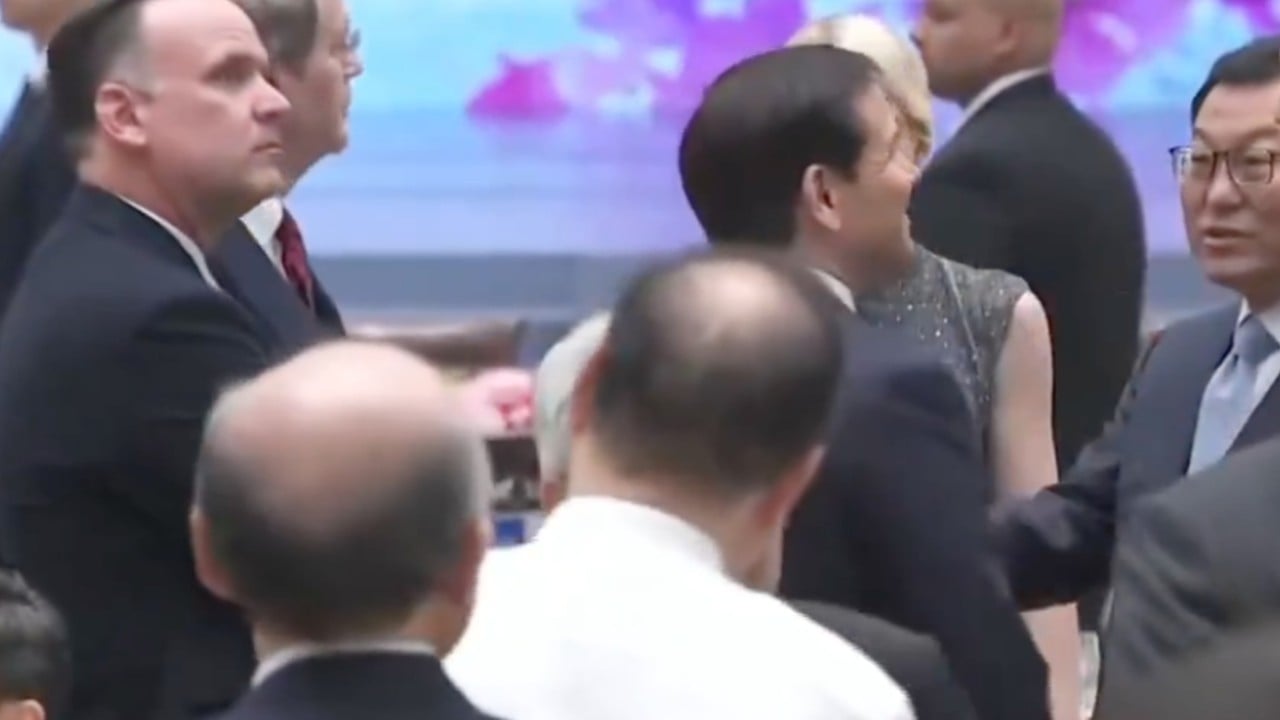
Diplomacy rarely hinges on formal speeches. It happens in the margins, often caught on a stray microphone or a wide-angle lens while world leaders walk between plenary halls.
During the 2026 Asia-Pacific Economic Cooperation summit hosted in China, cameras caught U.S. Secretary of State Marco Rubio pausing to admire traditional Chinese architecture—again. For a politician who built his Senate career as one of Washington’s fiercest China hawks, the visual immediately set off chatter across diplomatic circles and social media feeds. Was it a calculated olive branch, simple human curiosity, or a sign that the frost between Washington and Beijing is thawing slightly at the edges?
Honestly, it’s a bit of all three. When you strip away the cable news noise, these unscripted moments tell us more about the mechanics of modern statecraft than a ten-page joint communiqué ever could.
The political theater of architectural appreciation
You can’t separate the setting from the message when China hosts a major international gathering. Beijing treats summit venues as physical arguments for its civilization's longevity and modern organizational muscle.
Whether it's the sweeping timber joinery of historic pavilions or the deliberate symmetry of imperial-inspired convention centers, the host nation curates every sightline. When Rubio—now serving as the top American diplomat—stops to look up at a coffered ceiling or remark on traditional craftsmanship, he isn't just being a tourist. He's participating in a time-tested diplomatic ritual.
This isn't the first time he has drawn attention for appreciating Chinese design elements either. Even during periods of intense legislative friction over trade, intellectual property, and security in the Indo-Pacific, observers have noted his genuine interest in history and aesthetics.
Politicians are human beings first. You can fiercely oppose the Chinese Communist Party’s economic policies and military posture in the South China Sea while still recognizing that centuries-old timber engineering is remarkable. Separating the state from the culture isn't weakness. It's basic sophistication.
Why optics at APEC carry heavy weight
APEC operates differently than the G7 or NATO. It’s built around economic integration across the Pacific Rim, bringing together twenty-one member economies with wildly different political systems.
Because the summit focuses on trade, supply chains, and regional stability, the atmosphere tends to favor pragmatism over ideological lecturing. When China holds the APEC chairmanship in 2026, the pressure on Washington is distinct. Allies in Southeast Asia—countries like Vietnam, Singapore, and Indonesia—watch every interaction between American and Chinese officials closely.
They don't want to be forced into a binary choice.
If the U.S. Secretary of State arrives looking perpetually scowling and refuses to engage with the host country's cultural heritage, regional partners read that as rigidity. On the flip side, showing basic respect for the host's environment lowers the temperature in the room before bilateral talks even begin.
Think about the choreography of past summits. In 2014, when Beijing hosted APEC at Yanqi Lake, the venue itself was designed to evoke traditional Han and Tang dynasty styles merged with modern engineering. World leaders walked across stone bridges and posed beneath sweeping eaves. Those visuals were engineered to project stability and hospitality.
Rubio’s reaction fits right into that visual grammar. By admiring the architecture, he signals confidence. Someone who feels insecure about their geopolitical standing feels compelled to sneer at everything the rival builds. Someone secure in American leverage can afford to compliment a roofline.
Separating hawkish policy from diplomatic manners
A lot of commentators struggle with nuance. They assume that if you’re a hawk on Beijing, you have to hate everything within China's borders.
That’s a cartoonish way to look at foreign policy. Throughout his years on the Senate Foreign Relations Committee and the Intelligence Committee, Rubio championed strict export controls, scrutinized Chinese telecommunications firms, and pushed legislation targeting supply chain dependencies. Moving into the State Department didn't erase that worldview.
What changed is the job description.
A senator's job is to stake out clear legislative positions, sound alarms, and represent their constituents' values. A Secretary of State's job is to manage relationships, prevent miscalculations, and keep communication channels open even with fierce competitors.
Good diplomats understand cultural respect is free. It costs zero concessions on tariffs, zero compromises on semiconductor restrictions, and zero retreat on security commitments to allies like Japan or the Philippines. Yet it buys goodwill and keeps the personal dynamic functional when tough negotiations happen behind closed doors.
I've watched plenty of negotiations stall because one side confused rudeness with strength. Walking into someone's house and refusing to acknowledge their hospitality doesn't make you look tough; it makes you look amateurish.
How China uses host-nation aesthetics as soft power
Beijing understands the power of physical spaces better than almost any government on earth. Whenever China hosts an international forum—whether it’s the 2008 Olympics, the 2016 G20 in Hangzhou, or the 2026 APEC meetings—architecture does half the diplomatic lifting.
Traditional Chinese architecture relies heavily on dougong (interlocking wooden brackets that hold up heavy roofs without nails), balanced courtyards, and integration with water and gardens. These structures aren't accidental. They communicate order, harmony, and continuity.
When foreign dignitaries praise these spaces, state media inevitably highlights those clips. For a domestic Chinese audience, seeing a prominent American critic admire Chinese heritage reinforces a message of national pride. It tells citizens at home that even Washington's toughest voices respect Chinese civilization.
Both sides get something useful out of the exact same five-second video clip:
- Beijing gets validation of its cultural prestige and an image of gracious hosting for its domestic audience.
- Washington gets a visual counter-narrative to claims that the U.S. is unreasonably hostile or unwilling to engage constructively in the Asia-Pacific.
- Regional APEC economies get reassurance that the world's two largest economies can at least share a room civilly.
Nobody loses here. That’s why these moments happen and why smart diplomats let them breathe rather than rushing to walk them back.
What critics miss about personal rapport in foreign policy
Whenever a photo like this circulates, predictable pushback follows from both extremes. Hardliners back home worry it looks soft. Skeptics abroad dismiss it as meaningless stagecraft while real structural disputes remain unresolved.
Both critiques miss how international relations actually work in practice.
Structural disputes—over industrial subsidies, maritime claims, or technological standards—aren't solved by admiring a pagoda. Nobody is suggesting otherwise. The U.S.-China relationship remains defined by deep strategic competition, and no amount of polite small talk changes the underlying math of global power.
However, diplomatic breakthroughs and crisis prevention almost always depend on human rapport built during low-stakes moments. When a naval incident happens in disputed waters or a trade dispute threatens to spiral, officials pick up the phone. Having established a baseline of mutual respect makes it far easier to de-escalate before pride gets in the way.
Look back at Cold War diplomacy or historic U.S.-China engagements in the 1970s. Visits to the Great Wall or the Forbidden City weren't policy agreements, yet they created the psychological space necessary for leaders to negotiate hard realities without treating each other as cartoons.
Reading diplomatic signals without overreacting
If you follow international news closely, you know how easy it is to over-interpret every handshake, seating chart, or camera angle at an international summit. Next time a viral clip emerges from APEC, the G20, or a bilateral visit, run it through a quick reality check before drawing sweeping conclusions.
First, look at the policy documents released alongside the photo op. Did tariffs change? Were new working groups announced on fentanyl precursors, military-to-military communication, or trade barriers? Visual warmth paired with zero policy movement simply means both sides want a calm news cycle.
Second, pay attention to who is in the room. Diplomatic body language matters most when principals are accompanied by their top economic and security advisors, signaling that pleasantries are paving the way for substantive bargaining.
Third, watch how domestic media in both countries frame the moment. If Beijing's outlets play the clip on loop while U.S. readouts focus strictly on tough bilateral concerns, you're watching two governments manage two entirely different audiences at the exact same time.
Marco Rubio admiring Chinese architecture at APEC isn't a plot twist in U.S. foreign policy. It's a reminder that effective statecraft requires holding two ideas in your head at once—standing firm on core national interests while showing basic appreciation for the history and craftsmanship of the country sitting across the table.