Most university research projects stay trapped on paper or die quietly in a dusty filing cabinet. Not this one. A concept born during a 2017 graduate design course at the Massachusetts Institute of Technology is turning into an 850 million dollar manufacturing bet in Springfield, Ohio.
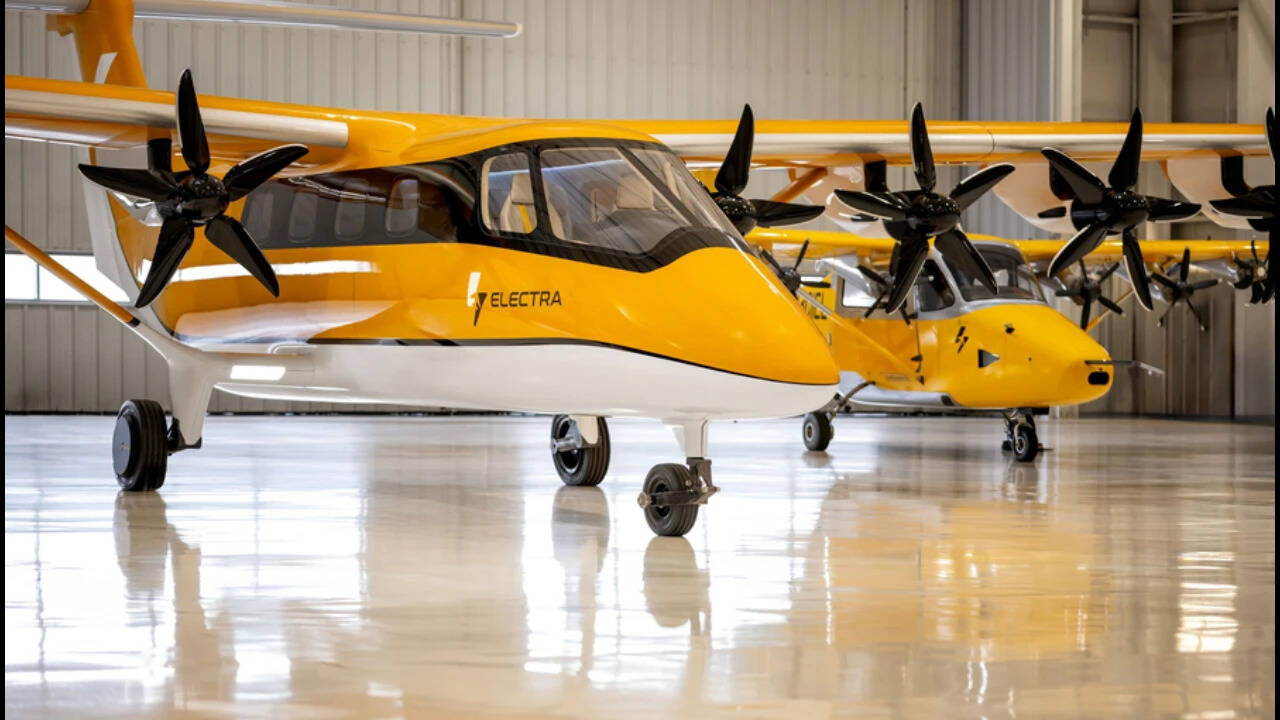
The startup behind the shift, Electra, wants to change how regional air travel works by building an eight-motor hybrid aircraft called the EL9 Ultra Short. Instead of relying on sprawling concrete runways, this nine-passenger plane can take off and land in spaces roughly the length of a soccer field.
If you are tired of driving three hours to a major airport just to catch a short hop, this technology targets your exact frustration. Let us look at how an academic brainstorming session turned into heavy industrial manufacturing.
Breaking Down the Eight-Motor Blown Lift Design
Traditional planes need long strips of asphalt because their engines have to do two conflicting jobs: generate enough raw speed to force air over the wings, and keep the craft moving in mid-air. Electra splits the workload.
The aircraft uses a gas-powered generator located in the nose paired with floor-mounted battery packs. During takeoff and landing, both sources feed power to eight electric motors distributed across the wings.
This setup creates what engineers call a blown-lift effect. Air gets forcefully pushed over the wing surfaces, generating lift at speeds low enough to let the plane clear fences and descend into tight spots like parking lots, barges, or small community strips.
Once the plane hits cruising altitude, the nose generator takes over entirely, cruising quietly at around 200 miles per hour while simultaneously recharging the onboard batteries. The gas engine is sized specifically for efficient cruising rather than heavy takeoff strain. That design choice cuts fuel burn and dramatically reduces cabin noise compared to standard turboprops or helicopters.
From Wind Tunnel Tests to a 96-Acre Factory Floor
The underlying physics were first mapped out in MIT course 16.886, where student teams built subscale models and tested them inside the campus Wright Brothers Wind Tunnel.
Among those students was Chris Courtin, whose doctoral research helped refine the propulsion dynamics. Aerospace veteran John Langford jumped in later to help formalize the company, bringing in MIT professors Mark Drela and John Hansman as founding technical advisers.
After testing a two-seater prototype called the EL2 through more than 200 flights, the team decided it was time to scale up.
That choice led to a massive financial announcement at the Farnborough International Airshow. Electra committed 850 million dollars to construct a 96-acre production facility at AirPark Ohio, right next to the Springfield-Beckley Municipal Airport.
Construction is slated to begin next year, with designs already underway. Once fully operational, the plant expects to churn out up to 400 aircraft per year in its initial phase, scaling up to 800 units annually while creating nearly 2,000 jobs in the region.
The Real World Hurdles Ahead
Building a factory is expensive, but getting commercial clearance from federal regulators is where most aviation startups hit a wall.
Electra submitted its type certification path to the Federal Aviation Administration under Part 23 rules for smaller aircraft. The agency closed out the initial G-1 issue paper, meaning the certification basis is established. Next come rigorous ground tests, structural inspections, and flight tests for the production-intent EL9.
The company aims for its first flight of the full-scale model around late 2027 or early 2028, targeting entry into commercial service by 2030.
Critics point out that hybrid systems still burn fossil fuels, meaning true environmental gains depend entirely on whether these planes replace carbon-heavy car trips or simply generate entirely new luxury travel demand. Even so, the economic momentum in Ohio signals that regional air mobility is moving past computer renderings and into heavy steel and composite assembly.
Keep an eye on Springfield over the next twenty-four months. If these eight-motor planes clear certification, your next regional flight might skip the major airline hub completely and leave from a field near your hometown.