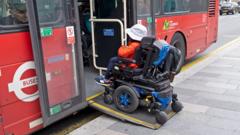
The clock does not care about your dreams. At two in the morning, the city of Leeds is a museum of cold brick and yellow sodium light, save for the rare, shuddering diesel engine of a night service cutting through the dark. Most people experience these hours from beneath a duvet. But for Arthur, who lives with cerebral palsy and uses a motorized wheelchair, two in the morning is often when the arithmetic of survival breaks down.
Consider what happens next: a shift finishes early, a social gathering runs late, or a medical emergency demands a cross-town journey. For decades, the unwritten rule of public transit was simple. Movement had a curfew. Concessionary bus passes across England came with strict operational windows. They governed when you could move, where you could stretch your day, and how late you were allowed to participate in the living pulse of society.
Freedom, it turns out, is deeply territorial. And much of it has historically been locked behind a timetable.
We talk about mobility as if it were a matter of ramps and hydraulic lifts. Those are merely the hardware. The software is time. A bus with a lowered floor is useless if the pass in your pocket stops working at eleven o'clock at night. It turns a mechanical accommodation into a conditional privilege. You can board, yes. But only while the sun is up, or while the shops are open, or while the bureaucracy deems your trip necessary.
Change is coming. Not as a whisper, but as a total rewrite of the contract between public transit and disabled citizens in England.
The policy shift introducing 24-hour free bus travel for disabled people changes the geometry of everyday life. It is easy to look at this strictly through the lens of municipal budgets or transport logistics. That is a mistake. This is about the restoration of spontaneous existence.
Think about what you did last Tuesday night. Did you stay out past midnight talking with an old friend? Did you run out for milk at midnight because the cupboards were bare? Did you catch a late-night train home and need a connecting bus that didn't treat your concession like a pumpkin turning back into a carriage?
Arthur knows those restrictions intimately. He describes the mental weight of clock-watching as a constant tax on his attention. Every conversation at a dinner party carries a low-grade static interference: the mental math of the last permitted bus. If you miss it, your options narrow to catastrophic expense or stranded isolation. Accessible taxis are notoriously scarce, notoriously expensive, and notoriously prone to cancellations for wheelchair users.
When transport is restricted by time, your world shrinks to fit the bus schedule.
The new framework dismantles that invisible cage. By extending the English National Concessionary Travel Scheme to cover round-the-clock journeys for eligible disabled pass holders, the government is acknowledging a fundamental truth. Life does not pause at dusk. Emergencies do not check a watch. Joy does not expire at the stroke of midnight.
To understand why this matters so deeply, we have to look past the spreadsheets and examine the geography of exclusion.
Urban planners often talk about accessibility as a static problem. They map out routes, count the number of low-floor vehicles, and pat themselves on the back when a fleet hits a certain percentage of compliance. But compliance is a paper metric. It tells you nothing about dignity.
Imagine living in a town where the buses run all night, carrying shift workers, students, and revelers home from the edges of the center. Now imagine watching those lights roll past your window, knowing your pass is an off-switch for your independence. That is the psychological friction of partial access. It creates a two-tiered society of movement. There are those who belong to the city at all hours, and there are those who must retreat indoors before the streetlamps fully take over.
This policy correction bridges that chasm. It recognizes that a public transit system funded by the public must serve the public in its entirety, without an asterisk attached to midnight.
There will be logistical friction. Bus operators will grumble about scheduling, farebox recovery, and nighttime security. Municipalities will juggle administrative overhead. These are real challenges, but they are engineering problems, not moral ones. We did not hesitate to install ramps because they took up floor space. We did not hesitate to add audio announcements because they required wiring. We did it because exclusion is unacceptable. Time-based exclusion is no different.
Listen to the sound of the city at three in the morning. It is quiet, but it is not empty.
In a quiet corner of Greater Manchester, a young woman named Maya is finishing a late shift at a digital archive. She uses a manual chair and relies entirely on the local bus network. In the past, her shifts were dictated by the cruel arithmetic of the evening concession cutoff. She had to turn down projects, decline late collaborations, and rush out the door while her colleagues lingered over final thoughts.
Next week, her life opens up. She can stay. She can finish the project. She can miss the early rush and catch the midnight bus without checking her watch every four minutes.
That is what structural change feels like on the ground. It is not an abstract legislative victory. It is the quiet click of a wheelchair securement dock locking into place on a bus rolling through the dark, carrying someone who finally has the same right to the night as everyone else.