Darkness smells like old cardboard, crushed tomatoes, and the sharp, coppery tang of wet aluminum. It is a thick, choking dark that presses against the eyelids and refuses to let go. There is no up. There is no down. There is only the low, vibrating roar of a Detroit diesel engine idling just feet away, and the terrifying, mathematical certainty that every few seconds, the world is about to squeeze together.
He didn't mean to be there.
Nobody climbs into a commercial waste collection vehicle voluntarily. Nobody wakes up thinking, Today, I will become a statistic of municipal transit and mechanical compression. Yet, life has a way of unraveling in the most mundane ways. A discarded mattress in an alley. A cardboard box large enough to sleep in when the autumn wind turns icy. Exhaustion. Pure, unadulterated exhaustion.
Consider what happens on an average Tuesday morning at 5:00 AM. The city is asleep, wrapped in a blanket of grey fog and streetlamp light. Sanitation workers roll down quiet residential corridors, executing a choreography perfected over decades. Grab, lift, dump, crush. It is a rhythm so familiar that residents barely stir when the hydraulic jaws of the truck roar to life. The metal hopper at the back acts as an insatiable mouth, swallowing glass, paper, and whatever else the night leaves behind.
On this particular morning, the mouth swallowed a man.
Noise is the primary language of the streets, and it is a language that dulls our senses. When the metal sides of the truck groaned under the weight of a fresh bin, the driver heard only the standard metallic symphony. But inside the dark, churning belly of the hopper, a human voice was screaming against tons of pressurized steel.
Panic has a distinct physical weight. It sits on the chest like a lead anvil. When the dual-sweep mechanism began its inward cycle—the heavy metal paddles designed to sweep refuse away from the loading sill and into the compaction chamber—time fractured. In the cramped, stinking interior, survival came down to inches. A fraction of a second too slow, and the hydraulic pressure would have done what it was engineered to do to solid iron and heavy timber.
Instead, a miracle happened in the form of a pair of keen ears and a pause in the route.
The driver, noticing an irregularity in the machine’s electrical draw and hearing a muffled shriek over the whine of the hydraulics, hit the emergency stop. In sanitation yards across the country, safety protocols are drilled into workers until they are second nature. E-stop buttons are painted bright, violent red. They are the difference between a shift ending at the diner or ending in an ambulance.
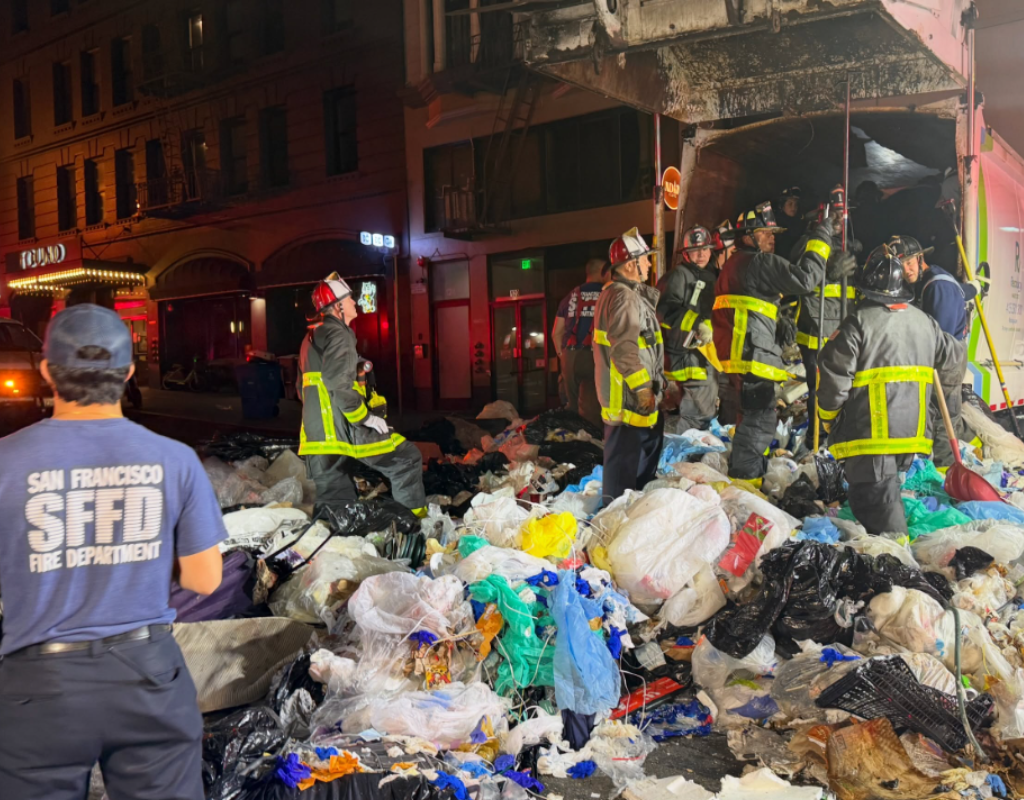
Emergency responders arrived to find a scene straight out of an industrial nightmare. Cutting through the steel housing of a modern waste vehicle requires specialized hydraulic rescue tools—the same jaws of life used to peel open crushed sedans after highway collisions. Firefighters worked with agonizing precision, acutely aware that shifting the wrong component could trigger a secondary collapse within the hopper.
When they finally pulled him out, he was covered in soot, damp with grease, and gasping for the sharp, cold autumn air. He was alive. Bruised, battered, terrified, but fundamentally, impossibly, alive.
We rarely think about the invisible infrastructure that hums beneath the surface of modern civilization. We roll our bins to the curb on Sunday nights. We expect them to be empty by Monday afternoon. We never look inside the hopper. We never think about the human stories colliding with the gears of commerce and municipal upkeep.
The truck drove away later that morning, its route finished, the blood and sweat washed from its floorboards with a high-pressure hose. But the memory of those steel walls closing in remains, a stark reminder of how fragile our routines are, and how close the edge always is, hidden just beneath the trash we throw away.