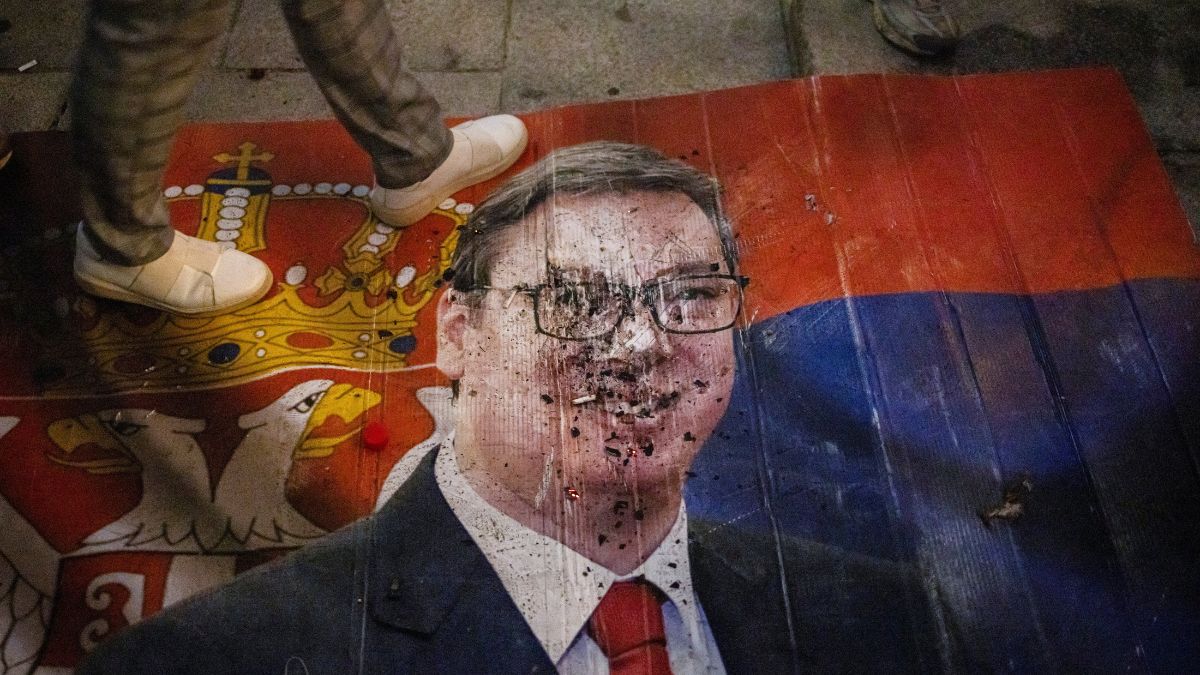
The premise of the competitor's headline—that Serbia's student movement has definitively ended Aleksandar Vučić's rule—gets ahead of the facts, though it captures the seismic shock of the largest sustained protest wave in modern Serbian history. Following the November 1, 2024 collapse of a concrete canopy at the Novi Sad railway station that killed 15 people, university students across Serbia organized decentralized blockades, cross-country marches, and mass demonstrations that forced the resignation of Prime Minister Miloš Vučević in January 2025 and fractured the ruling Serbian Progressive Party's aura of invincibility. While President Vučić remains in office and continues to command state institutions, the student-led revolt broke his decade-long monopoly over public discourse, exposed systemic corruption in state infrastructure projects, and permanently altered the political calculus in Belgrade.
To understand how a generation written off as politically apathetic managed to destabilize one of Europe's most entrenched competitive authoritarian systems, you have to look beyond the street crowds. For years, opposition parties in Serbia followed a predictable script. They formed fragile coalitions, campaigned on broad pro-European or anti-corruption platforms, and inevitably splintered under the weight of state-controlled media smears and internal rivalries.
The students threw out that playbook entirely.
How Decentralized Plenums Neutralized State Tactics
Traditional political movements in the Balkans rely on charismatic leaders. That is a fatal flaw when facing an administration that controls the major national television networks, the tabloid press, and the state security apparatus. Whenever a prominent opposition figure emerged over the past twelve years, pro-government tabloids launched coordinated character assassination campaigns within hours, branding them foreign mercenaries, corrupt tycoons, or traitors.
The student movement made itself immune to decapitation by refusing to appoint leaders.
Instead of a central committee or a recognizable spokesperson, students across more than 60 university faculties in Belgrade, Novi Sad, Niš, and Kragujevac adopted direct democracy through faculty plenums. Every major decision—from blocking a major highway intersection to organizing a 140-kilometer march—was debated and voted on openly by assemblies of students, with rotating moderators and strict rules against partisan affiliation.
When state officials demanded to know who they could negotiate with, there was nobody to summon to the presidency. When pro-government media tried to dig up dirt on individual protesters, the movement simply rotated its public faces. According to political analysts at the Belgrade Centre for Security Policy and regional observers tracking the demonstrations, this horizontal structure paralyzed the government's standard crisis-management machinery. You cannot buy off, intimidate, or smear a rotating assembly of tens of thousands of students who explicitly reject political party banners.
The Architecture of the Novi Sad Catalyst
The anger did not materialize out of thin air, nor was it driven by abstract ideological debates about European Union accession or geopolitical alignment between Brussels and Moscow. It was rooted in concrete, steel, and public safety.
The Novi Sad railway station had undergone a high-profile renovation led by a Chinese consortium and local subcontractors, inaugurated with fanfare by government officials twice before the canopy collapsed on November 1, 2024. For ordinary citizens, the tragedy became an undeniable physical manifestation of what critics had long called state capture—a system where public tenders are awarded without transparency, regulatory oversight is gutted to speed up photo-op deadlines, and political loyalty outweighs engineering competence.
The students distilled this complex systemic failure into four concrete, non-negotiable demands:
- Full publication of all documentation related to the Novi Sad railway station reconstruction, including financial contracts and subcontractor agreements.
- Dismissal of charges against students and citizens arrested during the initial protests demanding accountability.
- Criminal prosecution of individuals identified on video attacking peaceful student demonstrators and university professors.
- A 20 percent increase in the state budget allocated to higher education.
By keeping their demands strictly focused on institutional accountability and the rule of law rather than calling directly for Vučić's resignation at the outset, the students boxed the government into a corner. Acceding to the demands meant exposing the inner workings of state-backed infrastructure deals and prosecuting party loyalists. Refusing them meant confirming the protesters' core accusation: that the state was actively shielding those responsible for a deadly public disaster.
Breaking the Media Quarantine on Foot
One of the most overlooked factors in the longevity of Vučić's rule has been the information divide between Belgrade and the Serbian interior. While independent cable channels like N1 and Nova S reach urban households, a large portion of the electorate outside major cities relies on national terrestrial broadcasters—RTS, Pink, Happy—which routinely frame protests as violent, foreign-backed attempts at a color revolution.
The students bypassed the television screen entirely by physically walking into the provinces.
In early 2025, columns of students embarked on multi-day marches from Belgrade to Novi Sad, and later to Kragujevac and Niš, covering dozens of kilometers in winter weather. Along the route, they passed through small towns and farming villages that rarely saw anti-government demonstrations.
The visual impact was immediate and impossible for state media to spin. Local residents who had been told by evening news broadcasts that the protesters were hooligans watched exhausted twenty-year-olds limp into their town squares carrying Serbian flags and calling for basic justice. Farmers showed up with tractors to escort the columns. Small-town bakers stayed up all night making bread and pastries for the marchers. Elderly residents wept on the sidewalks, offering blankets and hot tea.
This direct human contact shattered the information monopoly that had sustained the ruling party's electoral majorities in rural districts. Even the public broadcaster, Radio Television of Serbia (RTS), faced internal rebellion from its own journalists and technicians, who demanded objective coverage of the marches after massive crowds surrounded the RTS headquarters in Belgrade.
Where the Competing Narratives Clash
To understand the true balance of power in Serbia, it is necessary to look at how both sides—and independent observers—interpret the crisis. The situation is far more nuanced than a simple triumph of democracy over autocracy.
| Dimension | The Student & Opposition View | The Government & SNS View | Independent Analyst Assessment |
|---|---|---|---|
| Root Cause | Systemic corruption, lack of institutional accountability, and state capture exposed by the Novi Sad tragedy. | A coordinated "color revolution" funded by Western intelligence and domestic tycoons to destabilize Serbia. | A genuine grassroots eruption triggered by governance failures, later amplified by broad societal frustration. |
| Political Nature | A civic, non-partisan struggle for the rule of law and functional state institutions. | An unconstitutional attempt to seize power without winning an election. | Explicitly anti-party in structure, though inherently political in its challenge to executive dominance. |
| Impact on Power | Exposed the fragility of the regime, forced the PM's resignation, and broke the culture of fear. | The state remains stable, economic growth continues, and the ruling coalition retains a parliamentary majority. | Severely damaged the government's legitimacy and deterrence, though institutional control remains intact. |
| Endgame | Full compliance with demands, transitional governance mechanisms, and genuinely free elections. | Dialogue within existing institutions, cabinet reshuffles, and elections only on the government's terms. | A prolonged war of attrition where neither side can easily deliver a knockout blow. |
President Vučić and officials from his Serbian Progressive Party (SNS) consistently argued that the government met the students' demands by releasing thousands of pages of construction documents, pardoning arrested protesters, and accepting the resignation of Prime Minister Miloš Vučević and Novi Sad Mayor Milan Đurić. From the administration's perspective, the continuation of blockades after these concessions proved that the movement was never really about the Novi Sad canopy, but rather a geopolitical plot aimed at weakening Serbia's independent foreign policy and stalling its economic development.
Critics, engineering experts, and the students themselves countered that the released documentation was incomplete, missing critical financial subcontracts that would reveal where public money actually went. Furthermore, independent legal monitors pointed out that the government's pattern of alternating between offers of dialogue and aggressive rhetoric—including incidents where vehicles drove into student blockades—undermined any trust in official promises.
The Structural Limits of Leaderless Revolt
Here is the hard truth that breathless headlines often miss: horizontal movements are brilliant at disrupting an entrenched regime, but notoriously weak at replacing it.
History offers sobering reminders. From the 2011 plaza occupations in Spain and Greece to the 2019 protest waves in Hong Kong and Lebanon, leaderless movements generate immense moral authority and massive street power. Yet when the moment arrives to translate that energy into governing institutions, legislative majorities, or electoral machinery, the absence of formal leadership becomes a liability.
Serbia's student movement faces this exact structural dilemma.
By maintaining strict distance from opposition political parties—a decision that protected their credibility and broadened their appeal—the students left a vacuum on the institutional side of the ledger. Someone eventually has to stand on a ballot, oversee polling stations across thousands of rural precincts, negotiate coalition agreements, and manage state ministries.
The ruling Serbian Progressive Party, despite suffering its worst legitimacy crisis since taking power in 2012, still commands a formidable organizational machine. With hundreds of thousands of party members, deep roots in public-sector employment, and firm control over state resources, the SNS does not simply evaporate because tens of thousands of people march in Belgrade. When Vučić rallies counter-protesters or shifts his political messaging—such as launching a broader "Movement for the People and the State" to rebrand his coalition—he is playing a long game designed to wait out street exhaustion.
The Geopolitical Silence From Abroad
Another factor complicating the narrative of an imminent regime collapse is the lukewarm response from international power centers.
Unlike the Otpor movement that helped topple Slobodan Milošević in 2000 with substantial Western diplomatic, financial, and logistical backing, Serbia's current student uprising is operating largely on its own. Both the European Union and the United States have maintained a cautious, transactional relationship with Belgrade. Brussels views Vučić as a key interlocutor on regional stability in the Western Balkans, Kosovo negotiations, and critical raw materials—most notably the contentious Jadar lithium mining project.
Meanwhile, Moscow and Beijing have openly backed the Serbian government, echoing narratives that portray the protests as Western-orchestrated destabilization. Caught between Western realpolitik and Eastern authoritarian solidarity, the students cannot rely on external diplomatic pressure to force concessions from Belgrade. Whatever political transformation occurs in Serbia has to be generated entirely from within.
What Actually Changed in Serbian Politics
Even though the competitor's claim that Vučić's rule has already ended overstates the immediate reality, the political landscape in Serbia has crossed a threshold from which there is no return to the status quo of 2014–2023.
First, the barrier of fear has collapsed. For over a decade, public-sector workers, teachers, judges, and local administrators understood the unspoken rule of Serbian politics: keep your head down, attend the occasional ruling-party rally, and protect your livelihood. During the winter and spring of 2025, high school teachers went on strike in solidarity with university students despite threats to their salaries. Bar associations walked out. Actors, athletes, and engineers publicly broke ranks. Once a society loses its fear of administrative retaliation, an authoritarian-leaning government can no longer rule through quiet compliance; it is forced into constant, exhausting crisis management.
Second, civic solidarity has been rebuilt across generational and regional lines. The marches through rural Serbia bridged a cultural divide that had paralyzed democratic politics for twenty years. Older generations who had grown cynical after the disappointments following the October 5, 2000 revolution saw a disciplined, principled movement that refused to be co-opted.
Third, the legitimacy of opaque governance is broken. Every major state infrastructure contract, foreign investment deal, and regulatory shortcut in Serbia will now face intense public scrutiny. The era when massive projects could be pushed through without environmental assessments or transparent accounting—relying solely on presidential authority—has hit a wall of public resistance.
Whether this civic awakening ultimately translates into a decisive electoral defeat for Aleksandar Vučić and the Serbian Progressive Party depends on what happens when the blockades end and the ballot boxes open. Street protests can strip a government of its moral authority and force prime ministers to resign, as Serbia's students proved beyond doubt, but only an organized political alternative capable of protecting every vote across every municipality can finish the job inside the institutions.