The mid-afternoon sun hit the courtyard of the Cité Internationale Universitaire de Paris with an unforgiving clarity. In fashion, light this bright is usually an enemy. It exposes the puckered seam, the rushed hem, the synthetic shortcut. But under this specific July sky, the light felt intentional. It was a spotlight on an intervention.
For a decade, the name Balenciaga evoked a specific visceral reaction. Cold ironies. Post-apocalyptic mud pits. Oversized hoodies that cost a month’s rent, designed to mock the very idea of luxury while aggressively cashing the check. It was brilliant theater, but it was freezing cold. The human being inside the clothes often felt like an afterthought, a prop in a cynical joke about late-stage capitalism.
Then a quiet Italian man with salt-and-pepper hair took a bow, and everything changed.
Pierpaolo Piccioli’s debut couture collection for the house was not a mere shift in style. It was a rescue mission for the soul of a brand.
Consider the ghost that haunts these ateliers. Cristóbal Balenciaga was a fundamentalist of form. He was an austere, deeply religious Spaniard who carved cocoons and envelopes out of stiff gazar fabric, treating the female body like an architectural site. For decades, the industry assumed that to honor Cristóbal was to honor rigidity. To look at his archival gowns was to see a beautiful, untouchable fortress.
Piccioli looked at those same archives and saw something else: freedom.
The tension in the air before the first model stepped onto the dramatic stone staircase was palpable. Fashion insiders had spent a year speculating since Piccioli left Valentino, wondering if his trademark emotional romanticism could survive inside a house built on such severe geometry. Could a man who famously declared that "couture is human" find a home in a brand that had become synonymous with digital alienation?
The answer arrived not with a roar, but with a breeze.
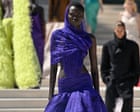
Anohni’s melancholic cover of "Perfect Day" began to play. The music carried a weighted nostalgia, setting a tone that was unapologetically earnest. Then came the clothes. A plum fringe skirt danced against a sheer lavender blouse. A lemon-yellow sequined gown caught the Parisian sun and practically glowed, radiating a warmth that had been absent from this label for a generation.
Color was the first weapon of choice. For years, Balenciaga had been draped in an obsidian uniform—black leather, black denim, black sunglasses shielding the eyes from an unfriendly world. Piccioli shattered that monotony with a single palette. Saturated, unapologetic pinks. Chartreuse. Deep, velvety plums. These were not intellectual colors meant to be decoded by art critics; they were emotional hues meant to evoke joy.
But the real transformation lay in the architecture of the garments.
To understand what Piccioli achieved, imagine a hypothetical architect tasked with remodeling a brutalist concrete monument. A lesser designer would simply tear down the walls or paint over them with cheap trends. Piccioli kept the monument's lines but changed the material from concrete to silk. He took Cristóbal’s famous, severe egg-shaped silhouettes and translated them through a vocabulary of softness.
An extra-large, sleeve-free garment moved down the runway, its shape distinctly archival, yet it was constructed entirely from light, airy materials that shifted with the model’s stride. A technical trench coat, typically rigid and protective, was buttoned just enough to reveal the delicate hem of a feather-trimmed evening dress beneath it. A crisp white button-down shirt slipped effortlessly off the shoulder, paired with opera gloves and a floor-length skirt spliced with fringe.
Movement. That was the missing ingredient.
Historically, Cristóbal’s clients had to learn how to move for the dress. Piccioli made the dress move for the woman. This philosophy reached its peak when Gigi Hadid made a surprise return to the couture runway after a four-year absence. Walking down the stone steps, she wore tailored trousers and a black chou top crowned with a sculptural, rose-like collar. It was sharp, yes. It was architectural, absolutely. But it framed her neck and shoulders with a tenderness that felt deeply respectful of the person wearing it.
The climax of the afternoon came with the closing look, worn by the model Yai. It was a striking trapeze wedding gown, a direct nod to the radical geometry that made the house famous in the mid-twentieth century. In the past, such a gown might have looked like a shield, protecting the bride from the world. Under Piccioli’s direction, the architectural lines became a sail, catching the wind of the courtyard, lifting the fabric as if it were weightless.
It was a visual thesis statement.
True luxury does not need to provoke to be relevant. It does not need to hide behind irony or rely on the shock value of a viral marketing gimmick. Sometimes, the most radical thing a fashion house can do is believe in romance.
By the time the final notes of the music faded, the audience was left with an image that will likely define this era of the historic house: a sea of living color moving gracefully through the open air, unburdened by the weight of the past, finally allowed to breathe.