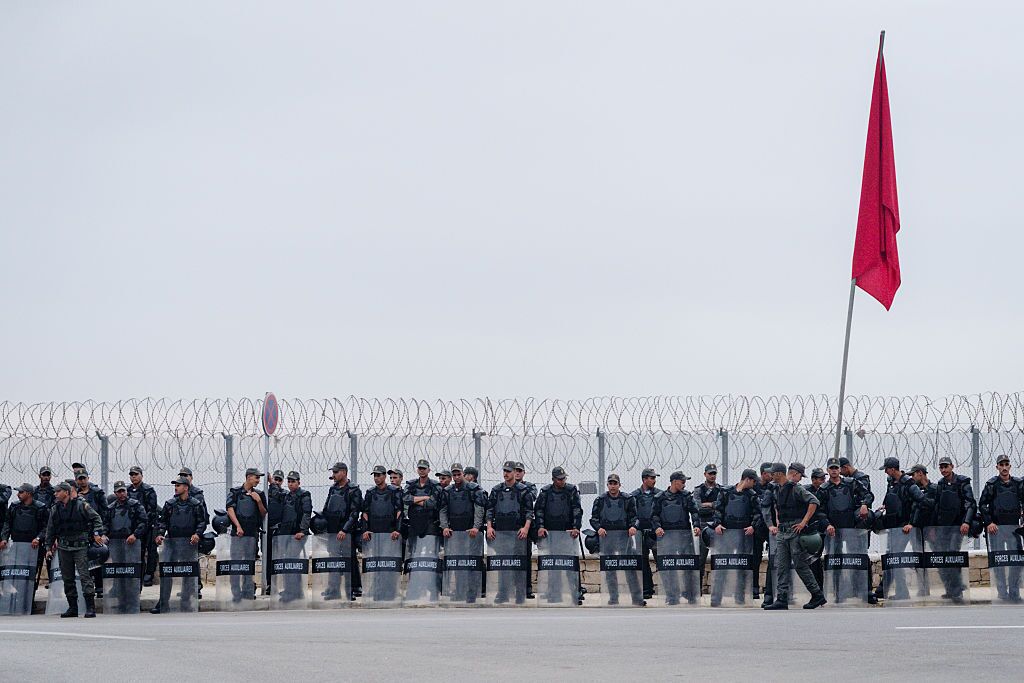
The physical breach of the Spanish autonomous enclave of Ceuta by approximately 80,000 individuals across a compressed forty-eight-hour window in late July represents a total failure of traditional border deterrence models. Observers framing this event through the lens of spontaneous migration misread the underlying mechanics. This crisis was not a randomized humanitarian surge; it was an acute operational stress test caused by the collision of state diplomatic friction, legal ambiguities, and weaponized digital distribution channels. Analyzing the trajectory of this border collapse requires isolating the variables that transformed a localized geographic bottleneck into an international crisis.
The Structural Drivers of Incursion
To understand the mechanics of the Ceuta breach, one must map the macro-economic and diplomatic baseline preceding July 30. Three distinct structural forces converged to create the pressure gradient that emptied neighboring Moroccan municipalities toward the maritime breakwaters of Tarajal and Benzú. For a closer look into similar topics, we recommend: this related article.
First, chronic youth unemployment within North Africa generated a stagnant demographic reservoir of individuals with near-zero domestic economic mobility. When domestic subsistence mechanisms stall, the threshold cost of risking an illegal border crossing drops relative to the expected value of reaching European labor markets.
Second, bilateral diplomatic friction between Madrid and Rabat historically acts as a regulatory thermostat for border enforcement. The recent rapprochement between Spain and Algeria, paired with shifting stances on regional sovereignty disputes, directly altered the calculus of Moroccan state containment. Border enforcement is an active administrative choice; when state-level security apparatuses selectively loosen perimeter vigilance, the operational friction of crossing drops to zero. For broader context on this topic, extensive reporting is available at Al Jazeera.
Third, digital misinformation functioned as an accelerant. Human trafficking syndicates and opportunistic actors utilized social media platforms to market a distorted interpretation of recent Spanish judicial rulings. Specifically, a Supreme Court decision regarding summary returns along land borders was misrepresented as a blanket maritime immunity policy—the false promise that entering the enclave via sea guarantees legal processing rather than immediate expulsion.
The Operational Failure Points
The immediate collapse of local infrastructure inside Ceuta illustrates how legacy administrative frameworks break under exponential volume spikes. Ceuta possesses a baseline population of roughly 84,000 residents compressed into an area of eighteen square kilometers. Ingesting 80,000 unauthorized entrants within a forty-eight-hour period instantly created a localized resource insolvency.
[Diplomatic Friction / Policy Shift]
       │
       ▼
[Digital Distortion & Syndicated Rumor]
       │
       ▼
[Volume Spike: 80,000 Entrants]
       │
       ▼
[Infrastructure Insolvency (Ceuta: 18 sq km)]
       │
       ▼
[Rapid Retraction & Voluntary Return (70,000+ within 48h)]
The system failed at three distinct operational levels:
- Intake Velocity: Reception centers, particularly those designated for unaccompanied minors, operated at multiples exceeding two thousand percent of standard capacity. Intake processing pipelines—biometric registration, identity verification, and medical triage—require time constants that cannot match continuous mass arrivals.
- Logistical Saturated State: Basic municipal services including potable water distribution, waste sanitation, and emergency medical response experienced complete exhaustion. The maritime safety agencies and civil guard units were forced into a reactive triage posture, prioritizing water rescues from breakwaters over containment.
- The Schengen Isolation Fallacy: Public and political commentary across Europe frequently mischaracterized the breach as an open door into the Schengen area. Operationally, Ceuta is structurally isolated. Secondary border controls at maritime ports and heliports enforce strict passport and identity checks for anyone attempting transit to the European mainland. The incursion offered no structural pathway to continental Europe; it deposited thousands into a secure, resource-constrained cul-de-sac.
Geopolitical Fallout and Institutional Fractures
The systemic shockwaves extended well beyond the municipal boundaries of the enclave, exposing deep policy fractures within the European Union and bilateral alliances.
When the Spanish government managed the crisis through a combination of security reinforcements and rapid administrative processing, the response triggered friction among member states. Italy, Denmark, and other member states pointed to prior regularization policies in Madrid as an underlying magnet for irregular arrivals, demonstrating a persistent lack of cohesive bloc solidarity during asymmetric border pressures.
Simultaneously, the utility of the European Union Migration Pact's crisis and force majeure mechanisms was sidelined. Member states hesitate to trigger formal instrumentalization regulations when doing so requires navigating complex diplomatic sensitivities with third-party transit nations whose ongoing cooperation remains vital for long-term border management. This hesitation exposes a core policy paradox: formal legal instruments designed to punish or manage state-sponsored migration flows are frequently too politically toxic to deploy in practice.
The rapid self-correction of the crisis—where over 70,000 individuals voluntarily returned to Morocco within days once the reality of the legal dead-end and humanitarian deprivation set in—proves that containment architecture relies as much on psychological deterrence and information integrity as it does on physical fences. When digital distortion is allowed to outpace state communication, physical borders face unsustainable surges.
Strategic Execution Playbook
Future prevention of structural border collapses requires shifting from reactive containment to integrated information and diplomatic operations:
- Deploy Counter-Narrative Digital Operations: Border control authorities must treat social media platforms as operational theaters. When trafficking networks or bad actors inject viral falsehoods regarding legal amnesties, state actors must deploy rapid-response digital communications to instantly neutralize the specific legal myths driving volume spikes.
- Enforce Strict Inter-State Transparency Metrics: Bilateral border security pacts must include clear, verifiable operational thresholds. Because perimeter enforcement is often leveraged as a diplomatic pressure valve, formal agreements need automated accountability mechanisms that decouple routine humanitarian management from political disputes.
- Harden Municipal Surge Protocols: Enclaves with unique geographic constraints, such as Ceuta and Melilla, require pre-engineered emergency logistics pipelines capable of scaling temporary housing, food security, and biometric processing units within twelve hours of an anomaly detection, preventing local administrative paralysis.