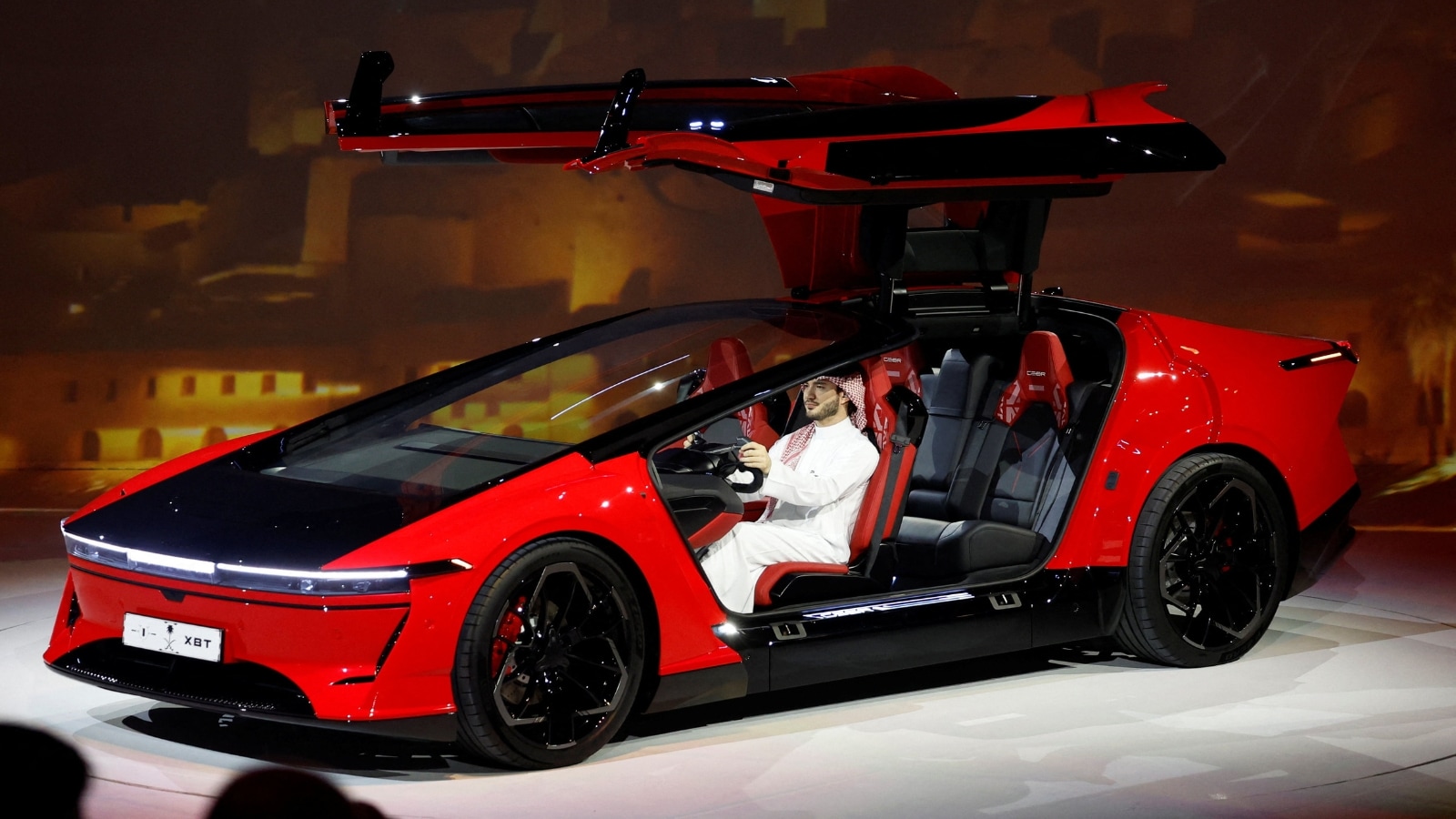
Every automotive headline written about Saudi Arabia follows a predictable, exhausted script. A sovereign wealth fund drops billions. A shiny prototype rolls onto a stage under theatrical blue lighting. Pliable journalists parrot press releases about gullwing doors, 670-kilometer ranges, and a bold new dawn for regional mobility. Then everyone pretends a localized manufacturing base magically spawns from the desert sand because a glossy sedan model rendered in CAD looks convincing enough for a stock exchange announcement.
Let us stop playing along with the corporate theater.
Ceer, the joint venture between Saudi Arabia Public Investment Fund and Foxconn, wants the world to believe that dropping cash on modular EV platforms creates an indigenous automotive powerhouse. They revealed their Exobot sedan and an SUV boasting those mandatory, impractical doors meant to distract you from structural realities. The lazy consensus says this is a masterclass in economic diversification. The oil state is buying its way into the future.
I have watched state-backed industrial vanity projects burn through nine figures of capital while missing the single variable you cannot import on a cargo ship: an actual ecosystem.
Building a car is not about assembling stamped aluminum, bolting down a Foxconn-sourced battery pack, and sticking a domestic badge on the grille. If capital were the only requirement, Apple would have shipped an electric car a half-decade ago instead of quietly killing Project Titan after burning ten billion dollars. If capital solved supply chain sovereignty, every petro-state would dominate high-tech manufacturing.
Capital is a commodity. Competence, tribal engineering knowledge, supplier density, and localized supply chains are not.
The Assembly Line Fallacy And The Foxconn Illusion
Look closer at the Ceer partnership. Foxconn is doing what Foxconn does best: providing contract manufacturing infrastructure, supply chain orchestration, and modular EV architectures (MIH). On paper, this looks smart. Why reinvent the skateboard chassis when you can buy a white-label blueprint?
Because white-label manufacturing does not build an industry. It builds an assembly plant.
There is a Grand Canyon-sized chasm between putting a kit together in a climate-controlled shed outside Jeddah and engineering a vehicle that survives real-world thermal stress, regulatory homologation, and consumer abuse on a global scale. Foxconn is a consumer electronics titan whose masterstroke is moving fast and iterating on plastic casing for iPhones. Automobiles operate in environments ranging from negative forty degrees to fifty degrees Celsius under continuous dynamic load, carrying human beings at highway speeds.
When you outsource the brain of the vehicle to a Taiwanese electronics manufacturer while relying on imported tier-one suppliers for motors, software stacks, and battery cells, what exactly do you own? You own the real estate. You own the marketing budget. You own the depreciation.
Imagine a scenario where global semiconductor supply chains tighten further or geopolitical friction forces Foxconn to prioritize domestic Taiwanese fabrication lines. Where does that leave a nascent Saudi brand whose entire technical pedigree lives in a contract manufacturer's server rack? It leaves them stranded with a half-built factory and a fleet of prototypes that cannot be homologated for export markets.
The 670 Kilometer Myth And Range Anxiety In A Vacuum
Every press release accompanying the Exobot rollout highlights the 670-kilometer range. It is the mandatory checkbox metric designed to make legacy automakers nervous.
Stop and ask a basic thermodynamic question. How much of that range remains when the ambient temperature hits 48 degrees Celsius, the air conditioning compressor is running at maximum load to keep cabin occupants from melting, and the vehicle is cruising at 140 kilometers per hour down a desert highway?
Battery chemistry hates extreme heat. Thermal management systems consume massive amounts of parasitic energy just to keep lithium-ion cells from degrading into thermal runaway. In moderate European or North American test cycles, a large battery pack might hit that magic 670-kilometer mark. In the actual operational theater where these vehicles are ostensibly supposed to thrive, expect that number to plummet by thirty to forty percent unless you are hauling an unfeasible amount of dead weight in chemical storage.
Range anxiety in the Gulf region is not about finding a charging stall in a parking garage. It is about spatial isolation and extreme thermal degradation. If your battery management software cannot handle continuous high-discharge cycles in scorching ambient heat, your shiny gullwing SUV becomes a very expensive paperweight fifty kilometers outside Riyadh.
And let us address the design choices. Gullwing doors? On a mass-market electric vehicle meant to establish industrial credibility? It is the automotive equivalent of a middle manager wearing a tuxedo to a casual Friday stand-up meeting. They are heavy, mechanically complex, prone to seal failures in dusty environments, and an absolute nightmare to engineer for side-impact collision safety standards. When your engineering team spends finite resources redesigning roof hinges just to look futuristic for a keynote presentation, your priorities are fundamentally broken. Real automotive innovation happens beneath the skin, in thermal dissipation efficiency, battery pack integration, and vertical software ownership. Door hinges are vanity.
Why Domestic Demand Cannot Sustain A Ghost Brand
The defense of these mega-projects always defaults to a domestic safety net. Saudi Arabia has a young, wealthy, car-obsessed population with high disposable incomes. Surely, the argument goes, domestic buyers will snap these up by the tens of thousands.
That is a dangerous delusion.
Modern car buyers are status-conscious and globally networked. A domestic buyer with fifty thousand dollars to spend on an electric vehicle is comparing your product against Tesla, Lucid, Porsche, and Chinese heavyweights like BYD and NIO who are iterating at breakneck speed with software ecosystems that have matured over a decade. They are not going to buy a domestic product out of charity if the infotainment system lags, the dealer network is thin, and the resale value drops off a cliff the moment it rolls off the lot.
China’s EV boom did not happen because Beijing handed out blank checks to state-owned companies to build random car brands. It happened because China spent twenty years ruthlessly consolidating rare earth supply chains, subsidizing cell chemistry research, fostering cutthroat domestic competition among hundreds of private startups, and forcing foreign automakers into joint ventures that transferred actual know-how to local engineers.
By the time domestic Chinese brands flooded the market with compelling products, their engineering talent pool was battle-tested. They had already buried their mistakes.
Saudi Arabia is trying to skip the graveyard shift. They want to jump straight to the prestige phase without earning the battle scars of failure. I have seen venture capital funds and corporate boards pump millions into hiring consultants from McKinsey and ex-executives from legacy German brands, paying them exorbitant consulting fees to draw organizational charts that look modern on PowerPoint slides. Those consultants cash out and leave before the first production line jams. The organizational chart does not write firmware. The slide deck does not source rare earth magnets.
The Brutal Downside Of The Contrarian Bet
To be fair, let us look at the downside of this aggressive skepticism.
Dismissing state-backed industrial plays entirely ignores the brute force of sovereign capital. When you have trillions of dollars in reserve, you can afford to fail repeatedly until you brute-force your way into competence. Look at aerospace. Ten years ago, the idea of a Gulf nation building a competitive aviation or defense sector from scratch was dismissed as an expensive hobby. Today, regional defense contractors are producing sophisticated hardware because they bought up engineering firms, partnered with global giants on equity terms, and absorbed talent through sheer purchasing power.
Could Ceer pull off the same trick through relentless iteration and multi-billion-dollar backstops?
Mathematically, yes. If you are willing to lose ten billion dollars a year subsidizing your own supply chain, you can eventually force the industry to take your calls. Foxconn will keep building your chassis. Tier-one suppliers will set up local assembly hubs just to capture a slice of the state budget.
But there is a massive difference between an enterprise existing because a government balance sheet keeps it on life support and an enterprise existing because it wins on global unit economics.
If Ceer relies indefinitely on domestic mandates, fleet purchases by state-owned enterprises, and heavy subsidies to stay afloat, it is not a car brand. It is an employment program wrapped in sheet metal. It drains national wealth rather than generating it.
The Uncomfortable Truth About The Future Of Mobility
The real question nobody in the boardroom wants to ask is whether Saudi Arabia needs an indigenous car brand at all.
In a world where software-defined vehicles, autonomous driving stacks, and modular EV platforms are rapidly commoditizing hardware, owning the physical factory is a low-margin trap. The real money in the next decade of mobility will not be made by the company stamping aluminum doors. It will be made by the entities controlling the energy grid, the charging infrastructure ecosystems, the autonomous navigation data layers, and the high-density battery chemistry patents.
Spending billions trying to out-Tesla Tesla or out-BYD BYD in traditional hardware manufacturing is fighting yesterday's war with tomorrow's checkbook.
Stop pretending that a flashy sedan concept with doors that open like a seagull is an economic revolution. It is a marketing exercise designed to satisfy sovereign KPIs and fill trade publication column inches.
If you want a genuine automotive footprint in the region, stop buying turnkey prototypes from contract manufacturers. Start by funding materials science labs in local universities, building localized battery recycling infrastructure, incentivizing software engineering talent from the ground up, and letting private startups fail fast until a real, organic engineering culture takes root.
Until then, the Exobot remains what it has always been: an expensive mirage shimmering on the horizon, built to look fast while standing completely still.