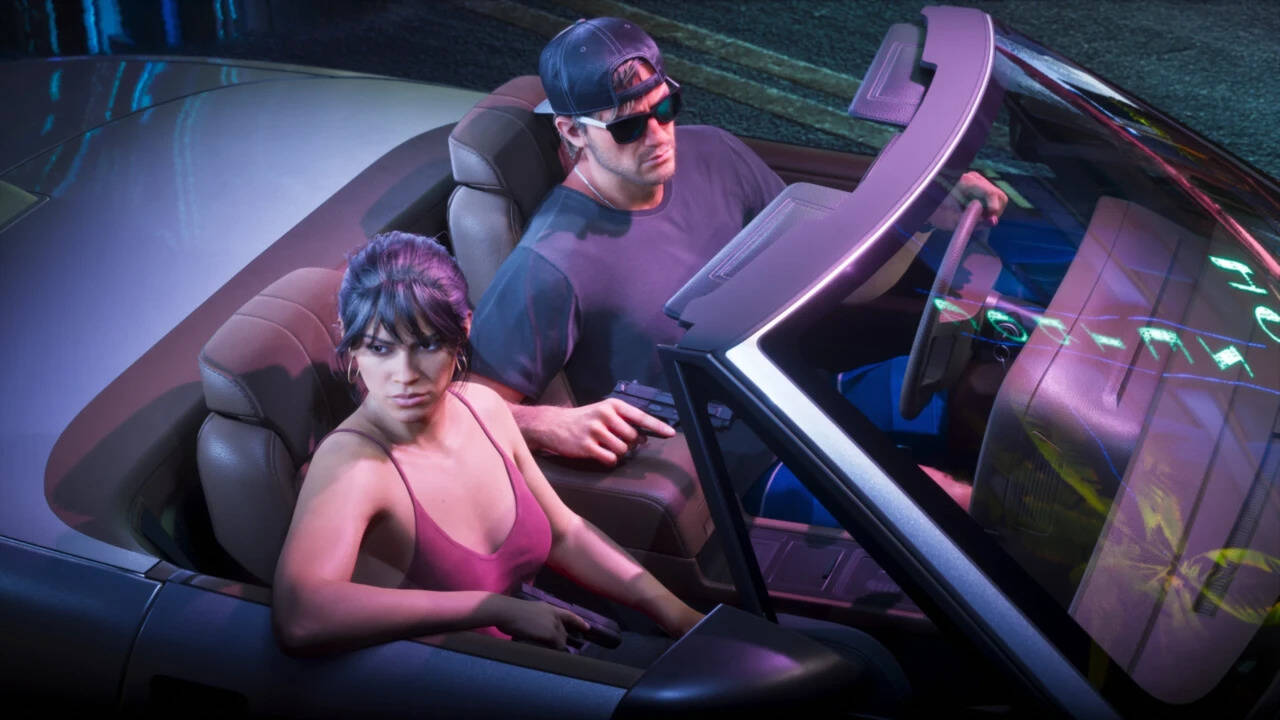
Grand Theft Auto VI is not merely a larger sequel to a decade-old blockbuster. It is a high-stakes architectural gamble by Rockstar Games to solve the most expensive problem in modern software development—making an open world feel genuinely reactive without collapsing under its own computational weight.
Standard coverage of the project leans heavily on predictable adjectives. Bigger. Bolder. More alive. Those words sell pre-orders, yet they obscure the brutal engineering and economic realities dictating every frame of the game. When a studio spends more than a decade and hundreds of millions of dollars on a single entertainment product, scale ceases to be a marketing bullet point and becomes an existential threat.
To understand what Rockstar is actually building in Leonida, you have to look past the neon sunsets of Vice City and examine the underlying mechanics of modern game design, asset streaming, and algorithmic crowd behavior.
The Illusion of Scale Versus Density
For twenty years, the video game industry equated ambition with square mileage. Publishers boasted about maps that took forty minutes to cross by car, ignoring the fact that thirty-five of those minutes were spent staring at empty scrubland or copy-pasted trees.
Rockstar hit the ceiling of that philosophy with Red Dead Redemption 2. The wilderness worked because the American frontier was supposed to be empty. Modern Miami—and the broader fictional state of Leonida—allows no such luxury. An urban satire relies entirely on friction. Traffic, pedestrians, strip malls, construction zones, and erratic human behavior must collide constantly to create the illusion of a living metropolis.
World density is infinitely harder to render than world size.
Consider what happens when a player speeds down a coastal highway at a hundred miles per hour. The console must simultaneously stream high-resolution textures for upcoming buildings, calculate physics for dozens of surrounding vehicles, run pathfinding routines for hundreds of pedestrians, and maintain a stable frame rate. If the storage pipeline stalls for even a few milliseconds, textures turn to mud or cars vanish into thin air.
Rockstar’s proprietary RAGE engine (Rockstar Advanced Game Engine) had to be fundamentally overhauled to handle this throughput. Utilizing the solid-state drives in the PlayStation 5 and Xbox Series X/S eliminates the mechanical hard-drive bottlenecks that forced previous Grand Theft Auto titles to hide loading behind clever camera angles or artificially slow vehicle top speeds. The result is not just a wider map, but an interior world. Industry analysis of the official footage and patent filings points toward a massive increase in enterable buildings, transforming flat architectural facades into functional spaces with verticality and distinct lighting profiles.
How Rockstar Engineered Synthetic Human Behavior
A city full of pretty buildings is just a museum if the people inside it act like wind-up toys.
In Grand Theft Auto V, non-playable characters operated on relatively simple state machines. A pedestrian walked along a spline, reacted to a gunshot by running in the opposite direction, and despawned the moment the player turned the corner. It was convincing enough in 2013, largely because players were distracted by the novelty of switching between three protagonists.
Today, that level of artificial intelligence feels archaic.
Publicly available patent filings attributed to Take-Two Interactive engineers—specifically patents detailing systems for virtual navigation and dynamic object interaction—reveal how Rockstar has attempted to fix this. Rather than relying solely on rigid, pre-scripted animations, the studio has invested heavily in procedural motion matching and memory-driven AI routines.
Here is how that works in practice. In older games, a character reaching for a cup on a table required a specific animation tailored to the exact height of that table and the exact position of the character. If the character stood two inches too far to the left, their hand clipped through the wood. Under a motion-matching architecture, the engine continuously scans a massive database of captured human movements, blending micro-animations in real time based on velocity, trajectory, and physical obstacles.
When applied to hundreds of NPCs simultaneously, the visual payoff is staggering. People do not just walk down the sidewalk; they shift their weight, check their phones, shield their eyes from the sun, and step awkwardly around puddles.
More importantly, these characters possess contextual awareness. A hypothetical example illustrates the shift. Suppose you cause a minor fender-bender at a busy intersection in downtown Vice City. In previous titles, the other driver might exit the vehicle, throw a single punch, or simply drive away into a wall. Under a modern, layered AI framework, bystanders pull out smartphones to record the altercation, traffic backs up organically as drivers attempt to merge around the wreckage, and emergency services navigate the resulting gridlock rather than spawning magically two blocks away.
The Social Media Mirror
Grand Theft Auto has always functioned as a funhouse mirror held up to American culture, and the dominant cultural force of the 2020s is algorithmic social media.
The first official trailer made it unmistakably clear that in-universe social platforms—complete with vertical video feeds, live streams, and clout-chasing stunts—are woven directly into the fabric of Leonida. This is not merely a clever way to deliver satirical jokes between missions. It is a structural tool for world-building.
In Grand Theft Auto IV, you watched television in your safehouse or browsed a static parody internet at a cybercafe to see the consequences of your actions. In Grand Theft Auto VI, the city itself acts as a distributed surveillance and broadcast network. Cause enough chaos on a crowded beach, and your exploits appear on an in-game feed minutes later, complete with user comments and shaky vertical framing. It turns the player’s emergent gameplay into diegetic media, closing the loop between what you do and how the world perceives you.
The Dual-Protagonist Tightrope
Narrative design in open-world games suffers from an inherent contradiction. The story demands urgency; the sandbox demands distraction.
Grand Theft Auto V solved this by splitting the narrative across three wildly different personalities—Michael, Franklin, and Trevor—allowing the writers to satirize different strata of Los Santos society while giving players an excuse to pivot from a bank heist to a round of tennis. However, the three-way split often diluted the emotional stakes. When everyone is a chaotic opportunist, nobody truly anchors the plot.
By narrowing the focus to two leads—Lucia and Jason—Rockstar is pivoting toward an intimate, Bonnie-and-Clyde dynamic that places trust and mutual survival at the center of the crime spree.
This structural shift carries massive mechanical implications. A criminal partnership relies on coordination, which suggests that companion AI and seamless character-switching during active combat or robberies will play a far more sophisticated role than they did a decade ago. Instead of treating your partner as an invincible turret who follows three paces behind you, the game must force players to manage two distinct lines of sight, inventory loadouts, and escape routes simultaneously.
The Economics of a Ten-Year Development Cycle
Behind the artistic ambition lies a sobering financial reality. The triple-A gaming model is groaning under the weight of its own budgets.
When Rockstar released Grand Theft Auto III, IV, and V, the company operated on a cadence that allowed for iterative growth every few years. That era is dead. The sheer fidelity required for current-generation hardware—4K textures, ray-traced global illumination, complex physics simulations, and thousands of hours of localized voice acting—has stretched production timelines to nearly a decade.
Take-Two Interactive is effectively betting its corporate valuation on a single release window. The financial pressure to recoup these astronomical development costs creates an unavoidable tension between the single-player campaign and the inevitable online ecosystem that will follow.
For the past decade, Grand Theft Auto Online has been one of the most lucrative entertainment properties in human history, generating billions of dollars through microtransactions and recurring updates. That success completely altered Rockstar’s internal priorities, leading to the quiet cancellation of planned single-player expansions for Grand Theft Auto V and the relative neglect of Red Dead Online.
What This Means for the Single-Player Experience
Players have every right to approach Grand Theft Auto VI with a healthy dose of skepticism regarding monetization and long-term support.
While the launch campaign will almost certainly stand as a monumental single-player achievement—Rockstar’s reputation depends on delivering an unmatched narrative sandbox out of the box—the studio’s broader design philosophy has undeniably shifted toward live-service retention.
You can see the fingerprints of online design in how modern open-world economies are structured. Weapons, vehicles, properties, and clothing are no longer simple collectibles; they are modular progression systems designed to keep players engaged for hundreds of hours. If Rockstar carries over the restrictive inventory systems from Red Dead Redemption 2—where your horse acted as a mobile trunk and you could no longer pull a rocket launcher out of thin air—it will fundamentally change the pacing of Grand Theft Auto. Players will have to plan their loadouts before leaving a safehouse or stashing gear in the trunk of a personal vehicle, introducing a layer of tactical friction that slows down the arcade chaos the series was built upon.
The Saturation Trap
There is also a creative risk that few industry cheerleaders are willing to confront. Satire becomes exponentially harder when reality outpaces fiction.
Dan Houser, the longtime co-founder and head writer who shaped the acidic, cynical tone of every modern Grand Theft Auto title, departed Rockstar Games in 2020. His exit, alongside other key creative veterans, marks the end of an era for the studio.
For twenty years, Rockstar’s writing room relied on exaggerating American excess—bloated SUVs, corrupt politicians, vapid celebrities, and aggressive talk radio. Today, headlines coming out of real-world Florida routinely eclipse anything a satire writer could invent. When the real world operates at peak absurdity twenty-four hours a day, traditional parody loses its bite.
To avoid feeling dated on arrival, the narrative team behind Grand Theft Auto VI cannot simply recycle the broad, juvenile slapstick of the early 2000s. It has to find a sharper, more grounded human core. Anchoring the story in the desperate, codependent relationship between Lucia and Jason suggests the writers recognize this trap, choosing emotional authenticity over cheap shock value.
The Hardware Reality Check
Finally, there is the question of performance. Marketing trailers are curated slices of perfection, often captured on high-end development kits under controlled conditions.
The base PlayStation 5 and Xbox Series X are already several years into their hardware lifecycles, and the Xbox Series S remains a persistent memory bottleneck for every multi-platform developer. Pushing dense crowds, complex vehicle physics, and advanced ray-traced lighting across a massive urban environment requires brutal compromises.
Frame rate is almost always the first casualty.
History shows that Rockstar prioritizes visual fidelity and simulation depth over high frame rates at launch. Grand Theft Auto IV, Grand Theft Auto V, and Red Dead Redemption 2 all launched at 30 frames per second on their target consoles, frequently dipping below that threshold during heavy gunfights or high-speed chases. Anyone expecting Grand Theft Auto VI to run at a locked 60 frames per second on base console hardware is ignoring fifteen years of studio precedent. Until a PC version arrives—typically twelve to eighteen months after the console debut—players will be trading responsiveness for sheer visual density.
Rockstar Games has spent over a decade building a digital machine designed to overwhelm the senses, dominate cultural conversation, and set a technical benchmark that rival studios will spend the next ten years chasing. Whether that machine runs smoothly on day one, or buckles beneath the weight of its own ambition, will define the next decade of interactive entertainment.