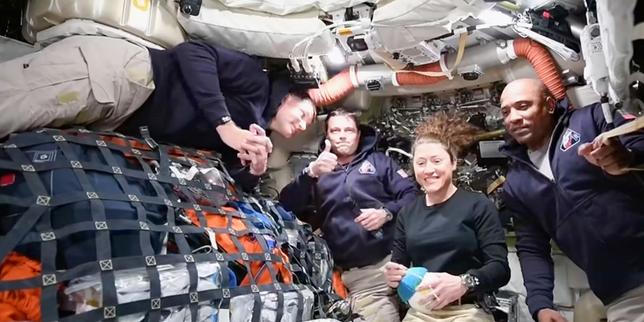
Stop celebrating the "space plumber."
The mainstream media is currently obsessed with a feel-good narrative: a brave technician or astronaut, armed with nothing but grit and a wrench, "saving" the Artemis mission by fixing a jammed waste management system. It makes for a great headline. It builds the myth of the rugged space explorer. It is also a total fabrication of what actually matters in deep space engineering. If you found value in this post, you should read: this related article.
If a toilet jam becomes a mission-critical "hero moment," your mission architecture has already failed.
The "lazy consensus" here is that hardware failures in space are inevitable, quirky hurdles that human ingenuity will always overcome. This is dangerous romanticism. In the vacuum of space, reliance on "handyman" fixes isn't a sign of resilience; it’s a symptom of a design philosophy that still treats spaceflight like a camping trip instead of a high-stakes physics problem. For another perspective on this event, see the latest update from TechCrunch.
The Waste Management Lie
NASA and its commercial partners spent years and roughly $23 million on the Universal Waste Management System (UWMS). It was marketed as the pinnacle of fluid dynamics and compact engineering. Yet, the moment it hiccups, we revert to the 1960s trope of the "MacGyver" fix.
The real story isn't the repair. The real story is the catastrophic lack of redundancy in life-support systems.
When a toilet fails on Earth, you call a plumber. When it fails on the way to the Moon, you are dealing with a biohazard that can literally clog the life-support scrubbers and electronics of the Orion capsule. Liquid and solid waste in microgravity do not "sit" in a bowl. They migrate. They permeate. They destroy.
I have seen engineering teams burn through six-figure budgets debating the viscosity of synthetic urine, only to see the actual hardware fail because of a simple valve tolerance issue. We are over-engineering the wrong things and under-testing the mundane.
The Physics of Failure
Let's look at the math that the press releases ignore. A standard space toilet relies on high-speed fans to create suction, separating waste from air.
$$F = m \cdot a$$
In a weightless environment, the "a" (acceleration) must be constant and mechanical. If the fan assembly jams, the centrifugal separation fails. You aren't just dealing with a "clog." You are dealing with a phase-separation failure in a closed-loop system.
The media calls it a "jam." Engineers know it’s a breakdown of the fluid-flow regime.
If we cannot master the movement of fluids in a $0g$ environment for a three-day trip to the Moon, we have zero business talking about a two-year transit to Mars. A "space plumber" on a Mars mission isn't a hero; they are a person trying to stop a floating petri dish from killing the entire crew.
Stop Humanizing Engineering Flaws
We need to kill the "space hero" narrative surrounding maintenance.
Every time we celebrate a manual fix for a preventable mechanical failure, we give contractors a pass for mediocre quality control. We should be asking why a $23 million commode isn't self-clearing. We should be asking why there isn't a solid-state, no-moving-parts backup system for the most basic human necessity.
The "People Also Ask" section of your brain is probably wondering: How do they go to the bathroom in space? The honest, brutal answer: They do it poorly, into systems that are remarkably prone to breaking, and then they spend precious mission hours acting as high-priced janitors.
The Actionable Truth for Aerospace
If you are building for the next frontier, stop designing for the "fix." Start designing for the "discard."
- Modular Redundancy: If a system has moving parts, it must be swappable in under five minutes. No "repairs." Just replacements.
- Passive Systems: If it requires a fan to work, it’s a liability. We need to move toward surface-tension-based waste management that utilizes the natural properties of liquids in microgravity rather than fighting them with noisy, power-hungry motors.
- The Janitor Test: If an astronaut has to spend more than 1% of their day thinking about their own waste, the mission architecture is a flop.
We are currently praising the "fix" because we are afraid to admit the "fail." Artemis is supposed to be our bridge to the stars. Right now, it looks more like a bridge held together by duct tape and PR spin.
The "space plumber" is a mascot for our inability to solve the most basic problems of biology in a vacuum. We don't need more heroes with wrenches. We need better engineers who find moving parts offensive.
Until we stop treating space toilets like an afterthought and start treating them like the critical flight hardware they are, we are just one "jam" away from a very messy, very expensive disaster.
Stop clapping for the repair. Start demanding a system that doesn't break.