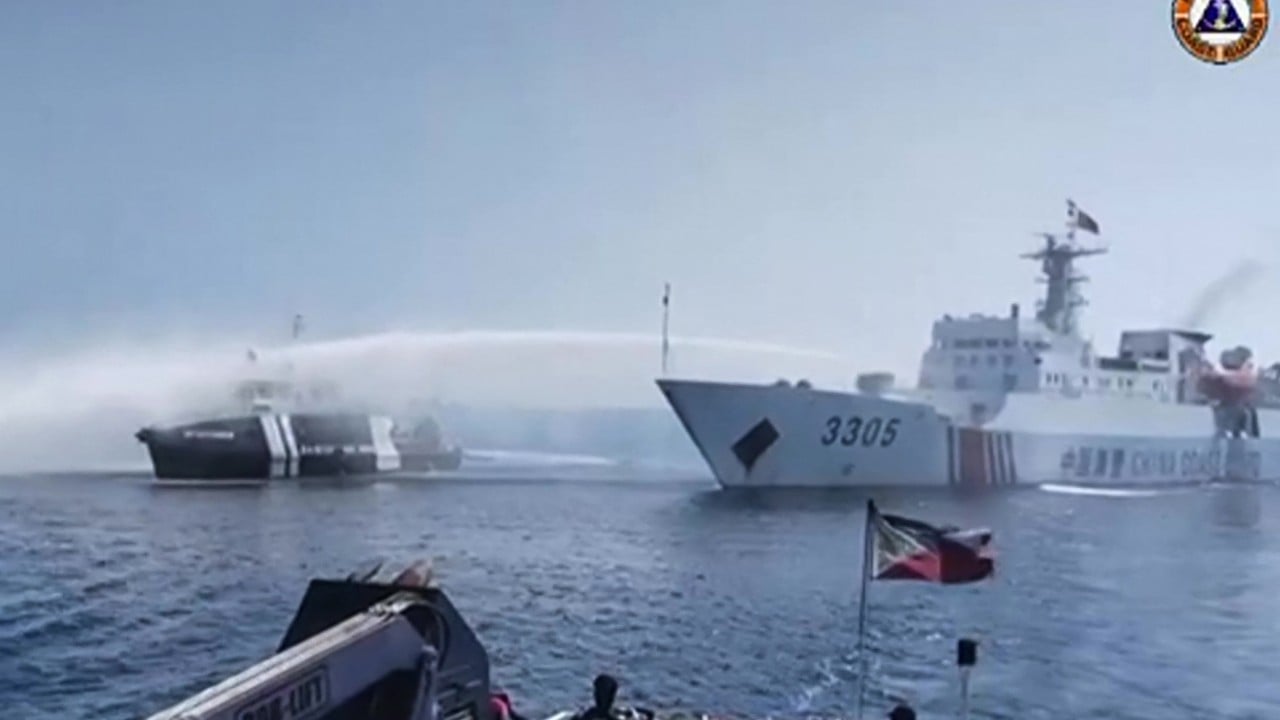
The sea off the coast of Hainan does not care about borders. It moves in heavy, rhythmic swells, carrying the scent of salt, diesel, and wet nets. To an observer standing on the deck of a weathered wooden trawler, the horizon looks empty save for the distant, ghostlike silhouette of a white-hulled coast guard cutter.
Below deck, however, the radio hums with encrypted data. Recently making headlines in this space: The Midnight Ledger In Stockholm.
For decades, the standard narrative of modern naval power has been written in steel: massive gray aircraft carriers, nuclear submarines slicing through the abyss, and thundering cruisers equipped with Aegis radar systems. But a quieter transformation has reshaped the contested waters of the South China Sea. Beijing has mastered an art that exists entirely in the shadows between peace and war. It is an armada of blue hulls. They look like ordinary commercial fishing vessels, complete with industrial winches and drying nets.
They are anything but ordinary. Additional information into this topic are detailed by Associated Press.
Consider what happens when hundreds of these civilian-flagged ships suddenly converge on a disputed reef. They do not fire missiles. They do not launch torpedoes. Instead, they drop anchors, lash their hulls together in massive floating barriers, and simply refuse to move. To a captain on a Philippine supply ship or a Vietnamese patrol boat, this is not an active military assault in the traditional sense. It is an immovable wall of steel and fiberglass. It is a slow, agonizing suffocation of maritime space.
The strategy relies on a clever exploitation of international law and human psychology. If a nation responds with military force against what appears to be civilian fishermen, that nation is instantly painted on the global stage as the aggressor, a heavy-handed bully picking on humble mariners. If the nation does nothing, the reef is lost. Inch by inch, anchor by anchor, the map is rewritten.
Think of it as a game of territorial go played on an oceanic scale. Every single vessel acts as a living stone, placed strategically to choke off access, exhaust adversaries, and stake permanent claims without ever crossing the threshold of open war. Behind them stand the formidable white hulls of the coast guard and the heavy gray warships of the People's Liberation Army Navy. But the front line belongs to the militia.
The men who crew these boats occupy a strange, liminal space. Many are commercial fishermen by trade, incentivized by generous government subsidies that pay them thousands of dollars a day simply to loiter in contested zones instead of dropping their nets for fish. They receive training in maritime surveillance, basic reconnaissance, and coordinated signaling. They are civilians when it is convenient, and a mobilized state reserve when orders arrive from the chain of command.
This creates an acute dilemma for rival coastal states and major powers alike. How do you counter a threat that wears no uniform, flies no battle flag, and hides behind the sympathetic guise of a working fisherman? Traditional naval doctrines are built to counter warships, not fleets of commercial trawlers equipped with reinforced hulls and high-frequency communication arrays.
When Washington or Manila attempts to push back, they find themselves trapped in a diplomatic maze. To treat the militia as a military combatant risks escalation; to treat them as mere civilians invites paralysis. Beijing has weaponized ambiguity, turning plausible deniability into a strategic shield.
Yet, this strategy carries its own hidden vulnerabilities. As these quasi-civilian fleets become more brazen, their operational footprint grows larger. Satellite imagery, open-source intelligence, and persistent tracking by regional navies are steadily pulling back the curtain. The more these vessels act in tight coordination with military commands, the harder it becomes to maintain the fiction of independent civilian behavior.
The South China Sea remains one of the most volatile choke points on Earth. Beneath the tropical sun and the gentle roll of the waves, a silent struggle defines the geopolitical future of the Indo-Pacific. It is a contest where the most powerful weapons are not fired from gun barrels, but anchored quietly in the shallow waters of disputed lagoons, waiting for the rest of the world to look away.