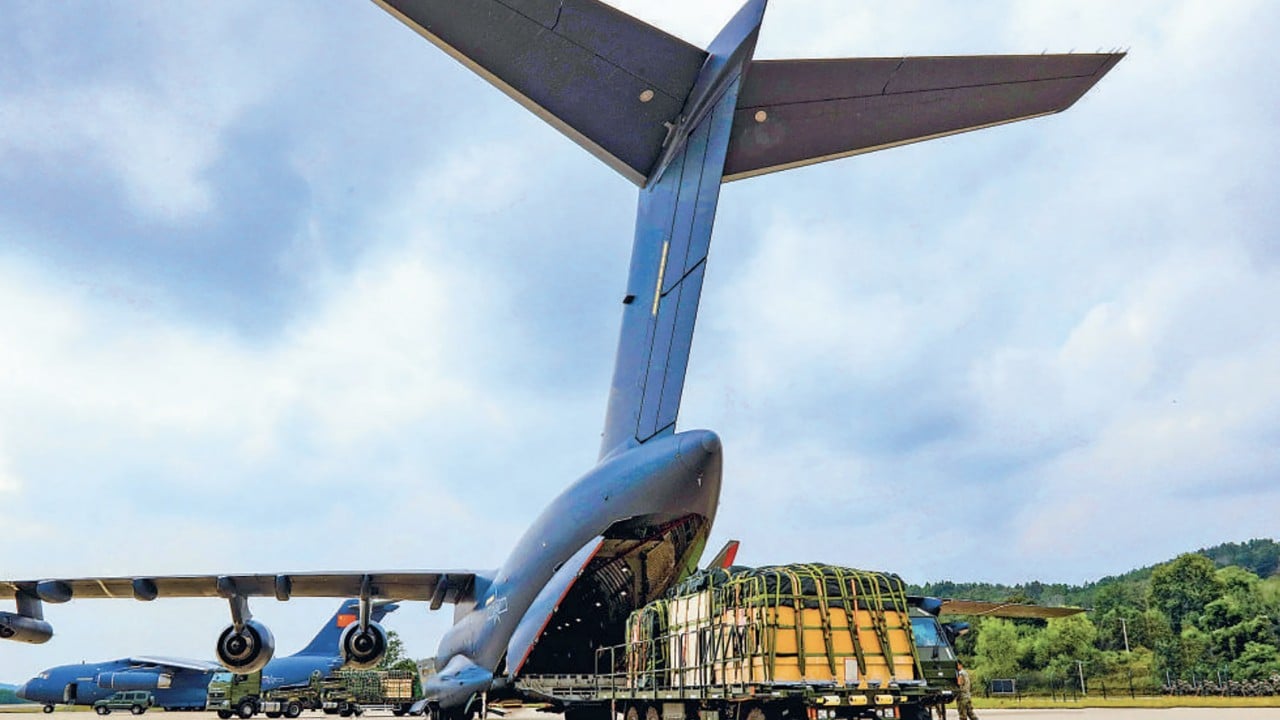
One October 2026 training photo says more about Beijing's airpower math than a dozen press releases.
When PLA Daily published an image on October 14 showing a four-engine Chinese heavy airlifter in standard grey military livery with underwing aerial refueling pods and its rear cargo ramp lowered next to an equipment truck, observers noticed something distinct. That wasn't just a standard cargo haul or a dedicated tanker sitting on the tarmac. It pointed to the Y-20B operating as a multirole tanker-transport, pairing domestic WS-20 turbofan power with the flexibility to haul freight and pass fuel in the same airframe family.
For years, military aviation watchers have debated whether China's airlift and refueling fleet was just catching up to old Cold War benchmarks or building something genuinely modular. Seeing the Y-20B configuration in an official training snapshot brings that shift out into the open. A single airframe line that can swing between cargo drops and airborne refueling gives planners options they simply didn't have when relying on older engines and single-purpose tankers.
Why the Y-20B Tanker Matters Right Now
Air refueling sounds unglamorous compared to stealth fighters or carrier groups. Honestly, it's the quiet bottleneck behind almost every long-range air operation.
Without enough tankers, a fighter jet's combat radius is stuck at whatever its internal tanks allow. With tankers orbiting along an ingress route, strike aircraft and escorts can fly farther, loiter longer, and cross oceans or continents that used to sit outside routine reach. As reported by Jane's Defence, an October 2026 infographic drawing on the PLA Daily photograph highlighted the Y-20B in a multirole tanker-transport setup, alongside commentary from Chinese military analyst Fu Qianshao suggesting the aircraft can conduct refueling missions using internal fuel capacity without needing auxiliary tanks inside the cargo bay.
That detail gets to the heart of why multirole design matters. If a crew doesn't have to sacrifice the entire cargo hold just to carry extra bladder tanks, the aircraft keeps more operational elasticity. Even if a mission calls for equipment loading at one end and fuel transfer at another, the fleet isn't locked into rigid single-role silos.
From Imported Engines to WS-20 Muscle
You can't talk about the Y-20B without talking about thrust. Early Y-20 variants leaned on Russian D-30KP-2 engines (and limited WS-18 batches), which got the program flying and into service but left performance on the table.
The Y-20B steps up to four domestic Shenyang WS-20 high-bypass turbofans. Open-source specifications and defense assessments put WS-20 thrust at roughly 127.5 kN to 140 kN per engine, giving the Y-20B a maximum takeoff weight around 220,000 kg (485,000 lb) and payload capacity near 66,000 kg (145,500 lb). More thrust does three practical things at once:
- Better takeoff performance: Heavy loads can get airborne off shorter runways or in hotter, higher-altitude conditions without punishing fuel burn.
- Stronger payload-range trade-offs: You can carry more fuel or freight over longer legs before hitting weight limits.
- Supply-chain independence: Building the core propulsion domestically removes foreign export bottlenecks as production scales.
Analyses cited by defense outlets like MiGFlug note that pairing stronger engines with tanker capability moves China closer to peer-class refueling performance—comparable in broad terms to Western multirole tankers like the Airbus KC-30A or Boeing KC-46A—rather than treating tanker conversion as a makeshift compromise.
Multirole Tanker-Transport vs. Dedicated Tankers
People often assume a multirole tanker-transport is automatically "better" than a dedicated tanker. That's not how air logistics works in practice.
A dedicated tanker is built around one job: getting fuel into receivers efficiently, with predictable configurations and streamlined turnaround. A multirole tanker-transport (MRTT) trades a bit of single-mission specialization for adaptability. When you have a smaller overall tanker fleet than a global superpower, versatility stretches every airframe further.
What the October Training Photo Actually Shows
Let's read that October 14 PLA Daily image carefully instead of over-interpreting it. Coverage from the South China Morning Post and regional defense trackers notes a grey four-engine aircraft with underwing refueling pods and an open rear cargo ramp backed by an equipment truck, tied to an Air Force unit training in loading equipment.
What does that confirm? It confirms that the PLA Air Force is actively training with a Y-20B airframe fitted with refueling pods while also exercising cargo and equipment handling. What it doesn't prove on its own is an exact initial operating date for every mission profile, or how many Y-20B tankers are fielded at any given week. Good defense analysis separates what's visible in a frame from what's inferred around the edges.
Fleet Numbers, Real Limits, and Common Myths
Here's where hype usually outruns reality. You'll see big headlines every time a new variant appears, yet fleet size still sets hard ceilings.
Across 2025 and 2026 assessments from sources such as the International Institute for Strategic Studies (IISS), the Lowy Institute, and Jane's, total Y-20 family production across all variants is generally estimated in the roughly 95 to 100 aircraft range, with tankers (including YY-20A/B configurations) representing a subset of that total and Y-20B numbers growing gradually rather than flooding the sky overnight. Even when you count dozens of tankers, scale matters:
- Tanker ratios still favor the United States by a wide margin. Comparing total aerial refueling fleets shows hundreds of U.S. KC-135 and KC-46 aircraft against a much smaller Chinese tanker inventory.
- Overseas basing remains narrow. Long-range air bridges work best when aircraft have friendly staging fields, maintenance support, and fuel stocks along the route.
- Maritime logistics have their own bottlenecks. Tankers extend air reach, but sustained distant naval operations also depend on replenishment ships, air defense, and command-and-control networks.
At the same time, it's a mistake to brush off what China has demonstrated. In late August 2026, during exercise Eagles of Civilization 2026 in Egypt, a Chinese YY-20A tanker supported a multi-thousand-kilometer deployment of J-16 fighters and was publicly documented refueling an Egyptian Rafale. That wasn't a local hop over coastal waters—it was out-of-region power projection backed by airborne fuel transfer.
Three Misconceptions to Drop Right Away
- "A training photo means full fleet-wide maturity overnight." Training photos show capability and integration, not immediate mass deployment across every theater.
- "Domestic engines erase every gap immediately." Moving to WS-20 engines solves a major propulsion hurdle, yet pilot hours, maintenance rhythms, and spare-parts pipelines take years to mature at scale.
- "Tankers only matter for war." Aerial refueling also speeds up rapid deployments, humanitarian airlifts, long-range exercises, and presence missions where stopping to refuel on the ground would cost hours or diplomatic clearances.
How to Track This Story Without Getting Fooled
If you follow defense aviation or regional security, tracking programs like the Y-20B gets much easier when you watch concrete signals instead of social-media rumors.
- Check serial numbers and unit markings in verified imagery to see whether aircraft are test/evaluation frames or assigned to operational transport and tanker regiments.
- Cross-check multiple outlets—pairing primary reporting from outlets like PLA Daily or SCMP with defense intelligence analysis from Jane's or IISS helps keep facts straight.
- Watch long-range exercise patterns, especially multi-leg deployments involving fighters, bombers, or AEW&C aircraft far from home bases.
- Pay attention to engine and pod configurations (such as underwing hose-and-drogue pods and WS-20 fan details) rather than relying on unverified labels.
The Y-20B tanker-transport configuration won't rewrite global airpower maps by itself, yet it shows a fleet steadily closing older technical gaps while building real operational flexibility.