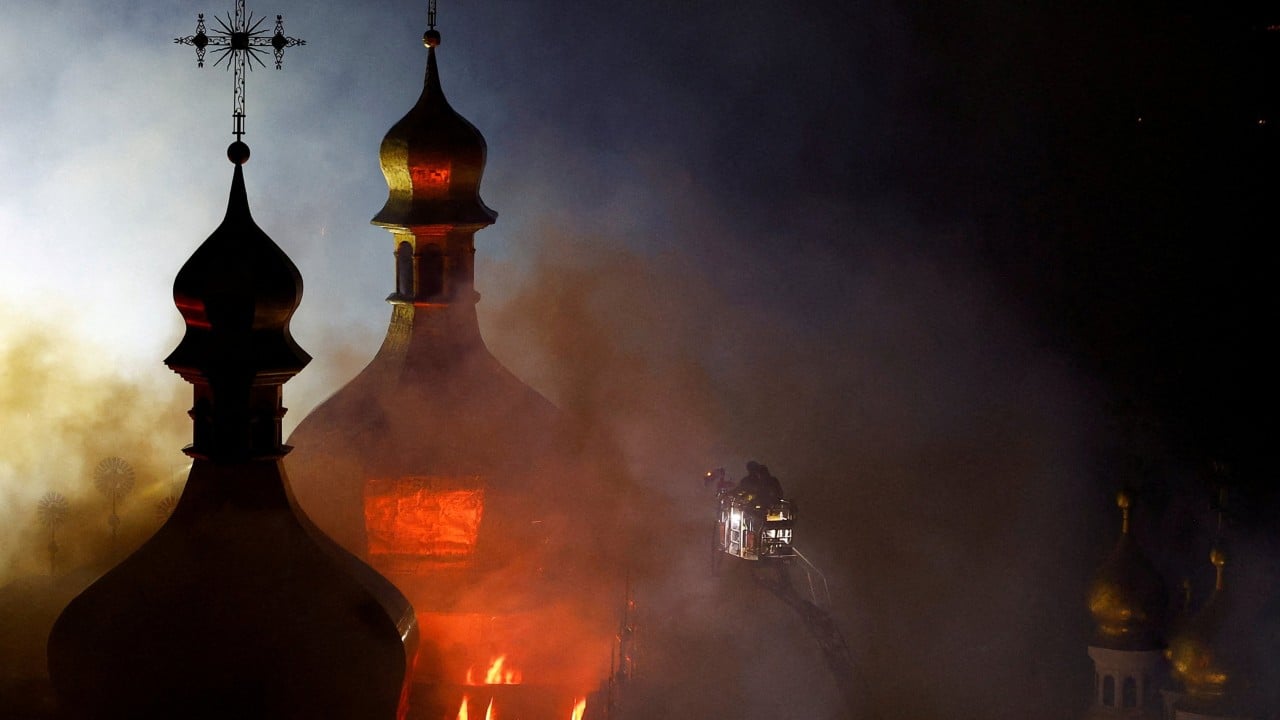
The roof of the Dormition Cathedral was burning. If you understand anything about Eastern European history, that sentence should make you sick. It is the heart of the Kyiv-Pechersk Lavra, a thousand-year-old monastic complex that has survived the Mongols, the Bolsheviks, and the Nazis.
Yet overnight on June 15, 2026, a massive Russian wave of ballistic missiles and Shahed drones tore through Kyiv. The resulting fire gutted parts of this UNESCO World Heritage site. Kyiv’s military administration confirmed the structural devastation. At the same time, the broader assault killed at least four people in the capital and five emergency workers in Kharkiv who were caught in a cynical double-tap strike.
This isn’t random collateral damage. It is a targeted war on identity. For years, Moscow has claimed to be the ultimate protector of Orthodox Christian values. But when your missiles burn down the very cradle of your own religious history, the mask falls off.
The Hypocrisy of Spiritual Warfare
The Kyiv-Pechersk Lavra isn't just another church. Founded in 1051, it predates the very foundation of Moscow. In fact, Yuriy Dolgorukiy, the grand prince who actually founded Moscow, lies buried right there on the Lavra grounds. By striking this complex, Russia is literally incinerating its own foundational history.
Ukrainian Prime Minister Yulia Svyrydenko pointed out this glaring contradiction on social media, calling the attack the true face of Russia's supposed values. The assault makes a mockery of the Kremlin's cultural rhetoric. You can't claim a shared holy heritage while launching explosive drones at it.
Metropolitan Epiphanius, the head of the Orthodox Church of Ukraine, did not mince words either. He called the burning cathedral a crime against humanity, history, and Christianity. Monks and emergency workers had to rush into the smoke to drag out ancient icons and priceless relics before the roof caved in. It’s a miracle they saved what they did, but the structural scars remain deep.
The Human Cost Hidden Behind the Headlines
International media loves to focus on the pretty gold domes in flames. It makes for dramatic footage. But we can't forget the immediate, brutal human toll of this specific overnight blitz.
- Kyiv under fire: Beyond the monastery, five strikes flattened civilian targets in the Shevchenkivskyi district within thirty minutes. A nine-story building in Obolon took a direct hit. Twenty-three people were wounded, including a pregnant woman and a child.
- The grid collapsed: The strikes ripped through local power lines, instantly cutting off electricity to 140,000 households across Kyiv.
- The Kharkiv horror: In Ukraine's second city, Russian forces used a favorite, cruel tactic. They struck a civilian area, waited for first responders to arrive, and then hit the exact same spot. Five firefighters died instantly while trying to put out the initial blaze.
This is the reality of the war in 2026. The front lines might seem static on some maps, but the skies are alive with terror.
Why the International Protection System is Broken
Let’s be honest about something. UNESCO status is basically a polite sticky note in a knife fight.
The Kyiv-Pechersk Lavra has been on the UNESCO World Heritage list since 1990. In 2023, the UN added it to the World Heritage in Danger list. Did that stop a ballistic missile? Not even close. Ukraine's culture ministry has tracked over 1,600 damaged cultural heritage sites since the full-scale invasion began in 2022.
The global community issues statements of deep concern, but these designations offer zero physical protection. Foreign Minister Andrii Sybiha announced that Ukraine is triggering urgent procedures within UNESCO to respond to this state barbarism. But what does that actually mean? More meetings in Paris. More strongly worded PDF files.
If international organizations cannot protect a site of universal human value from targeted bombardment, we need to rethink what global heritage protection even means.
What Needs to Happen Next
Documenting the wreckage isn't enough anymore. If you want to see these ancient spaces survive for the next generation, global policy has to shift from passive monitoring to active preservation.
First, Western allies must stop hesitating on air defense. The only thing that protects an 11th-century cathedral from a 21th-century missile is a functional air defense battery. Poland scrambled fighter jets during the attack to protect its own airspace, which shows how close these strikes are getting to NATO borders. Ukraine needs a dense, permanent shield over its historic urban centers.
Second, international legal bodies must categorize targeted strikes on recognized cultural sites as distinct, non-negotiable war crimes. The documentation being gathered by the National Police and Lavra experts right now needs a direct pipeline to the International Criminal Court.
If you want to help, support the local preservationists and independent groups on the ground. Organizations like the Kyiv-Pechersk Lavra National Reserve don’t just need thoughts and prayers. They need specialized construction materials, structural engineering expertise, and financial backing to secure the foundations before the autumn rains hit the exposed interiors. Stop waiting for bureaucratic agencies to fix this. Support the teams doing the heavy lifting in the smoke.