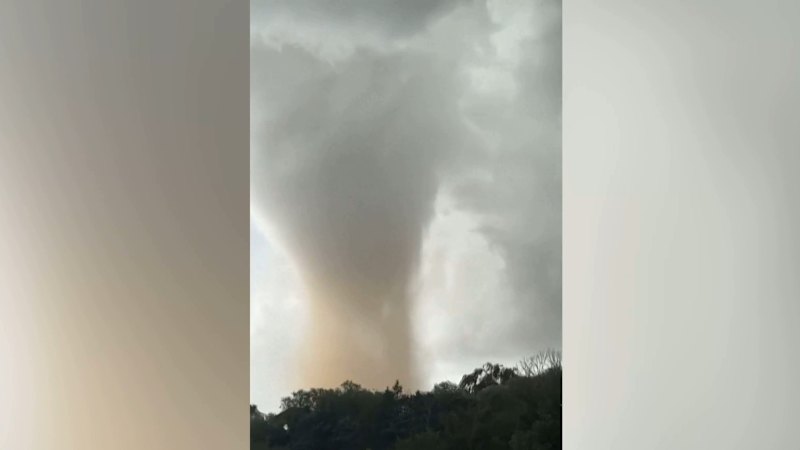
A rare and violent tornado tore through a rural French village, leaving a trail of shattered limestone, ruined centuries-old barns, and bewildered residents staring at a sky that had turned green before delivering its devastating blow. Meteorologists often categorize Western Europe as a low-risk zone for high-end convective windstorms, yet severe weather events are increasingly challenging traditional climate models across the continent. When a destructive funnel cloud strikes an area unaccustomed to such atmospheric violence, the immediate aftermath exposes deep structural vulnerabilities in rural European architecture and emergency response frameworks.
The Meteorological Shockwave
France averages dozens of minor tornadoes each year, but most remain weak water-spouts or brief land-spouts that dissipate harmlessly over agricultural fields. The event that recently crushed a historic commune in the country's interior operated on an entirely different scale. This was a mesocyclonic tornado, born from a rotating supercell thunderstorm fed by unusual thermal contrasts.
Warm Mediterranean moisture clashed with a late-season surge of cold air dropping from the north. The resulting atmospheric instability created vertical wind shear severe enough to tilt the updraft of the storm.
Old stone houses crumbled not because of poor craftsmanship, but because they were never engineered to resist upward suction. Traditional French farmhouses rely on thick load-bearing stone walls designed to carry downward weight against gravity. A violent tornado exerts massive negative pressure from above, effectively popping roofs off buildings like corks from champagne bottles before the inward collapse of the walls follows.
Infrastructure and the Heritage Trap
Restoring a medieval or early modern village presents a bureaucratic and engineering nightmare when disaster strikes. Historic preservation laws in France are notoriously strict. Every fallen tile, timber beam, and arched doorway must be painstakingly reconstructed using authentic materials and period-accurate techniques.
Insurance payouts rarely cover the total cost of heritage reconstruction. Local mayors find themselves caught in a slow-moving administrative bog between national disaster relief funds and regional architectural commissions.
- Rural municipalities operate on razor-thin municipal budgets.
- Specialized artisans capable of restoring ancient masonry are in short supply.
- Modern wind-resistant retrofitting is often banned on historic facades.
Residents face a grim choice. They can rebuild to modern, safer specifications and risk losing their architectural designation, or they can restore the historical aesthetic and remain acutely vulnerable to the next severe weather cycle.
Changing Atmospheres Across Western Europe
Climatologists studying these anomalies point to a shifting baseline in European weather patterns. The jet stream is becoming wobblier, prone to amplified meanders that trap weather systems in place or accelerate localized thermal collisions. While scientists hesitate to attribute any single storm directly to global climate shifts, the statistical frequency of high-energy convective events in atypical regions is creeping upward.
France is notoriously centralized. Emergency response protocols, weather radar density, and civil defense warnings are heavily weighted toward urban centers and coastal storm risks. Deep rural departments often rely on volunteer fire brigades and localized alert networks that lack the real-time telemetry needed to track rapidly spinning supercells.
Sirens do not wail across the vineyards of Burgundy or the rolling hills of the Dordogne. People look out their kitchen windows, watch the horizon turn an bruised shade of amber, and assume it is just another heavy summer thunderstorm until the freight-train roar begins.
The Cost of Isolation
Recovery in these isolated pockets of rural France moves at a glacial pace compared to urban disaster zones. Power grids mapped out decades ago snap under the strain of fallen oaks and shattered utility poles. Water supplies become contaminated as debris fouls local wells and municipal cisterns.
Small business owners, particularly winemakers and local artisans, absorb losses that threaten multi-generational livelihoods. A ruined harvest combined with structural destruction of production facilities creates a financial cascade that insurance policies written for standard agricultural damage fail to address.
The psychological toll on tight-knit rural communities is equally profound. These villages thrive on continuity, shared history, and generational permanence. When a thirty-second wall of wind strips away landmarks that have stood since the reign of Louis XIV, the damage extends far beyond shattered timber and bruised stone. It fractures the illusion of permanence that defines life in the French countryside.
Rebuilding will happen, stone by heavy stone, backed by state declarations of natural catastrophe and local grit. Yet the quiet hum of normalcy has been permanently disrupted by the realization that the atmosphere overhead is changing, and no valley in Europe is entirely safe from the sky's new violence.