The human eye is trained to look for anomalies in the wilderness. A flash of orange jacket against grey scree. The unnatural straight line of a tent pole. Three miles away, standing on a lower ridge where the air still smelled of damp pine and wet earth, it looked like a patch of unseasonal snow clinging to the steep, fractured face of the peak.
But the sun was high, and the temperature was well above freezing. Snow doesn't glint with that specific, aggressive glare. Expanding on this idea, you can find more in: The Mechanics of Holiday Aviation Surge: Quantifying the July 4th Infrastructure Strain.
It was plastic. Thousands of pieces of it, caught in a jagged gully high up the mountain, shifting slightly in the alpine wind like a living creature.
To the casual hiker, a mountain is a static monument of rock and ice. To the volunteers who spend their weekends carrying heavy canvas sacks up vertical trails, a mountain is a fragile ecosystem held together by sheer gravity and goodwill. When someone drops a wrapper at 3,000 feet, it doesn't stay there. It travels. It gathers companions. It bleeds into the landscape until it becomes a crisis. Analysts at Condé Nast Traveler have provided expertise on this situation.
What unfolded over the next twelve hours wasn't just a cleanup operation. It was a brutal, exhausting battle against gravity, geography, and human carelessness.
The View from Three Miles Away
When the call came into the mountain rescue base, it didn't involve a broken ankle or a stranded climber lost in the mist. It was a report of a visual scar. A local guide had spotted the anomaly through binoculars from a neighboring valley.
Imagine looking at a masterpiece in a gallery and noticing a thick, greasy smear of oil paint across the canvas. That is what this was. A literal river of rubbish, wedged into a deep cleft on a slope so steep that a single misstep would send a person sliding hundreds of feet down sharp limestone.
The logistics of moving a human body off a mountain are complicated enough. The logistics of moving half a ton of loose, wind-scattered waste from a sheer cliff face are a nightmare.
The team assembled at dawn. The air was cold enough to turn their breath into brief clouds of steam. These men and women are engineers, teachers, and paramedics by day. They are used to adrenaline. They are used to the sharp, sudden panic of a rescue mission.
This was different. This was a grueling marathon of manual labor at an altitude where every breath feels half as deep as it should.
They carried empty bulk bags—the kind used on construction sites to hold metric tons of sand—strapped to their rescue frames. Each volunteer was weighted down before they even began the three-hour ascent to the site. The trail quickly gave way to loose shale. Every step forward felt like half a step back.
Anatomy of a Landfill in the Clouds
When the team finally reached the gully, the sheer scale of the mess became apparent. It wasn't just a few discarded water bottles. It was a concentrated deposit of decades of neglect.
There were crushed aluminum cans from brands that hadn't existed since the late nineties. There were shredded blue tarpaulins, heavy industrial plastic sacks, rusted metal stakes, and hundreds of plastic bottles, bleached white and brittle by years of intense ultraviolet radiation.
The wind had funneled the debris into a natural trap, a bottleneck in the rock formation. Over time, the mountain had swallowed the trash, burying it under layers of loose stone and scree.
To get it out, the rescue team had to drop to their knees.
The work was agonizingly slow. Volunteers wore heavy work gloves to protect against the jagged edges of broken glass and rusted tin, but the gloves made it impossible to pick up the smaller fragments of microplastics. They had to peel off the protection, exposing their hands to the freezing rock, to pick out the tiny, colorful shards embedded in the dirt.
The mountain didn't want to give up the waste. Every time a volunteer pulled a large plastic sheet from the debris, a small avalanche of loose stones would trigger from above, forcing the team to scramble for safety against the rock face.
The mental toll of this work is heavy. When you rescue a person, there is a profound sense of purpose. You see the life you saved. When you spend twelve hours dragging thirty-year-old crisp packets out of a rock fissure, the prevailing emotion isn't heroism. It is a profound, quiet anger.
You realize that every single piece of trash in that gully was carried up there by choice. Someone packed it in, full and heavy, but decided it was too much effort to pack it out empty.
The Weight of Twelve Hours
By midday, the sun was baking the south face of the mountain. The volunteers were caught in a brutal microclimate—freezing wind from the peaks above, radiating heat from the limestone below.
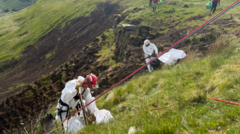
The canvas bags were filling up, each one growing to the size of a small vehicle. Moving them was a masterclass in ropework. The team had to set up complex pulley systems, anchoring themselves to solid rock boulders, just to hoist the massive sacks out of the gully and onto a stable ridge where they could be managed.
Their hands were raw. Their backs ached from hours of bending double on a forty-degree slope.
Consider the physics of a mountain descent. Carrying a heavy pack uphill is a test of lung capacity and cardiovascular strength. Carrying a sixty-pound bag of crushed garbage downhill is a violent assault on the knees and quadriceps. Every step requires a conscious braking action. The knees take the impact of your body weight plus the weight of the trash, multiplied by the momentum of the slope.
By hour nine, the conversation had stopped. The only sounds were the scraping of boots on stone, the heavy, rhythmic breathing of the team, and the metallic clatter of trash shifting within the bags.
The valley below was waking up, oblivious. Through binoculars, you could see tiny cars moving along the ribbon of road miles away, tourists stopping at viewpoints to take photos of the beautiful, pristine peaks. They had no idea that a dozen people were currently red-faced and bleeding on the upper ridges, trying to keep those peaks looking the way they did in the brochures.
What the Mountain Keeps
It took until dusk to clear the final pocket of waste. The last bag was tied off just as the shadows from the western ridges stretched across the valley floor, turning the limestone from brilliant white to a cold, bruised blue.
The final tally was staggering. Twelve hours of continuous physical labor by a team of highly trained rescue specialists. The result was a pile of bags that required a specialized transport plan just to get down to the valley disposal site.
The white scar was gone. Viewed from three miles away, the ridge was once again a uniform, unbroken line of grey stone. The mountain looked clean.
But the volunteers knew better. They knew about the microscopic fibers that had already broken down and washed into the soil. They knew about the plastics that had disintegrated into dust over the last twenty years, entering the mountain streams that feed the towns below.
You can haul away the bags, but you cannot easily heal the dirt.
As the team finally began their descent in the twilight, their headlamps cutting small beams through the gathering darkness, the mood was subdued. They were exhausted, battered, and hungry. They had done something extraordinary, but there was no celebration.
The mountain is vast, silent, and indifferent. It doesn't say thank you. It simply waits for the next weekend, the next crowd of visitors, and the next piece of plastic dropped by someone who assumes that out of sight means out of existence.