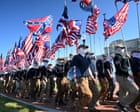
The mid-afternoon heat on the National Mall does not merely warm the skin; it radiates upward from the concrete, thick and suffocating, smelling of cheap sunscreen, evaporated sweat, and the sulfurous ghost of early fireworks. On a typical Fourth of July, this space belongs to a specific kind of American chaos. Children with sticky fingers chase melting popsicles. Families spread checkered blankets over patchy grass. It is a day of collective, noisy celebration.
Then came the drums.
It began as a low, synchronized thudding, vibrating through the soles of sneakers before it could be clearly heard. The casual chatter of tourists faded, replaced by an uneasy silence that rippled through the crowd near the Lincoln Memorial. Emerging from the humid haze was not a marching band or a parade of veterans, but a column of men moving with military precision.
They wore identical uniforms: khaki pants, dark blue jackets, and baseball caps. But it was their faces that stopped people in their tracks. Every single man had covered his head in a white gaiter, leaving only a narrow slit for the eyes. They carried standard-issue riot shields. And bobbing above the sea of masked heads, catching the heavy July air, was the unmistakable cross of the Confederate battle flag.
This was Patriot Front. On the day meant to celebrate the birth of a republic, a neo-fascist group had decided to occupy the symbolic heart of that republic's capital.
Watching them march felt like stepping into an uncanny valley of American iconography. To understand what this demonstration actually means, one must look past the jarring visual spectacle and look at the calculated mechanics of fear, anonymity, and the deliberate rewriting of history.
The Strategy of the Screen
There is a distinct psychological weight to a masked crowd. When an individual walks down the street, they carry the vulnerabilities of a human being—a name, a reputation, a recognizable face that can be held accountable. A mask strips that away. It replaces human nuance with a blank, unreadable wall.
Consider a hypothetical bystander named Sarah. She traveled from Ohio with her two teenagers to show them the monuments. She wanted them to stand where Martin Luther King Jr. delivered his dream. Instead, she found herself pushing her children behind her back as two hundred masked men marched past, their boots clicking in unison on the pavement.
The fear Sarah felt in that moment was not accidental; it was the entire point of the exercise.
Groups like Patriot Front rely on an aesthetic of intimidation. By wearing identical clothes and concealing their faces, they attempt to project an illusion of overwhelming force and unity. They want to appear as a monolith, an invading army rather than what they actually are: a fringe network of individuals who are deeply afraid of the changing world around them.
The masks serve a dual purpose. While they project power outward to the public, they protect the marchers inward from the consequences of their choices. Many of these men lead quiet, unremarkable lives during the week. They are IT technicians, retail workers, students, or mechanics. The white fabric ensures they can peddle hatred on Sunday afternoon and return to their air-conditioned workplaces on Monday morning without their employers or neighbors ever knowing the truth. It is a cowardice wrapped in the language of revolution.
A Stolen Heritage
The presence of the Confederate flag on the National Mall during Independence Day is a historical contradiction that requires a staggering amount of cognitive dissonance to execute.
The Fourth of July commemorates the Declaration of Independence in 1776—the birth of a union. The Confederate flag represents the literal antithesis of that union: an armed insurrection aimed at tearing the country apart to preserve the institution of human chattel slavery. Flying the two together is not an act of patriotism; it is an act of historical vandalism.
But extremist groups do not care about historical accuracy. They care about symbols.
They use the Confederate flag as a shorthand code. It signals defiance, racial hierarchy, and a longing for a romanticized past that never actually existed. By parading it past the Lincoln Memorial—the very monument dedicated to the president who preserved the Union and signed the Emancipation Proclamation—the group attempted a hostile takeover of American history. They wanted to twist the narrative of freedom into a weapon of exclusion.
The march was tightly choreographed. They did not stop to engage with the public. They did not hold open debates or hand out policy pamphlets. They moved through the city like a traveling theater troupe, capturing footage for their own promotional videos. This is modern extremism: a movement designed for the algorithm, optimized for social media clips that can be used to recruit lonely young men in dark corners of the internet.
The Invisible Stakes
It is easy to dismiss an event like this as a bizarre sideshow. A couple hundred men playing dress-up in the summer heat can seem pathetic, even laughable. But ignoring the phenomenon misses the deeper, more fragile reality of our civic life.
Democracy is not a permanent monument carved out of granite. It is a social contract, a fragile agreement among millions of people to treat each other with a basic level of dignity and equality. It survives only because we agree to uphold it.
When a hate group marches openly through the nation's capital, they are testing the boundaries of that agreement. They are pushing against the walls of our collective tolerance to see how much they can erode before the structure pushes back. They want to normalize their presence. They want the sight of masked fascists on the National Mall to become just another predictable feature of American political life, as routine as a filibuster or a campaign rally.
The true danger is not that Patriot Front will launch a sudden coup. The danger is the slow, quiet numbing of the public conscience. It is the moment when a mother like Sarah looks at a sea of white masks and Confederate flags, sighs, and simply walks away because she has grown used to the sight.
The marchers eventually reached their destination, packed their flags and shields into rented moving trucks, and vanished into the suburbs. The white masks came off, stored away in backpacks until the next rally. The National Mall emptied, leaving behind the usual debris of discarded soda cans and plastic wrappers.
But the air felt different. The drums had stopped, yet the silence they left behind was heavy with a realization that many of us try desperately to avoid. The struggle for the definition of America is not a settled matter of history. It is an active, ongoing argument happening right now on our streets, and the people holding the flags are banking on our fatigue.