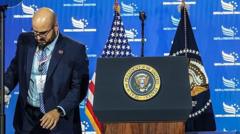
Imagine knowing exactly what the President of the United States is going to say before he says it. Better yet, imagine having the power to literally load those words onto the glass screens in front of him.
If you had that kind of access, you could make a quick fortune.
That is the reality behind a wild new scandal hitting Washington. Gabriel Perez, a veteran White House teleprompter operator who has worked with Donald Trump since 2016, was just placed on unpaid administrative leave. The accusation? He allegedly used his backstage access to rake in over $100,000 by betting on Trump’s live speeches using the prediction market Kalshi.
This is not just a story about a rogue staffer trying to make a quick buck. It is a massive wake-up call for the entire prediction market industry, exposing a glaring regulatory blind spot.
How the Teleprompter Hustle Worked
Most people think of prediction markets as places to bet on who wins an election or whether the Federal Reserve will cut interest rates. But platforms like Kalshi and Polymarket also host hyper-niche "mention markets". These markets let users wager on whether a public figure will utter specific words or phrases during a major speech.
For example, will the president say "illegal alien," "tariff," or "inflation" during the State of the Union?
To the average trader, these bets are a guessing game based on speechwriters' habits and political trends. But to Gabriel Perez, it was reportedly a sure thing.
As a deputy assistant and technical adviser earning $175,000 a year, Perez was part of an incredibly tight circle with advance access to Trump’s drafted remarks. He was often the very last person to touch a speech, sometimes inputting live, last-minute edits straight from the president himself.
Federal investigators with the Commodity Futures Trading Commission (CFTC) found that Perez allegedly bet on more than a dozen speeches over a three-month span. His targets included prime-time addresses, remarks at the World Economic Forum in Davos, and even a Medal of Honor ceremony.
Here is where it gets crazy. Trump is famous for veering off-script. He famously boasts that he goes off-prompter "about 80% of the time." Because of this, Perez couldn't just place a bet and walk away. Sources say investigators caught him actively hedging or backing out of his bets during the live broadcasts when he saw Trump skipping over sections of the pre-loaded text.
If the president skipped a paragraph containing his target word, Perez allegedly hopped on his phone to limit his losses before the market closed. That isn't just taking a flyer on a speech—it is active, real-time insider trading.
The Catch and the Freeze
You can't routinely pocket thousands of dollars on highly specific political speeches without someone noticing.
Kalshi uses proprietary surveillance systems to monitor unusual volume and irregular buying patterns. When their system flagged a series of highly accurate, large-scale trades on Trump’s vocabulary, analysts dug into the account.
Once Kalshi identified the trader as a federal employee with direct ties to the administration, they moved quickly. They locked Perez’s account, freezing more than $90,000 in unrealized profits, and handed the evidence over to the CFTC.
Press Secretary Karoline Leavitt confirmed Trump was furious when he found out, calling the situation "deeply unfortunate and frankly a disgrace." Perez was immediately suspended without pay and will not be returning to the White House.
While the Department of Justice in Manhattan ultimately declined to file criminal charges, Perez is currently negotiating a civil settlement with the CFTC. He will likely have to forfeit all his winnings and agree to a permanent ban from these platforms.
The Broader Threat to Prediction Markets
This scandal highlights a massive problem that prediction platforms have been desperately trying to ignore. If you allow people to bet on highly specific, human-controlled outcomes, those close to the source will always find a way to exploit it.
This isn’t an isolated incident either. We are seeing a sudden wave of insider trading cases in the prediction space:
- A special forces soldier was recently prosecuted for betting on the high-profile capture of Venezuelan President Nicolás Maduro using classified operational details.
- A Google employee was caught wagering on proprietary search data trends.
- Former Congressman George Santos was investigated for allegedly betting on whether he would attend the State of the Union.
Even corporate leaders have messed with these markets. Last year, Coinbase CEO Brian Armstrong jokingly ended an earnings call by rattling off a list of buzzwords like "Web3" and "staking" just to trigger payouts for traders on Polymarket.
While Armstrong did it as a joke, the teleprompter case shows how easily the system can be abused for actual profit.
The Next Steps for Traders and Platforms
If you trade on prediction platforms, or if you are just watching this space blow up, expect major structural changes. The Wild West days are rapidly coming to an end.
1. The Death of the "Mention Market"
Platforms are realizing that betting on what a person says is too easy to manipulate. Companies like Robinhood, which recently partnered with Kalshi, have already opted out of offering "mention" bets entirely because of manipulation risks. Expect other exchanges to quietly phase out these micro-markets to avoid regulatory wrath.
2. Aggressive KYC and Workplace Disclosures
Kalshi has already started requiring users to disclose their exact employers before trading in high-risk markets. If you work in government, corporate tech, or public relations, expect to face heavy scrutiny or flat-out bans on placing wagers related to your industry.
3. Internal Compliance Crackdowns
The White House sent an internal memo back in March warning staff not to bet on prediction markets using nonpublic information. Moving forward, expect every major corporation and federal agency to draft strict, explicit bans on prediction market trading in their standard employment contracts. If you have access to a press release, an earnings report, or a product launch, betting on it will get you fired.
The Perez scandal proves that prediction markets are no longer a niche playground for internet trolls. They are high-stakes financial environments, and they are finally being regulated like them.