Political authority is no longer maintained solely through institutional execution or legislative output; it requires the continuous capture and monetization of public attention. The staging of "UFC Freedom 250" on the White House South Lawn—conceptually positioned as a celebration of the nation’s 250th anniversary but timed precisely with President Donald Trump’s 80th birthday—is not merely an unprecedented security anomaly or an unconventional party. It is a calculated deployment of attention economics designed to maximize political equity, deepen corporate alliances, and execute an aggressive strategy of narrative diversion.
Analyzing this event requires moving past superficial critiques of presidential decorum and evaluating the hard mechanics of infrastructure, asset allocation, legal defense, and corporate value creation. For an alternative look, check out: this related article.
The Infrastructure and Capital Expenditures of the Claw
The physical transformation of the executive mansion's grounds represents a massive logistical and financial undertaking. To evaluate the scale of this private-public convergence, look at the operational parameters filed in federal regulatory and court challenges:
- Total Capital Expenditure: The Ultimate Fighting Championship (UFC) and its parent entity, TKO Group Holdings, fully funded a reported $60 million production budget. This includes a $700,000 reservation explicitly earmarked for the post-event ecological restoration of the South Lawn turf.
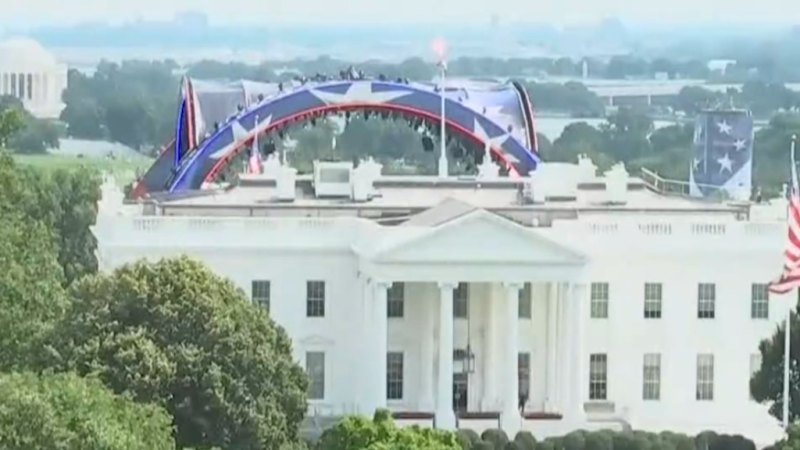
- Structural Demands: The central structure, a 92-foot-tall, 600-tonne steel canopy system designated "the Claw," was erected over a custom 4,300-seat outdoor stadium. This configuration encloses a standard eight-sided wire-mesh cage (the Octagon).
- Labor Overhead: Constructing this temporary arena required tens of thousands of aggregate industrial labor hours. The physical build altered the historic Washington D.C. skyline, drawing logistical coordination from seven distinct federal agencies, including the National Park Service and the United States Secret Service.
The immediate bottleneck to this execution was not technical, but legal. Two Virginia residents mounted a federal lawsuit alleging that the National Park Service violated explicit land-use regulations by permitting a private, for-profit sporting entity unfettered commercial access to federal parklands without a standard environmental impact review. Similar reporting on this matter has been published by The Motley Fool.
The administration bypassed this legal challenge via a strategic defense led by the Department of Justice. The government’s legal framework rested on two arguments: laches (the plaintiffs delayed filing their suit until the infrastructure was largely complete) and a failure to demonstrate standing through concrete, individualized harm. The federal court declined to issue an injunction, establishing a precedent for the commercial utilization of executive real estate.
The Corporate Value Function: Paramount and TKO Group Holdings
For TKO Group Holdings and its broadcast partner, Paramount Skydance, the economic utility of hosting a main-card fight night at the White House goes far beyond standard ticket sales. Ticket distribution was heavily rationed to eliminate standard public retail:
[Total Seat Capacity: 4,300]
├── Executive / Presidential Invitations: 1,400 seats
├── UFC CEO Allocation: 300 seats
├── TKO Group Parent CEO Allocation: 200 seats
└── Remaining Inventory: Military personnel and corporate partners
Because public ticketing was suppressed, the monetization model shifts entirely to media distribution and corporate alignment.
The Subscription Acquisition Funnel
The broadcast strategy leveraged the event as a high-conversion mechanism for the Paramount+ streaming platform. In media economics, live sports act as the primary driver for lowering customer acquisition costs (CAC) while boosting immediate subscriber numbers. By structuring the card as a high-density, seven-fight main event with zero preliminary bouts, the organizers engineered a high-impact viewing window between 8:00 PM and 12:00 AM Eastern Time. This structure maximizes audience retention and drives a high-volume sampling rate for the UFC's broader media ecosystem.
Specialized Incentive Alignments
The event served as a launchpad for specialized financial integrations. The introduction of World Liberty Financial as an official corporate partner created a distinct $250,000 tokenized or alternative asset bonus pool allocated specifically for winning athletes. This integration bridges decentralized finance products directly with mainstream sports entertainment, utilizing the high visibility of a White House event to validate and normalize emergent financial platforms.
The Diverted Attention Function: Domestic and Foreign Metrics
The timing of this sports spectacle operates as a classic diversionary mechanism, a tactical maneuver well-documented in political science literature where a state leader uses highly visible domestic entertainment to offset negative macroeconomic or geopolitical pressure.
[Macroeconomic / Geopolitical Pressures]
  ├── Sustained Domestic Inflation
  ├── Escalated Military Spending (Iran Conflict)
  ├── Depressed Public Approval Ratings
  └── Volatile Global Energy Markets
$$\downarrow$$
[The Diversionary Mechanism: UFC Freedom 250]
  ├── High-Density Media Spectacle (8 PM - 12 AM)
  ├── Hyper-Nationalistic Branding ("Freedom 250")
  └── Consolidation of Core Populist Demographics
$$\downarrow$$
[Resulting Strategic Outcome]
  └── Dilution of Negative News Cycles & Real-Time Narrative Recalibration
The event occurred precisely as the United States and Pakistan announced a major diplomatic breakthrough: a negotiated deal with Iran to end three months of intense kinetic warfare and restore stability to the blockaded Strait of Hormuz. While this development yields positive economic signals for global oil markets, the administration faced sustained pressure over domestic inflation and depressed public approval numbers.
By anchoring the news cycle to a $60 million cage-fighting event featuring prominent global champions like Ilia Topuria and Justin Gaethje, the administration successfully recalibrated the domestic media focus. The narrative shifted from complex geopolitical risk assessments to a digestible, highly commercialized display of American populist culture.
The Evolution of Political Authority
This convergence of a major sports brand and executive governance marks a permanent shift in how presidential influence is built and sustained. Historically, an executive's authority was derived from institutional stability, policy execution, and formal public addresses. The modern political architecture, however, treats the office as a direct-to-consumer media brand.
By embedding the Ultimate Fighting Championship into the physical architecture of the White House, the administration cements a 25-year mutual optimization strategy between the president and UFC executive leadership. This relationship, which began in 2001 when the Trump Taj Mahal hosted early, un-sanctioned mixed martial arts events, has evolved into a highly integrated political and commercial network.
The strategic play here is clear: insulate the executive office from traditional media critiques by building a self-sustaining ecosystem of entertainment, corporate capital, and direct public engagement. Future administrations will find it difficult to reverse this trend. The precedent has been set, demonstrating that the ultimate metric of political power is no longer just policy consensus—it is the absolute control of the broadcast platform.