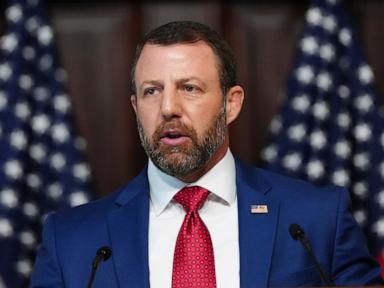
Homeland Security Secretary Markwayne Mullin thinks he can run local elections from Washington. He can't. That didn't stop him from threatening state officials with fines, funding cuts, and prison time if they don't bow to his new election directives.
The political world shook when Mullin took the podium at the White House complex. Fresh off a primetime address by President Donald Trump focused on alleged voting vulnerabilities, Mullin laid down a heavy-handed ultimatum. He targeted states that refuse to hand over sensitive voter data or adopt federal scrubbing tools. Specifically, he took aim at California, New Jersey, Nevada, and Pennsylvania. Mullin claimed the federal government found a combined 250,000 potential noncitizens on their voter registration lists.
This isn't just standard political theater ahead of the 2026 midterm elections. It's a fundamental rewrite of how Washington interacts with local election boards. By tying federal grants and Federal Emergency Management Agency (FEMA) funds to compliance, the Department of Homeland Security (DHS) is attempting to nationalize voting procedures.
It is a bold strategy. It is also completely hitting a legal brick wall.
The Threat to Prosecute Local Officials
Mullin didn't mince words during his press briefing. He explicitly warned that election officials who don't comply with administration mandates to clean voter rolls could face federal criminal investigations. The administration wants states to submit their voter data directly to a federal database system.
If states choose not to participate, Mullin promised to make those states a priority for federal scrutiny. He said the government would look at exactly who voted in those states and hold local administrators personally accountable. The DHS chief tied the issue directly to national security. He asserted that foreign adversaries manufacture components used in American voting systems. He argued these components could allow bad actors to alter registration details or change actual votes.
To force compliance, the administration has weaponized federal funding. The plan makes cybersecurity support and election infrastructure grants contingent on using federal screening tools. If a state pushes back, Washington intends to lock the vault.
Local election leaders view this as an unprecedented overreach. Some are fighting back with intense rhetoric. Arizona's top election official Adrian Fontes openly mocked the administration's aggressive posturing, telling critics to suck on a salt lick. The anger among state administrators is real, and it crosses party lines.
The Battle Over the SAVE Database
The core of this fight involves the Systematic Alien Verification for Entitlements program, known as SAVE. Historically, government agencies used this database to check the immigration status of people applying for public benefits like housing or Medicaid. The current administration overhauled the database to transform it into an election tool.
The administration wants every state to run its entire voter registration list through the SAVE program. At least 25 states have voluntarily used the tool to some degree. The problem arises when the federal government tries to make this mandatory.
The SAVE system was never designed to be a voter roll auditor. It tracks noncitizens who have interacted with federal immigration authorities. It doesn't update in real time when an immigrant becomes a naturalized citizen. If a green card holder becomes a citizen and registers to vote legally, the SAVE database might still flag them as a noncitizen for months or years.
A federal judge recently blocked the mandatory use of the overhauled SAVE program for voter purges. The court raised serious concerns about privacy violations and the high probability of wrongfully removing eligible American citizens from voting rolls. The legal challenge highlighted real cases where legitimate voters were flagged as illegal residents due to outdated federal files.
Mullin remains undeterred by the courts. He announced that the Cybersecurity and Infrastructure Security Agency (CISA) will release an updated election infrastructure plan within 30 days. This plan will offer resources to local offices, but only if they fully cooperate with the SAVE audits.
The Math Behind the 250,000 Figure
The administration based its aggressive policy shift on specific numbers sent to four key states. Mullin dispatched official letters to secretaries of state demanding action within two weeks. The letters contained startling claims about noncitizens sitting on active voter rolls.
According to the DHS letters, preliminary reviews uncovered specific estimates of ineligible registrations:
- 190,832 potential noncitizens registered in California
- 35,152 potential noncitizens registered in New Jersey
- 15,903 potential noncitizens registered in Nevada
- 14,576 potential noncitizens registered in Pennsylvania
Independent election experts quickly picked these numbers apart. David Becker, executive director of the Center for Election Innovation and Research, pointed out that the federal government used raw, public voter data to reach these conclusions. Public voter lists don't include confidential identifiers like full Social Security numbers or complete dates of birth. Trying to match raw public lists against immigration databases leads to massive false positives. Common names result in thousands of incorrect matches.
Secretaries of state from the targeted regions pushed back immediately. California Secretary of State Shirley Weber and Pennsylvania Secretary of State Al Schmidt noted that their offices already perform regular list maintenance. They use official state records, motor vehicle data, and death certificates to keep rolls clean. Numerous independent academic studies show that noncitizen voting is incredibly rare.
The federal government's data is fundamentally flawed. Relying on incomplete matching systems to threaten criminal prosecution creates chaos right before an election cycle.
The Constitutional Wall Defending States
Mullin's threats sound terrifying to a local county clerk. In reality, the legal ground beneath the federal government is incredibly shaky. The United States Constitution does not give the president or the DHS the power to run elections.
Article I, Section 4 of the Constitution contains the Elections Clause. This clause explicitly gives state legislatures the power to prescribe the times, places, and manner of holding elections for senators and representatives. Congress can pass overarching laws to regulate federal elections, but the executive branch cannot simply issue decrees. A cabinet secretary cannot invent new criminal penalties or force states to hand over sensitive state data without explicit statutory authority.
Courts have repeatedly slapped down federal attempts to commandeer state resources. Fifteen separate federal court rulings have established that Washington cannot legally force states to hand over confidential voter data against their will. Six of those rulings came from judges appointed by Trump himself.
The administration's legislative attempt to change this reality has flatlined. The SAVE Act, a bill designed to require proof of citizenship for all voter registrations nationwide, remains stalled in the Senate. Without the votes to break a filibuster, the administration is trying to use executive pressure to achieve what it couldn't pass through Congress.
Using federal fund withholding as a weapon also faces tight legal restrictions. The Supreme Court has ruled that the federal government cannot unconstitutionally coerce states by threatening to pull existing, unrelated federal grants. If FEMA funds or standard security grants were already allocated by Congress, Mullin can't legally block them just because a state clerk refuses to use an unapproved database.
Actionable Steps for Election Administrators
Local election officials must navigate this political crossfire without compromising the integrity of their local systems or breaking the law. The pressure is intense, but administrators possess clear paths forward.
First, document all existing list maintenance procedures. State offices should compile clear, public-facing reports detailing exactly how they verify voter eligibility. Proving that your office uses verified data from the Electronic Registration Information Center (ERIC) or local vital statistics destroys the narrative that your rolls are unmonitored.
Second, cooperate within the bounds of established law. If the DHS offers voluntary cyber threat resources through CISA that don't require violating voter privacy or ignoring court orders, take advantage of them. Securing physical voting machines and protecting local networks from foreign hackers remains a critical priority. You can accept federal help with hardware security without participating in legally dubious voter purges.
Third, consult with state attorneys general immediately. If your county or state receives an official demand letter threatening funding cuts or prosecution, let state legal teams handle the response. Do not allow federal officials to isolate local county clerks. Legal precedent shows that the states hold the upper hand under the Constitution.
The upcoming midterms will see intense scrutiny. Local officials must keep their heads down, rely on verified data, and refuse to let federal bluster disrupt the voting process. Washington can make noise, but the Constitution leaves the actual work of running elections to the states.