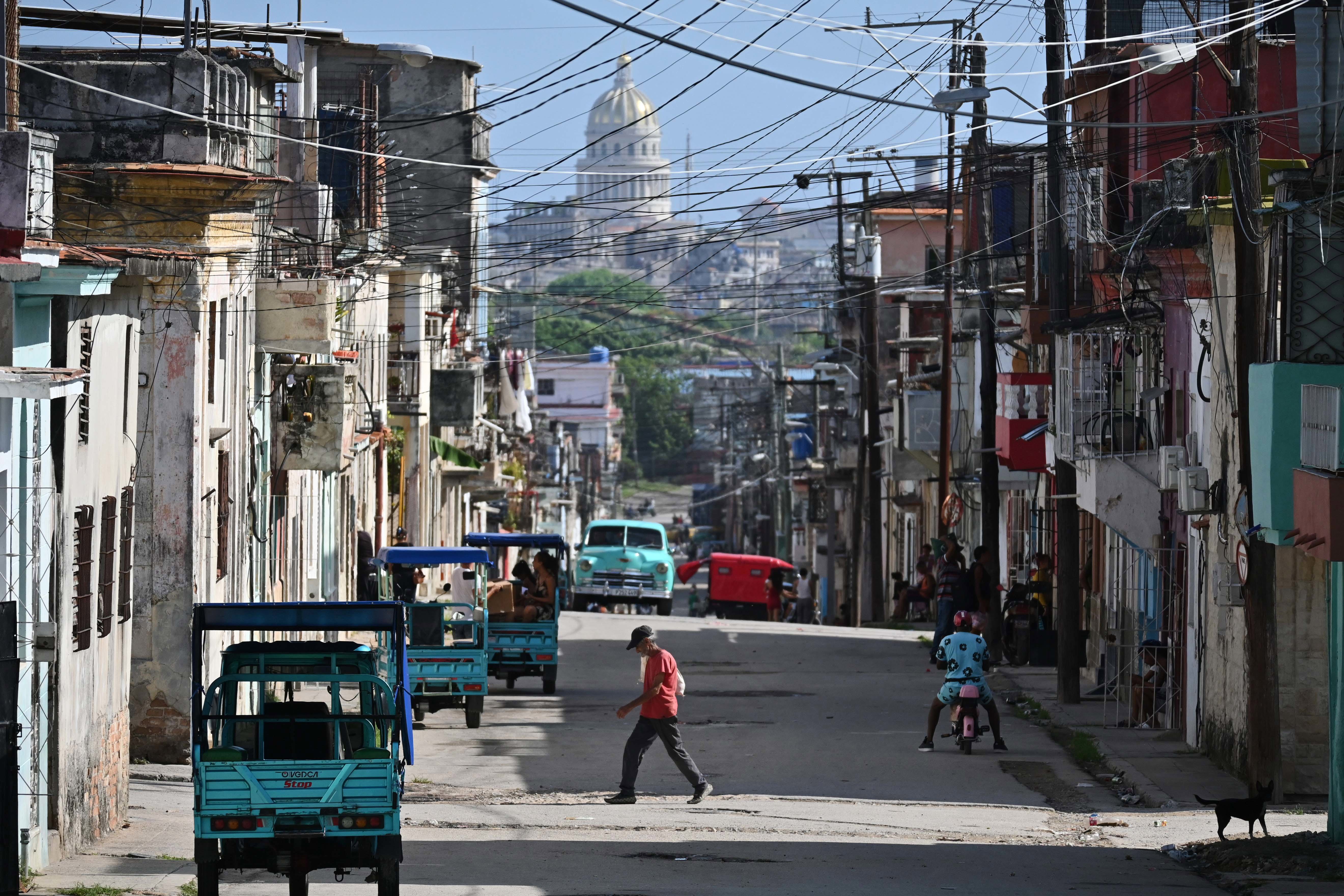
The saltwater between Key West and Havana spans exactly ninety miles, but the true distance cannot be measured in leagues. It is measured in silence. For generations, that narrow stretch of the Florida Straits has functioned as a geopolitical vacuum, a place where words disappear and assumptions harden into concrete.
When the metal of a military transport plane cools on a tarmac in Havana, it makes a specific, ticking sound. It is the sound of heat escaping. In the spring of 2026, that sound carried an unfamiliar weight. A high-ranking United States military commander stepped out into the heavy, humid air of the island, his boots meeting the concrete of a nation that Washington has spent more than six decades trying to freeze out of existence.
This was not a formal state visit marked by cascading flags and synchronized brass bands. It was something far more fragile. The meeting took place under the lengthening shadow of intense, public pressure from the Trump administration—a white-hot spotlight of economic threats, rhetorical escalation, and a demand for total alignment. Yet, beneath the political thunder rolling out of Washington, a quiet, human calculation was happening on the ground. Two military establishments, historically trained to view each other through the crosshairs of a cold war that never quite thawed, were looking each other in the eye.
To understand the stakes of this room, you have to understand the geography of isolation.
Consider a mid-level Cuban logistics officer. Let us call him Alejandro. He does not exist in the grand speeches delivered in Florida amphitheaters or the legislative chambers of Capitol Hill. He exists in a cramped office near the Port of Mariel, watching the horizon through salt-crusted windows. For Alejandro, the pressure from the north is not an abstract foreign policy concept; it is a tangible shortage of spare parts for his department's aging transport trucks. It is the rolling blackout that cuts the power to his daughter’s school at mid-afternoon.
When a superpower squeezes a small island, the pressure does not distribute evenly. It pools in the kitchens of ordinary citizens and the lower echelons of the state apparatus.
The strategy from the White House has been clear: apply maximum friction until the machine breaks. By tightening sanctions, restricting remittances, and publicly castigating the Havana government, the administration intends to force a geopolitical pivot, severing Cuba's lingering ties to adversaries like Russia and China. It is a game of chicken played with macroeconomics.
But machines do not always break the way planners predict. Sometimes, when you apply immense pressure to an enclosed system, you do not get a clean fracture. You get an explosion. Or worse, you force the entity inside to seek a sturdier shelter.
The arrival of the American commander was an unspoken acknowledgment of this danger. While the public rhetoric remains unyielding, the professional soldier's job is to calculate risk without the luxury of delusion. The Pentagon knows what political campaigns often ignore: a completely destabilized Cuba, ninety miles from the American coastline, is a nightmare scenario for domestic security.
Imagine a sudden, chaotic collapse of authority on the island. The immediate result would not be a orderly transition to Western-style democracy. It would be a humanitarian migration crisis that would overwhelm the Caribbean. It would create a security vacuum that transnational criminal organizations would fill within forty-eight hours.
The men sitting across from each other in that Havana briefing room understood this implicitly. They spoke the shared language of logistics, chain of command, and stability.
The Language of the Map
A map is a stubborn thing. You can change a government, you can rewrite a constitution, and you can embargo an entire economy, but you cannot move the dirt. Cuba sits precisely where it has always sat, commanding the mouth of the Gulf of Mexico.
During the discussions, the American delegation brought more than just grievances; they brought the reality of geographic proximity. The conversation drifted toward shared vulnerabilities that ideological differences cannot erase. Drug trafficking corridors in the Caribbean do not respect the trade embargo. When a hurricane spins out of the Atlantic, its path of destruction ignores the ideological boundary between capitalistic democracy and revolutionary socialism.
The American commander’s presence was a calculated gamble in strategic empathy. It required listening to the grievances of Cuban officials who have spent their entire lives under the narrative of American encirclement. For the Cuban generals, many of whom are aging veterans of long-past proxy conflicts in Africa, the American uniform represents an existential threat. Every movement by the US military in the region is interpreted through a lens of deep-seated historical paranoia.
To bridge that gap requires an intellectual agility that standard diplomatic cables cannot convey. It requires looking past the medals on a uniform and recognizing the underlying anxiety of an institution that knows its infrastructure is crumbling, yet possesses the stubborn pride of survival.
The Cuban military is not just an army; it is the economic backbone of the country. They run the hotels, the ports, and the agricultural distribution networks. When Washington pressures Cuba, it is directly targeting the institution represented by the men sitting across the table. The conversation was less about signing treaties and more about establishing a baseline of predictability. If a crisis occurs—a collision at sea, a rogue migrant vessel, a misinterpretation of a naval exercise—there must be a working telephone line that connects the Pentagon to Havana. Silence, in those moments, is lethal.
The Friction of Distance
The real tension of the meeting did not stem from the disagreement between the two delegations, but from the invisible tether connecting the American commander back to Washington.
Every word spoken in Havana had to be weighed against how it would play in the political arenas of Miami and Washington D.C. The administration's public posture demands absolute capitulation from the Cuban regime. To engage in dialogue, even of a strictly technical and military nature, carries immense political risk for the actors involved. It creates a strange dual reality. On television, the relationship is defined by zero-sum hostility and uncompromising demands. In the room, the relationship is defined by the meticulous, dry business of preventing accidental escalation.
This dualism is exhausting for those who have to navigate it. The policy of maximum pressure assumes that the target will eventually choose surrender over suffering. But history suggests that for the Cuban state, suffering is a familiar terrain, one they have integrated into their national mythos. When the pressure increases, the government digs in, utilizing the external threat to justify internal control and silence domestic dissent.
The true cost of this stalemate is borne by the people who look out across the water every day, wondering if the bridge between their world and the giant to the north will ever be rebuilt, or if it will be dismantled piece by piece until nothing remains but the sharks and the silence.
The meeting concluded without a joint communique, without a handshake photograph released to the international press, and without a breakthrough that would change the headlines. The American transport plane taxied back onto the runway, its engines roaring against the Cuban afternoon. As it lifted off, turning north toward the Florida coast, it left behind the same ninety miles of deep, unpredictable water.
The silence returned to the straits, but for a few hours, it had been broken by the quiet, dangerous business of pragmatism. The general had crossed the water, looked into the mirror of America's oldest foreign policy obsession, and reminded both sides that no matter how loud the shouting becomes in the capitals, the geography remains unchanged. The dirt does not move.