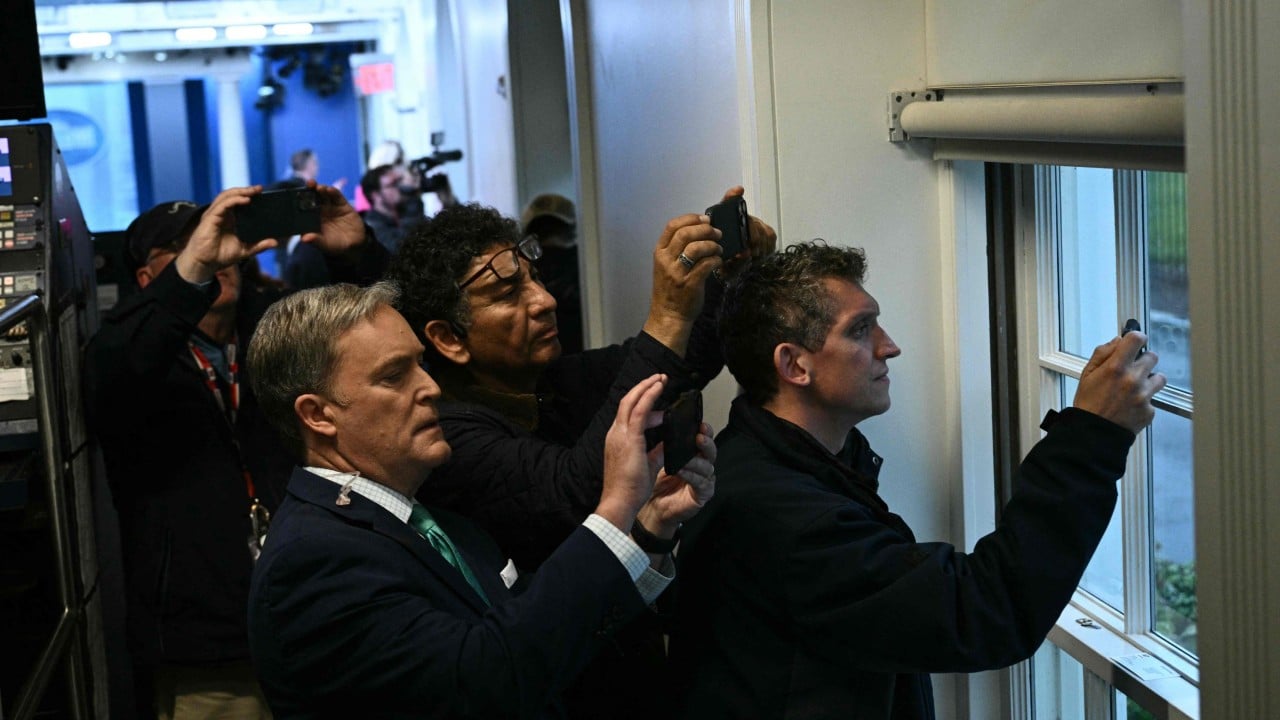
The marble corridors of the Longworth House Office Building possess a strange acoustic property. If you stand in exactly the right spot, beneath the sweeping arches of the stone ceiling, a murmur uttered on one side of the hallway bounces over the heads of the crowd and lands with crystal clarity into the ear of someone standing fifty feet away.
Washington has always been a city built on the mechanics of the whisper. For decades, the lifeblood of American journalism has not been the formal press conference, with its polished podiums and vetted talking points. It has been the hurried conversation in a dim garage, the encrypted text message sent from a burner phone at midnight, and the document slipped into a manila folder.
Now, the architecture of the whisper is being systematically dismantled.
Donald Trump’s intensified campaign to hunt down and punish federal employees who leak information to the media is more than a standard political crackdown. It represents a fundamental rewiring of how the public learns what its government is doing behind closed doors. When the machinery of the state turns its full weight inward, looking for the cracks in its own hull, the atmosphere inside the bureaucracy changes overnight. Paranoia becomes the default setting. Trust evaporates.
Let us trace the trajectory of an anonymous tip. To understand the gravity of this shift, look at a hypothetical mid-level analyst inside the Department of Homeland Security. We will call her Sarah.
Sarah does not view herself as a dissident or a spy. She is a career civil servant who has spent twelve years tracking budgetary anomalies and policy implementations under three different administrations. One Tuesday morning, she uncovers a directive that appears to violate statutory law—a quiet diversion of funds intended for humanitarian relief toward an unapproved surveillance initiative.
She tries the internal channels. She files a report with the Inspector General. The report sits on a desk, caught in a bureaucratic bottleneck that feels entirely intentional. Meanwhile, the policy is moving forward. The clock is ticking.
Sarah faces a choice that will define the rest of her life. She can remain silent, becoming complicit in an illegality by virtue of her inaction. Or she can reach out to a reporter.
In the old days, this was a calculated risk. Today, it is closer to professional and financial suicide. Under the current administration's aggressive enforcement directives, the tools deployed to find Sarah are no longer confined to standard administrative reviews. They are forensic, technological, and relentless.
The administration has weaponized the very infrastructure designed to protect national security, turning it toward the internal ranks. Polygraph examinations, which were once reserved for high-level espionage investigations or security clearance renewals, are being introduced as routine compliance checks. If Sarah’s name appears on an internal log of people who accessed the sensitive file, she may find herself strapped to a machine, watching the needles measure the sweat on her palms as she is asked if she has ever spoken to a member of the press.
The digital dragnet is even tighter. Every keystroke on a government-issued laptop is logged. Every print job leaves a microscopic yellow dot pattern that identifies the exact machine and the exact minute the paper was produced. Metadata is an unforgiving biographer. If a government employee moves their personal phone within a specific radius of a known investigative journalist's office, geolocation data can flag them as a security anomaly.
This is the reality of the modern federal workplace. It is an environment where holding a security clearance feels less like an honor and more like wearing a digital ankle monitor.
The argument from the White House is straightforward, and on its surface, it possesses a certain logical weight. A government cannot function if its internal deliberations are constantly spilled onto the front pages of newspapers. National security requires secrecy. Diplomatic negotiations demand privacy. When sensitive memos are leaked, it can compromise ongoing operations, endanger sources, and paralyze the decision-making process. A leader cannot command an army of four million civil servants if any disgruntled employee can hijack the narrative by dropping an unauthorized email into a reporter's inbox.
There is a legal framework here that the administration is leveraging with maximum force. The Espionage Act of 1917, a sweeping wartime statute, is no longer a historical artifact used for actual foreign agents. It has become the primary tool for prosecuting whistleblowers. By framing internal disclosures not as bureaucratic infractions but as existential threats to the republic, the state justifies the use of aggressive surveillance techniques against its own workforce.
But this argument ignores a vital counterweight in the American system of self-governance. The executive branch is not a corporate monolith where the CEO commands absolute loyalty. It is a public entity funded by taxpayers, accountable to Congress, and bound by the Constitution.
When the administration seals every window and locks every door, it eliminates the only safety valve the public has against waste, fraud, and the abuse of power.
Consider the historical ledger. Without the willingness of individuals to risk everything by speaking outside of official channels, the American public would have remained ignorant of some of the gravest overreaches in modern history. The secret bombing of Cambodia, the systemic deception of the Vietnam War revealed in the Pentagon Papers, the illegal wiretapping of American citizens under the post-9/11 surveillance state—none of these came to light through official press releases. They were dragged into the public square by people who decided that their allegiance to the Constitution superseded their non-disclosure agreements.
The current crackdown produces a chilling effect that extends far beyond national security secrets. It alters the daily behavior of scientists, regulators, and analysts across every agency.
Imagine an epidemiologist at the CDC who notices that data regarding a foodborne illness outbreak is being suppressed to protect a powerful agricultural lobby. Or an environmental engineer at the EPA who watches a major corporation get a pass on toxic dumping because of a political favor. If these experts know that sending an anonymous email will trigger a forensic audit of their hard drive and a mandatory polygraph, they will close the file. They will look at their mortgage, think of their children's college tuition, and keep their heads down.
The true casualty of this war on leaks is not the press corps. Journalists will always find stories. The true casualty is the accuracy of the information that reaches the public.
When career experts are terrified to speak, the only voices left are the political appointees. The narrative becomes entirely top-down. The nuance, the dissent, the internal warnings that a policy is disastrous—all of it is scrubbed clean before it reaches the daylight. The public is left with a sanitized version of reality, a theatrical production where every actor follows the script because the penalty for ad-libbing is ruin.
This environment changes the psychology of public service. The federal government has long relied on top-tier talent—scientists, lawyers, and economists who could make far more money in the private sector but choose the bureaucracy because they believe in the mission. When that bureaucracy begins to treat its employees like potential traitors, the culture rots from within. The brightest minds leave. The people who remain are often those who are most compliant, those least likely to challenge bad ideas or blow the whistle on corruption.
The administration’s strategy is not merely about punishment; it is about deterrence through spectacle. When a leaker is caught, the response is designed to be loud, public, and devastating. The goal is to ensure that every other employee watches the perp walk, reads about the canceled pension, and calculates the cost of their own conscience.
Yet, history suggests that total silence is an illusion. The human drive to expose injustice is notoriously difficult to fully suppress. When you close the standard channels of communication, people do not stop talking; they simply find more dangerous, erratic ways to be heard. They turn to foreign platforms, or they dump massive, unredacted datasets into the public domain without the careful vetting that responsible journalism provides, creating far greater risks to national security than a targeted disclosure ever would have.
The sun sets over the Potomac, casting long shadows across the concrete plazas of the Pentagon and the neoclassical facades of the National Mall. Inside those buildings, thousands of computer screens illuminate the faces of men and women who are deciding what to do with what they know.
The architecture of the whisper has changed. The stone walls no longer just carry the sound; they are listening back. And somewhere in an office complex in Northern Virginia, an employee stares at a document, feeling the sudden, cold weight of a choice that should never be this heavy in a free society.