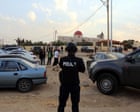
Seven people are dead. Forty more are bleeding in hospital beds. Gunmen opened fire on a Christian funeral in Jordan, and within hours, the global news cycle snapped into its predictable, prefabricated routine.
If you read the standard wire reports—including the lazy, surface-level coverage dominating your feed right now—you are being fed a dangerously comforting lie. The mainstream narrative frames this tragedy as an isolated spike in regional sectarian violence, an inevitable spillover from neighboring conflicts, or a random act of religious extremism. They count the bodies, quote a shocked official, mention regional tensions, and move on to the next outrage.
They are asking the wrong questions. And because they are asking the wrong questions, they are blinding you to the actual mechanics of security, governance, and ideological warfare in the Levant.
Having spent over a decade analyzing Middle Eastern security infrastructure and counter-terrorism failures from the ground up, I have watched Western outlets repeat this exact analytical mistake after every major attack from Amman to Beirut. Treating a coordinated assault on a funeral in the Hashemite Kingdom as just another headline about Middle Eastern instability ignores the calculated, strategic reality of what just happened. This was not random hatred. It was a deliberate stress test of Jordan’s internal security apparatus—and a calculated strike at the quiet social contract that keeps the country from imploding.
The Lazy Consensus of "Spillover Violence"
Walk into any major newsroom when an attack happens in Jordan, and you will hear the exact same reflex. Editors immediately reach for the "regional spillover" framing. The logic goes like this: the surrounding neighborhood is on fire, therefore sparks are bound to land in Amman.
That framing is intellectually bankrupt. It treats terrorism like weather—an uncontrollable atmospheric pressure system rather than a deliberate, resource-intensive military operation.
Gunmen do not accidentally wander into a crowded funeral with automatic weapons and ammunition capable of inflicting nearly fifty casualties. That requires reconnaissance. It requires weapons smuggling across heavily militarized borders. It requires safe houses, logistical networks, and operational security capable of bypassing the General Intelligence Directorate (GID)—widely recognized by defense analysts and institutions like the Washington Institute for Near East Policy as one of the most pervasive and capable intelligence services in the Arab world.
When a competitor's headline simply states that gunmen opened fire at a church funeral, it strips away agency and strategy. It implies a sudden eruption of mob rage. In reality, high-casualty attacks on soft targets in tightly controlled security states are almost always asymmetric signaling. The perpetrators are not trying to win a religious debate. They are trying to prove that the state cannot protect its most vulnerable minorities, thereby fracturing the domestic legitimacy of the monarchy.
What the Headlines Ignore About Jordanian Security Architecture
To understand why this attack matters, you have to understand how Jordan actually functions. Unlike failed or fracturing states in the region, Jordan relies on a deeply entrenched patronage system and a hyper-vigilant security state. Historically, Jordanian Christians—who make up a small but historically foundational percentage of the population—have enjoyed high levels of state protection and political integration relative to their neighbors.
That protection is not charity. It is a cornerstone of the Hashemite brand. King Abdullah II and the Jordanian establishment have spent decades positioning the kingdom as an island of interfaith stability and a reliable Western ally.
Attackers know this. When militants target a Christian funeral, they are executing a classic asymmetric strategy outlined decades ago by counter-insurgency theorists like David Galula and later operationalized by jihadist strategists like Abu Musab al-Suri: attack the protected minority to humiliate the protector.
Imagine a scenario where a rival syndicate wants to bankrupt a high-end private security firm. They do not attack the firm's heavily fortified headquarters. They walk into the lobby of the firm's most prestigious, publicly visible client and cause chaos. The physical damage is localized, but the reputational damage to the security firm is total.
That is the exact calculus behind striking a church funeral in Jordan. The casualty count is horrific, but the operational objective is psychological. It tells the domestic population that the GID is not omniscient. It tells international investors and tourists that the oasis is no longer insulated. And it forces the Jordanian military and intelligence services into a defensive crouch, diverting resources from border interdiction to domestic static defense.
Dismantling the "People Also Ask" Fallacies
Whenever an attack like this hits the algorithms, search engines flood with the same predictable queries. Let’s look at the questions people are actually typing into Google right now—and dismantle the flawed premises baked into every single one of them.
"Is Jordan becoming unsafe for Christians?"
This question treats safety as a binary switch—either a country is a peaceful utopia, or it is a warzone. That is not how threat environments work. Jordan remains vastly more secure for religious minorities than Syria, Iraq, or Lebanon. However, treating safety as a static condition ignores the reality of cellular infiltration. Jordan does not have a widespread domestic sectarian civil war brewing; what it has is a porous northern and eastern border crisis driven by Iranian-backed militias and Captagon smuggling networks that have flooded the region with weapons and cash. The danger is not your neighbor turning on you. The danger is external networks exploiting smuggling corridors to insert armed cells into domestic soft targets.
"Why didn't intelligence stop the funeral attack?"
The public watches too many movies. They assume intelligence agencies have magic satellites that read minds. In counter-terrorism, this is known as the "defender's dilemma." Intelligence services must succeed every single day, across thousands of potential targets, against an enemy that only needs to get lucky once. Funerals are uniquely vulnerable soft targets. Unlike a Sunday church service, which happens on a predictable schedule and can be hardened with bollards and armed guards, funerals are planned within 24 to 48 hours. They are emotionally charged, chaotic, and open to the public. Expecting state security to seamlessly lock down every pop-up gathering without turning the country into an open-air prison is a fantasy.
"Is this directly tied to regional wars?"
Yes, but not in the simplistic way cable news pundits claim. It is not just "anger" spilling across borders. It is operational opportunism. When regional powers are locked in high-intensity conflicts, border security degrades, black-market weapons prices drop, and extremist recruiters have an easier time radicalizing disenfranchised young men. The war next door didn't cause the shooting; it lowered the logistical barrier to entry for the shooters.
The Hard Truth About Hardening Soft Targets
If you are a security director, a diplomat, or an NGO operating in the Levant, the standard advice you will get from corporate risk consultants after an event like this is pure theater. They will tell you to hire more unarmed guards, install metal detectors at church doors, and issue travel advisories.
I have watched organizations blow millions of dollars on this kind of security theater. Metal detectors at the entrance of a crowded gathering do nothing against gunmen willing to die in a firefight; they just create a bottleneck of trapped people outside the door, giving shooters a denser target.
Real risk mitigation in high-threat environments requires abandoning comfortable illusions and implementing brutal, unglamorous protocols:
- Ditch the static perimeter: Armed guards standing visibly at a front gate are simply the first targets to be neutralized in an assault. Effective protective details operate in concentric, layered rings, utilizing plainclothes spotters positioned blocks away to identify pre-attack surveillance and vehicle staging.
- Control the choke points, not just the doors: Most mass-casualty attacks in the Middle East succeed because attackers can drive directly up to the venue, dismount, and engage immediately. If a venue lacks standoff distance—at least 50 to 100 meters of vehicle-free buffer zone—no amount of indoor security matters.
- Compartmentalize public schedules: For high-risk communities, publishing exact times and locations of large gatherings on public social media feeds is operational suicide. Information hygiene must become a community standard, moving event logistics to verified, encrypted channels until the last possible moment.
- Invest in immediate trauma response, not just prevention: Look at the numbers from this attack: seven dead, forty injured. In mass shootings, the difference between an injury and a fatality is measured in minutes, specifically how fast someone stops arterial bleeding. Standard first-aid kits are useless against rifle rounds. Facilities in volatile zones need wall-mounted trauma stations stocked with combat tourniquets and hemostatic gauze, paired with staff trained to use them before ambulances arrive.
The Downside Nobody Wants to Admit
There is a massive catch to this reality, and pretending it doesn't exist would be dishonest.
Every single measure required to actually stop this kind of attack corrodes the very society it is meant to protect. If Jordan responds to this shooting by turning every funeral, wedding, and religious gathering into a militarized checkpoint, the attackers win without firing another shot.
Hyper-securitization breeds paranoia. It disrupts commerce. It reminds minorities every single day that they exist only behind blast walls and armed escorts. Furthermore, heavy-handed intelligence sweeps—the inevitable reflex of a state embarrassed by a security breach—frequently sweep up innocent people alongside actual militants, creating fresh grievances that terrorist recruiters will harvest three years from now.
Governments are trapped between two bad options: allow soft targets to remain vulnerable to catastrophic violence, or suffocate civil society with a draconian security apparatus that alienates the public. There is no clean middle ground. Anyone selling you a painless policy solution is lying.
Stop Reading the Casualty Count and Start Watching the Response
The media will move on from these seven deaths by Tuesday. They will find another crisis, another outrage, another superficial headline to feed the content machine.
If you actually care about what happens next in the Middle East, ignore the pundits debating the motives of the gunmen. Watch the Jordanian security apparatus over the next thirty days. Watch whether the raids target isolated lone wolves or dismantle cross-border smuggling networks. Watch whether the state quietly restricts public gatherings or doubles down on intelligence partnerships with Western agencies.
Because a shooting at a funeral is never just about the people in the ground. It is a live-fire test of whether a state still holds the monopoly on violence—and right now, the whole region is waiting to see if Amman passes.



