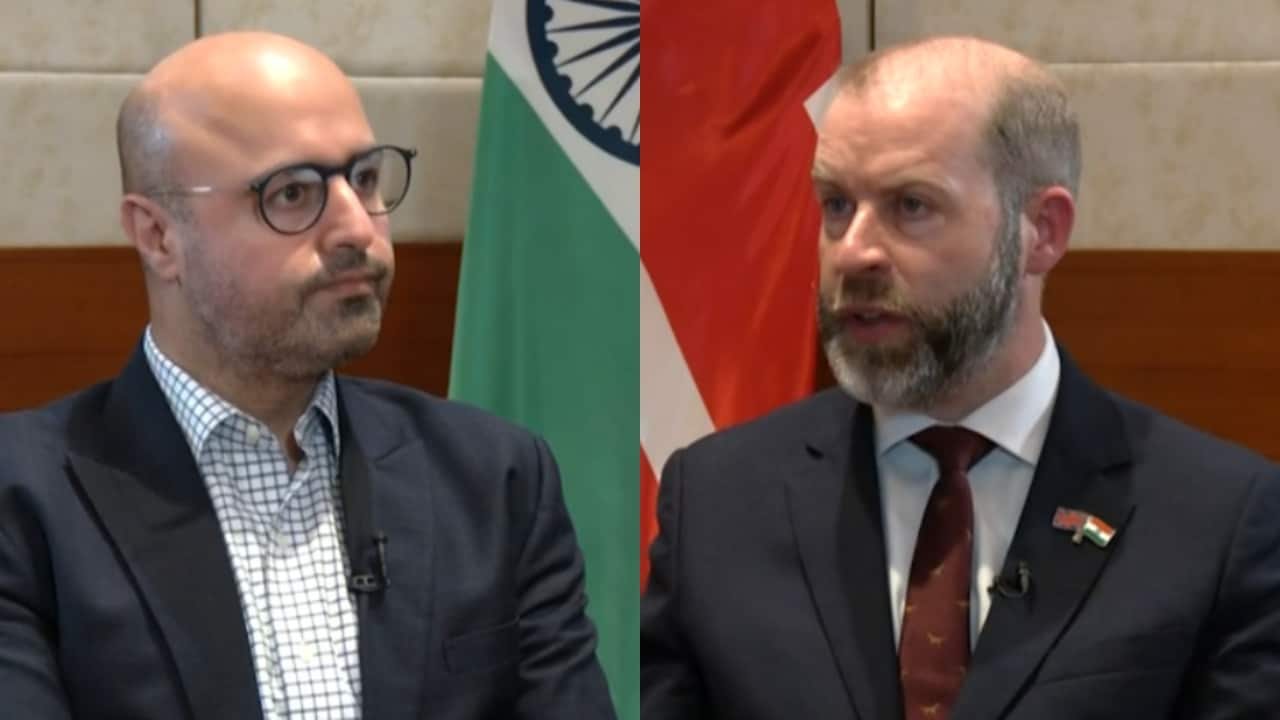
Foreign ministers love handing out gold stars for democracy until the check clears.
British officials caught the microphone recently and offered sweeping praise for India's governance model against a backdrop of local street demonstrations. It plays well on evening broadcasts. It sounds like high-minded statesmanship across the Atlantic. It is also a masterclass in strategic fiction.
We treat international praise for foreign elections like validation of an institutional scoreboard. If a foreign dignitary nods approvingly at a nation's voting tallies, the narrative settles into comfortable complacency: the system works, the checks and balances hold, and everyone breathes a sigh of relief.
That is the lazy consensus. It misses the entire point of how modern geopolitical survival actually operates.
Foreign capitals do not care about the health of India's judiciary, the tone of its broadcast media, or the granular details of local legislative friction because they love political theory. They care because India is the ultimate swing state in a fractured global supply chain. When a UK minister stands at a podium and applauds democratic resilience amidst civil unrest, they are not assessing civic virtue. They are securing trade corridors.
The Transactional Reality of Institutional Praise
Let us be entirely clear about the mechanics of diplomatic flattery.
Realpolitik operates on leverage, not sentiment. India represents a market of over a billion consumers, a massive digital infrastructure, and a crucial geopolitical counterweight against an expansionist Beijing. Western nations need a stable partner in South Asia that can manufacture goods, buy defense hardware, and project regional stability.
If you possess the fifth-largest economy on earth and hold the geographic keys to the Indo-Pacific, you could hold elections via carrier pigeon and still receive standing ovations in London and Washington.
The mistake analysts make is parsing these diplomatic statements as human rights assessments. They are not. They are economic insurance policies. When foreign ministries validate domestic political models during periods of intense protest, they are engaging in a calculated ritual of mutual convenience. New Delhi gets international legitimacy; Western partners get supply chain diversification away from China.
Pretending this is about the sanctity of the ballot box is an insult to anyone who understands basic international relations.
Why Protest Is Not a Glitch But the Core Operating System
Domestic critics and international observers often look at widespread demonstrations in urban centers and panic. They view street protests against agricultural reforms, citizenship laws, or economic policies as proof that the constitutional machinery is seizing up.
They have it backward.
In a massive, hyper-diverse federal republic, friction is not an indicator of failure. Friction is the engine.
Western political science models are obsessed with smooth consensus. They assume a functioning democracy looks like a tidy parliamentary debate in Scandinavia, where everyone agrees on tax brackets and renewable energy targets over artisanal coffee. That model shatters entirely when applied to a subcontinent with twenty-two official languages, dozens of distinct regional political movements, and immense wealth disparities.
India does not achieve stability through calm uniformity. It achieves stability through a chaotic, loud, and sometimes violent contest of competing local interests.
When millions take to the streets, it does not mean the system is breaking down. It means the safety valves are functioning. In nations where dissent is genuinely crushed, you do not see mass protests on television; you see total silence, followed by sudden structural collapse. The noise in Indian public squares is the sound of a billion people negotiating a shared reality in real time.
The Western diplomats praising this process are often secretly terrified of it. Their own domestic political spheres are increasingly brittle, paralyzed by hyper-partisanship and institutional sclerosis. Watching a sprawling, messy democracy absorb massive shocks, adapt, and keep moving forward looks alien to leaders whose home legislatures can barely pass a municipal budget without a crisis.
The Myth of the Neutral Observer
Who gets to define a healthy democracy anyway?
For decades, the global standard for democratic health has been authored by think tanks in Washington and London using metrics that heavily favor Western European institutional norms. They grade countries on press freedom indices, judicial independence scores, and bureaucratic transparency models that often fail to reflect the realities of governing developing nations.
This creates a peculiar double standard. When a Western democracy struggles with police accountability, economic inequality, or electoral interference, it is chalked up to growing pains or political evolution. When India experiences similar institutional strains, it is diagnosed as a democratic crisis on the verge of collapse.
This framing serves a specific political utility. It keeps the West in the eternal role of the teacher grading the homework of the Global South.
I have watched foreign policy analysts spend months dissecting procedural controversies in New Delhi while completely ignoring the structural decay happening in their own electoral systems. The hypocrisy is staggering. True institutional authority does not come from earning a passing grade from a European policy institute. It comes from the ability to govern a continent-sized population without descending into civil war or authoritarian collapse.
What Everyone Gets Wrong About Political Resilience
The conventional narrative assumes that democracy survives when everyone agrees on the rules.
History proves the exact opposite. Democracy survives when the rules are strong enough to withstand people who want to break them, yet flexible enough to accommodate populations that feel entirely ignored by the center.
India's political durability does not stem from pristine institutions or polite discourse. It stems from deep-rooted political consciousness. Voter turnout in rural and marginalized communities often outpaces affluent urban centers precisely because ordinary citizens understand that the ballot box is their only leverage against entrenched local hierarchies.
When a farmer in Punjab or a gig worker in Bengaluru marches for their interests, they are participating in a system that forces elites to negotiate. That is messy. It is inefficient. It stalls major economic reforms for years.
It is also the only way a multi-ethnic democracy of this scale avoids tearing itself apart at the seams.
The Real Story Behind the Headlines
Strip away the diplomatic theater. Ignore the breathless commentary from foreign pundits who have never spent a week outside a five-star hotel in South Delhi.
The resilience of India's governance model does not rest on the approval of foreign ministers looking for trade partners. It rests on the sheer stubbornness of a populace that refuses to be ignored by its rulers.
Next time you read about a visiting dignitary praising local democratic traditions, stop looking at the podium. Look at the balance sheets, the supply chain contracts, and the geopolitical chess board. That is where the truth lives. The speeches are just for the cameras.


