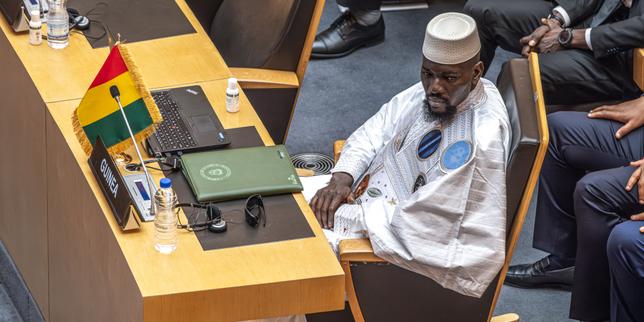
The tarmac at Ahmed Sékou Touré International Airport shimmered under the heavy August heat. For eleven days, the capital had breathed a different kind of air. It was an air charged with quiet speculation, whispered theories in the bustling markets of Madina, and cautious glances across government corridors. When General Mamadi Doumbouya boarded a flight toward Greece at the start of the month, the official word was simple: annual leave. Yet, in a country where power is forged in the aftermath of upheaval, a president's absence is never treated as a mere vacation.
Consider the ordinary citizen sitting under the tin roof of a Conakry café, listening to the radio crackle. To the outside observer, a leader taking a brief respite is mundane. Here, it triggered an immediate collective holding of breath. Whispers traveled faster than data. Was the grip slipping? Were the institutional foundations sturdy enough to withstand the pause of a single man?
The machinery of the state swung into motion immediately to project absolute control. Military chiefs stepped before the cameras, their posture rigid, their voices dense with warnings against misinformation. They spoke of unshakeable loyalty. They mapped out a picture of a nation running smoothly on autopilot. But in political physics, whenever a regime feels compelled to loudly reassure its people that everything is fine, the underlying tremor is already being felt by everyone in the room.
Then came the return.
The general stepped back onto domestic soil, cutting his private stay short to confront the murmurs head-on. No leader survives the fragile architecture of a transition by hiding behind bureaucratic statements. Doumbouya understood that perception dictates reality. His immediate reappearance was designed to shatter the narrative of vulnerability.
Words followed action with striking velocity. Addressing the nation, the tone was uncompromising. There were no soft diplomatic cushions. He invoked the absolute necessity of institutional discipline, targeting corruption with a bluntness that left little room for ambiguity. When a leader's authority is quietly questioned in the alleys and coffee shops, the response cannot be ordinary governance. It must look like total reassertion.
To anchor this fragile stability into something permanent, the administration moved beyond mere rhetoric. Maps were redrawn. New administrative regions and prefectures materialized out of recent population data, stretching the reach of the central government deeper into the provinces of Siguiri and Beyla. Imagine a sprawling web trying to catch every falling leaf before it hits the ground. That is what administrative expansion looks like when a government seeks to prove its omnipresence. It is an exercise in footprint-building. By bringing the state closer to the populace, the message was unmistakable: the center holds.
Yet, doubts in politics possess a long half-life. They do not vanish simply because a plane lands or a decree is signed. They retreat into the shadows, waiting for the next test of endurance.
The heat over Conakry remains thick. The market vendors return to their stalls, and the daily struggle for livelihood resumes beneath a relentless sun. Power, ultimately, is not maintained merely by the force of a uniform or the speed of a presidential return. It lives in the quiet space between what a government promises and what a citizen dares to believe.