The air inside the federal courtroom in Buffalo was heavy with the sort of silence that usually precedes a verdict or a funeral. Four years had passed since a peaceful summer morning in western New York was violently fractured, yet the shadow of that amphitheater stage still stretched long across the room.
Salman Rushdie sat upright, taking his place on the witness stand to do something extraordinary. He was there to bear witness not just against the man who tried to kill him, but for the fragile, enduring premise that words matter more than weapons.
Consider what happened next, because the reality of violence is rarely a clean cinematic struggle. It is clumsy. It is sudden.
Rushdie recalled the initial moments of the 2022 attack with the precision of a man who has replayed them in the dark thousands of times. He felt what he first mistook for a heavy punch beneath his chin. There was no grand theatrical warning. There was only the sudden, hot rush of liquid, followed by a realization that defied comprehension.
"Soon I was on the stage, lying down, with an enormous pool of blood all around me," Rushdie told the court, his voice steady against the weight of the memories. "It was an enormous and expansive lake of blood."
Fifteen knife wounds. Fifteen strikes delivered from behind by a man who had spent years nursing a digital trail of grievances, tracking schedules, and writing notes to himself about an urgent need to destroy a life. During the federal terrorism trial, prosecutors laid out the blueprint of that radicalization—messaging apps filled with digital anger, references to old fatwas issued decades prior, and a calculated pursuit that culminated on a stage meant to celebrate the safety of writers.
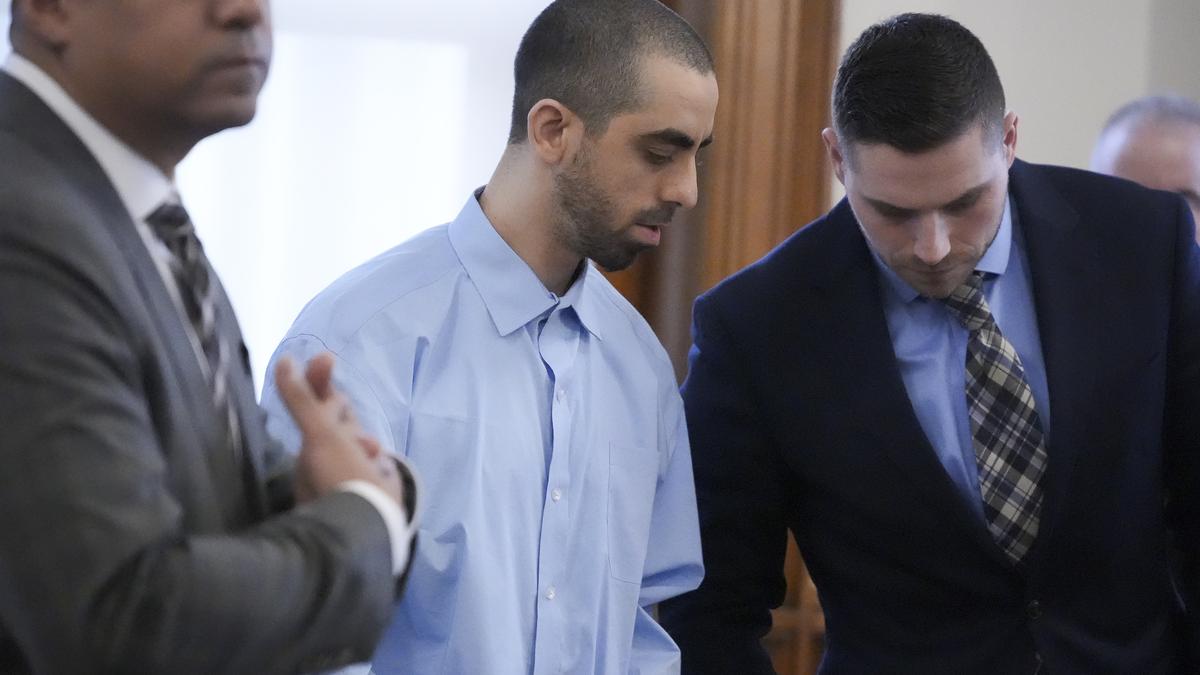
The defendant, Hadi Matar, sat just yards away, frequently staring down at the defense table, occasionally leaning over to speak to his attorney while avoiding eye contact with the man he had ambushed. Rushdie, too, offered only a fleeting glance. The distance between them was measured not just in feet across a courtroom floor, but in entire philosophies of human existence. One side represented the force of dogma and blade; the other represented the stubborn, bleeding resilience of thought.
At one point during the proceedings, Rushdie removed his glasses. He turned toward the jury box and showed them his right eye, now sightless.
It was a quiet, devastating gesture. The physical toll of that morning at the Chautauqua Institution remains etched into his daily existence: a damaged liver, a paralyzed hand that slowly fought its way back to life, and a margin of survival so razor-thin that medical professionals noted the blade came within a millimeter of his brain.
The defense argued over the boundaries of intent, questioning whether the legal definition of transnational terrorism applied, and probing whether the author had anticipated blowback when he published The Satanic Verses back in 1989. Rushdie’s response was characteristically sharp. For decades, he had walked public streets, lived an open life, and trusted that time had cooled the fires of fanaticism.
"For two decades or more, I led a public life without a hint of trouble," he testified.
When pressed further about the controversies of his past work, he cut through the legal sparring with a sentence that reframed the entire proceeding: "I believe someone else is on trial".
He was right, of course. The pages of a novel written decades ago were not bleeding on that courtroom floor. A man's freedom, a nation's commitment to justice, and the fundamental right to speak without fear of assassination were the elements hanging in the balance.
We often talk about freedom of expression as an abstract legal theory, a dusty line in a constitutional text or a talking point for political debates. But freedom has a physical weight. Sometimes, that weight looks like an 79-year-old author sitting under bright courtroom lights, missing the sight in one eye, detailing the exact distance a blade missed his brain just to ensure that violence does not get the final word.
The trial will end, the jury will deliberate, and the legal machinery will record its judgments. But the image that lingers is not of the steel or the shadows. It is the silhouette of a writer who stepped back up to the microphone, refusing to let the dark dictate the end of his story.