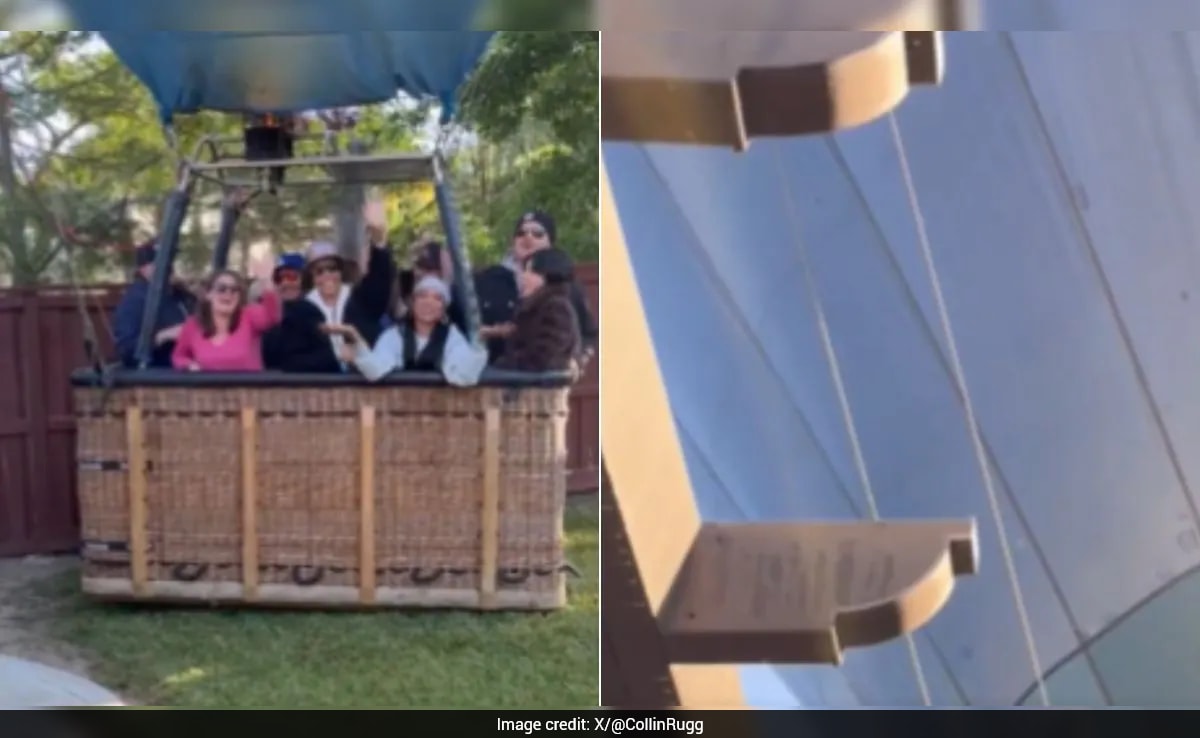
The wicker basket of a hot air balloon is a fragile contradiction. It is sturdy enough to carry the weight of thirteen human lives, yet light enough to be bullied by a shift in the coastal breeze. When you are two thousand feet above the San Diego coastline, the world is a muted painting of turquoise and terracotta. There is no engine hum. There is only the rhythmic, dragon-like roar of the propane burner and the terrifyingly beautiful realization that you are essentially a passenger in a giant silk bubble.
For thirteen people drifting over the affluent enclave of Solana Beach on a Sunday evening, that silence suddenly became heavy.
The transition from a scenic sunset tour to a survival situation doesn't usually happen with a bang. It happens with a calculation. A pilot looks at the fuel gauges, feels the cooling air of the Pacific marine layer pushing inland, and realizes the math no longer adds up. The designated landing zone—usually a wide-open park or a vacant lot—might as well be on the moon if the wind decides to push you three degrees to the left.
The Physics of an Unplanned Descent
To understand why a multi-ton aircraft ended up in a suburban backyard, you have to understand the invisible war between hot air and gravity. A balloon doesn't have a steering wheel. It has a vent cord and a blast valve. To move horizontally, a pilot must find a layer of air moving in the desired direction by changing altitude.
But as the sun dips below the horizon, the thermodynamics change. The ground cools. The air gets dense. If a pilot finds themselves "boxed in" by buildings and power lines, the options narrow until there is only one choice left: put the basket down wherever the ground is flat enough to take it.
On this particular evening, the "flat enough" spot turned out to be the meticulously landscaped backyard of a residential home.
Thirteen Hearts in a Wicker Box
Imagine standing in that basket. You aren't a "passenger" anymore; you are a variable in a high-stakes physics experiment.
Among the thirteen was a group of friends, perhaps celebrating a birthday or an anniversary. They had spent the last hour clinking plastic flutes of cheap champagne, peering down at the sprawling mansions and the winding ribbons of the Pacific Coast Highway. Then, the tone changed. The pilot’s voice, previously filled with trivia about the local geography, likely turned sharp and instructional.
"Stay inside the basket. Hold on to the internal handles. Knees bent."
The terror of an emergency landing isn't the height; it’s the obstacle course. In a place like Solana Beach, the sky is a minefield of high-voltage power lines, palm trees, and chimneys. One wrong gust and the nylon envelope—the "balloon" part of the craft—snags on a transformer. If that happens, the silence of the sky is replaced by the violent crackle of electricity.
The pilot managed to thread the needle.
The Backyard Invasion
The residents of the home were likely settling in for a quiet Sunday night when the sky literally fell. A hot air balloon is roughly seven stories tall. When it lands in a suburban yard, it doesn't just sit there. It looms. It breathes. The massive fabric envelope collapses slowly, draped over fences and patio furniture like a ghost of a giant.
Local authorities, including the San Diego County Sheriff's Department and firefighters, arrived to a surreal scene. A dozen stunned tourists were climbing out of a basket nestled between a swimming pool and a sliding glass door.
There were no injuries. No fire. No blood.
By the standards of aviation reporting, it was a "non-event." But for the thirteen people who felt the jolt of the wicker hitting the grass, it was a fundamental shift in perspective. They went from being observers of the world to being intruders in it.
The Hidden Cost of the View
We live in an era where we expect total control over our environments. We book "experiences" through apps with the expectation of a guaranteed outcome. We pay for the sunset, the safety, and the story.
But the "Video: Hot Air Balloon Carrying 13 People Makes Emergency Landing" headline misses the true narrative. It’s not a story about a mechanical failure or a pilot’s error. It is a story about the stubbornness of nature. We can stitch together the strongest ripstop nylon and burn the purest propane, but we are still ultimately guests of the atmosphere.
When the balloon landed, the "experience" ended and reality began. The passengers had to deal with the awkwardness of standing in a stranger's yard, the adrenaline dump of a near-miss, and the logistical headache of getting home from a place they were never supposed to be.
The homeowner, meanwhile, was left with a story that would last a lifetime and a backyard that suddenly felt much smaller.
There is a specific kind of hum in the air after something like this happens. It’s the sound of thirteen people realizing that the ground is much firmer than they remembered. They walked away from the basket, leaving the deflated silk behind, and stepped back into a world where they were no longer drifting.
The silk was packed away. The propane tanks were secured. The backyard was eventually cleared. But as those thirteen people lay in their own beds that night, the walls of their bedrooms likely felt a little more solid, and the sky outside their windows felt a lot more vast.
Gravity always wins. The trick is to negotiate the terms of your surrender so that you land on the grass instead of the wires. On a quiet Sunday in California, thirteen people negotiated perfectly. They didn't just land; they arrived back at the realization that life is a series of controlled falls, and sometimes, the best part of the flight is the moment your feet finally touch the earth.
The balloon is gone now, but the silence it left behind in that Solana Beach neighborhood is different than it was before. It’s a silence that knows how easily the sky can open up and drop a dozen strangers into your life.


:strip_icc()/pic2513216.jpg)