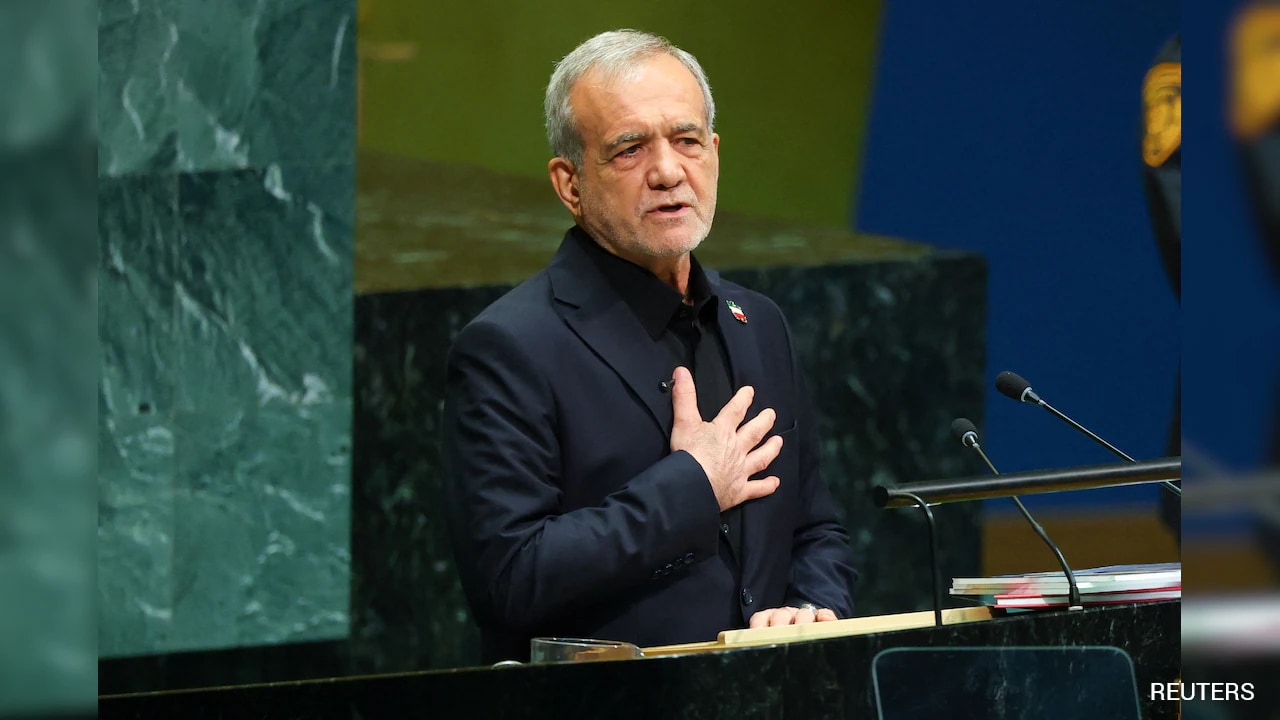
The desk is heavy. It is made of dark, unyielding wood that has absorbed the sighs of men who thought they could command the tide.
Across that desk, the air tastes like old paper and unlit matches. When a head of state speaks of weariness, of an exhaustion that transcends biological sleep and settles deep into the marrow of institutions, pay attention. Weariness in high places is rarely just a personal grievance. It is a tectonic shift. It is the sound of ice cracking beneath a winter road.
"We do not wish to continue."
The words are simple, almost startling in their plainness. They were uttered against a backdrop of regional fracture, lingering smoke, and the ceaseless calculus of deterrence that defines modern statecraft. But beneath the diplomatic vocabulary lies a rawer truth. War is an engine that demands constant feeding, and eventually, even the hands that stoke the furnace grow blistered. The Iranian president’s assertion that the ball is in Washington’s court—that the onus to end the cycle rests entirely across an ocean—is more than a political pivot. It is an invitation to stare into the machinery of escalation and ask a terrifying question: Who actually holds the off switch?
Consider what happens in a quiet kitchen miles away from any parliament or command bunker.
Imagine a young woman in Tehran wiping flour from her hands, listening to the radio while the autumn light fades through a lace curtain. She is not a general. She is not a strategist calculating missile trajectories or sanctions relief. She is simply living inside the friction of two nations locked in a perpetual game of geopolitical chicken. To her, the grand rhetoric of resistance and containment translates into the price of medicine, the tremor of anxiety when a headline turns sharp, and the quiet, stubborn persistence of everyday life.
When leaders posture from podiums, they speak in abstractions. They talk of proxies, enrichment percentages, strategic depth, and red lines. But history is made of kitchens, not war rooms. History is the accumulation of what ordinary people endure while men in tailored suits decide how much pressure a population can bear before it fractures or hardens into something unrecognizable.
For decades, the dynamic between Tehran and Washington has operated on a grim physics of action and reaction. One side presses; the other pushes back. Sanctions bite deep into the economy, squeezing ordinary citizens while hardening the resolve of the apparatus built to resist them. Retaliation breeds retaliation until the original grievance is lost beneath a mountain of fresh grievances. It becomes a theater of mutual assured resentment.
Yet, every protracted conflict reaches a thermodynamic limit. Energy dissipates. The cost—measured not just in dollars or military hardware, but in human capital, diplomatic capital, and the sheer psychological exhaustion of endless hostility—begins to outweigh any conceivable gain.
When the leadership in Tehran signals a fatigue with the ongoing friction, it opens a narrow, fragile window. Whether that window is an opening for genuine diplomacy or merely another tactical maneuver in a long chess match is the question haunting every intelligence desk from Langley to Vienna. But motives matter less than the reality of the stalemate. Stalemates have a way of rotting from the inside out.
The argument that "it is up to the United States to end the war" is vintage realpolitik, designed to shift the burden of concession onto the adversary. It frames the Islamic Republic as a respondent rather than an instigator, ignoring the complex web of regional actions that helped build the very walls enclosing them. It is a narrative designed for domestic consumption and international staging, a rhetorical jiu-jitsu that attempts to turn exhaustion into moral leverage.
We must look past the choreography of the blame game.
The United States, for its part, views the region through the lens of non-proliferation, maritime security, and the protection of regional allies. To Washington, ending the cycle cannot mean rewarding destabilizing behavior or abandoning security commitments built over half a century. The American establishment looks at Tehran’s regional network—from Lebanon to Yemen—and sees an ongoing security threat that cannot simply be wished away by a conciliatory phrase dropped in an interview.
Herein lies the trap of modern enmity. Both sides are trapped in narratives of their own making. Both are convinced that blinking first is a sign of existential weakness.
And so the machine grinds on.
Or does it?
There is a distinct rhythm to the descent of empires and the cooling of feuds. It rarely happens in a blaze of dramatic treaty-signing on the deck of a battleship. More often, it happens in whispers, in backchannels, in the quiet realization that the alternative—perpetual, managed hostility—is slowly consuming the very nations waging it.
When an Iranian president says they do not wish to continue, he is acknowledging a fundamental reality that economic charts and military intelligence reports have been whispering for years: the cost of the standoff is climbing faster than the capacity to pay it. The rial tells a story of unrelenting domestic strain. The quiet grumblings of a populace grappling with inflation, environmental degradation, and restricted futures tell another.
Leadership, even authoritarian leadership, cannot entirely insulate itself from the crushing weight of economic gravity. You can rhetoric your way through a crisis for only so long before the grocery store shelves and the empty factories demand a reckoning.
What would it actually take to break the spell?
It requires a leap of imagination that diplomacy rarely affords. It requires stepping outside the well-worn grooves of suspicion. For Washington, it means testing whether a diplomatic opening is genuine or a trap. For Tehran, it means accepting that sovereignty and security cannot be built on the perpetual threat of regional conflagration.
Neither side trusts the other. Trust, in these altitudes, is a dangerous currency. But absence of trust is not an excuse for paralysis. History is full of bitter enemies who stopped fighting not because they suddenly loved one another, but because they finally understood that the fire they were feeding was about to consume their own houses.
Back in that kitchen in Tehran, the radio broadcast fades into music. The woman goes back to her kneading. The dough resists, then yields, then stretches under the pressure of her palms.
Somewhere across the world, a diplomat adjusts his glasses, looking at a briefing paper that says the same things it has said for twenty years, yet feels strangely different today. The ink is the same. The names are the same.
Only the air has changed. It is thinner now. And the smell of smoke is a little too close for comfort.