The screen of the smartphone illuminated the damp walls of a concrete basement in Kharkiv. Outside, the low, rhythmic thud of artillery vibrated through the earth, a familiar bassline to a life lived in suspension.
Inside, Olena did not look up at the ceiling. She was staring at a Telegram notification.
To the rest of the world, the news was a headline, a push notification on a Tuesday morning, a clean arrangement of black letters on a white background: Ukraine’s president had dismissed his defense minister. But to Olena, who spent her days sourcing tactical medical kits and night-vision optics for boys she had watched grow up, the news felt like a sudden drop in cabin pressure.
Trust, in a country fighting for its survival, is not an abstract moral concept. It is a currency. It is the fuel that keeps civilian volunteers packing boxes of dried soup at three in the morning. When that trust is shaken at the very top, the ground beneath everyone’s feet begins to feel soft.
The Anatomy of an Exit
Wartime leadership is a meat grinder of human relationships.
The dismissed minister had been a constant. He was a face associated with the darkest days of February 2022, a man who stood shoulder-to-shoulder with the president when the world gave Kyiv three days to fall. He was the one who translated Ukraine’s desperate battlefield needs into the polite, bureaucratic language of Western defense departments. He secured the air defense systems that kept Olena’s city from turning entirely to ash.
Then, with a signature on a decree, he was gone.
The official reasons cited were the need for "new approaches" and a clean slate after months of grinding, static warfare. There were whispers of procurement scandals deeper down in the ministry hierarchy—scandals that did not directly touch the minister himself but left a greasy film on the institution he ran. In a war of survival, even the perception of rot is a luxury the state cannot afford.
But the public did not see a calculated bureaucratic reset. They saw a scapegoat. They saw the sudden removal of a man who had become a psychological anchor.
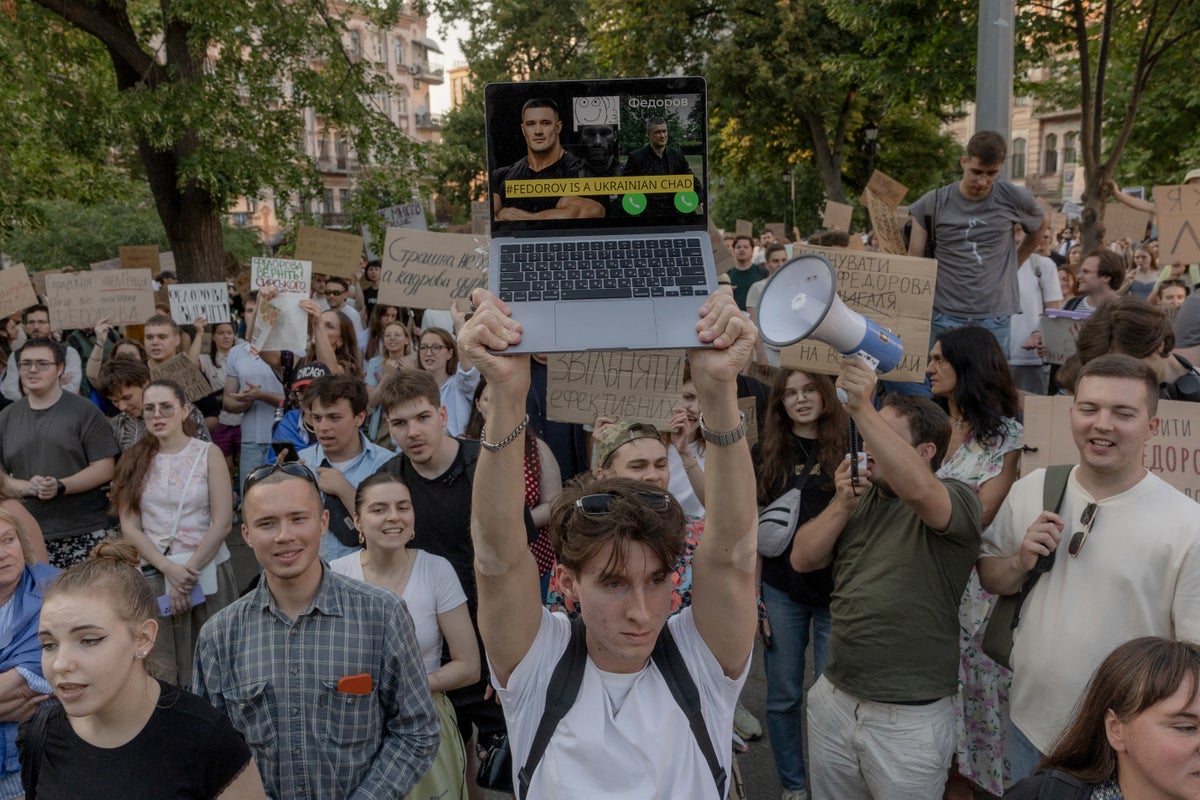
Within hours of the announcement, the streets near Maidan Nezalezhnosti in Kyiv, usually quiet during the weekday air alerts, saw small, quiet gatherings. These were not the loud, flag-waving protests of peacetime. They were gatherings of quiet fury. People stood in the cold drizzle, holding hand-painted cardboard signs, their eyes reflecting the neon signs of closed cafes.
They felt betrayed.
The View from the Trenches
To understand why a cabinet reshuffle can spark outrage during a war, you have to leave the high-ceilinged offices of Bankova Street in Kyiv and travel east.
Consider a soldier we will call Dmytro. He is thirty-four, a former high school history teacher now holding a trench line outside Bakhmut. His world has shrunk to a few hundred meters of churned grey mud, the smell of wet wool, and the constant, high-pitched whine of reconnaissance drones overhead.
For Dmytro, political stability in Kyiv is synonymous with his supply line.
"When they change the leaders in the capital, we don't think about politics," Dmytro said through a crackling voice note sent via an encrypted app. "We think about the shells. We think: will the new guy know how to get us the 155mm ammunition by next week? Or will everything freeze for a month while the new team finds their desks?"
This is the hidden cost of political upheaval in a nation under siege. Every transition, no matter how necessary, introduces friction. And in war, friction costs lives.
The outrage that spilled onto the streets of Kyiv and flooded Ukrainian social media was not merely about affection for one man. It was a collective panic attack. It was the fear that the fragile machinery keeping the frontline supplied was being dismantled by politicians playing a different game.
The President’s Lonely Calculus
Volodymyr Zelensky occupies a space of unimaginable isolation.
He knows that the initial romantic narrative of the Ukrainian resistance has faded in the eyes of the international public. The war has entered a grueling, industrial phase. It is a war of attrition, of factory outputs, of grain corridors, and of cold, hard math.
To keep Western allies sending billions of dollars in aid, the president must project absolute, uncompromising intolerance for internal inefficiency and corruption. If a ministry underperforms, or if the public begins to suspect that funds are being mishandled, the flow of foreign weapons could dry up.
So, he made a choice.
It was a cold, pragmatic decision. He chose the long-term survival of the state over the short-term morale of the public. He cut away a popular figure to signal to Washington, Brussels, and London that no one is indispensable, and no one is shielded from accountability.
But a leader cannot govern purely by geopolitical calculus.
When you strip away the familiar faces of a struggle, you risk hollowed-out national morale. The citizens are the ones paying the tax of this war in blood. If they believe their sacrifices are being managed by an unstable, rotating door of politicians, the national will to fight begins to fray at the edges.
The Unspoken Contract
The protests in Kyiv eventually dispersed, dissolved by the curfew and the sheer exhaustion of a population that has been running on adrenaline for years. But the silence that followed was not one of agreement. It was the silence of watchful waiting.
The new minister faces an impossible task. He must not only master the complex logistics of a multi-billion-dollar military apparatus, but he must also win back the hearts of a skeptical public. He must prove that his appointment was not a political maneuver, but a functional necessity.
Olena, back in her Kharkiv basement, closed her phone and reached for another box of tourniquets. Her hands were cold, her fingers stiff.
"We will keep packing the boxes," she said. "We don't do this for the ministers. We don't even do this for the president. We do this for the boys in the mud. But they need to know that someone up there has their backs. Right now, we are all holding our breath."
The pen that signs a dismissal is light. The weight of the consequences, however, is carried on the shoulders of millions.