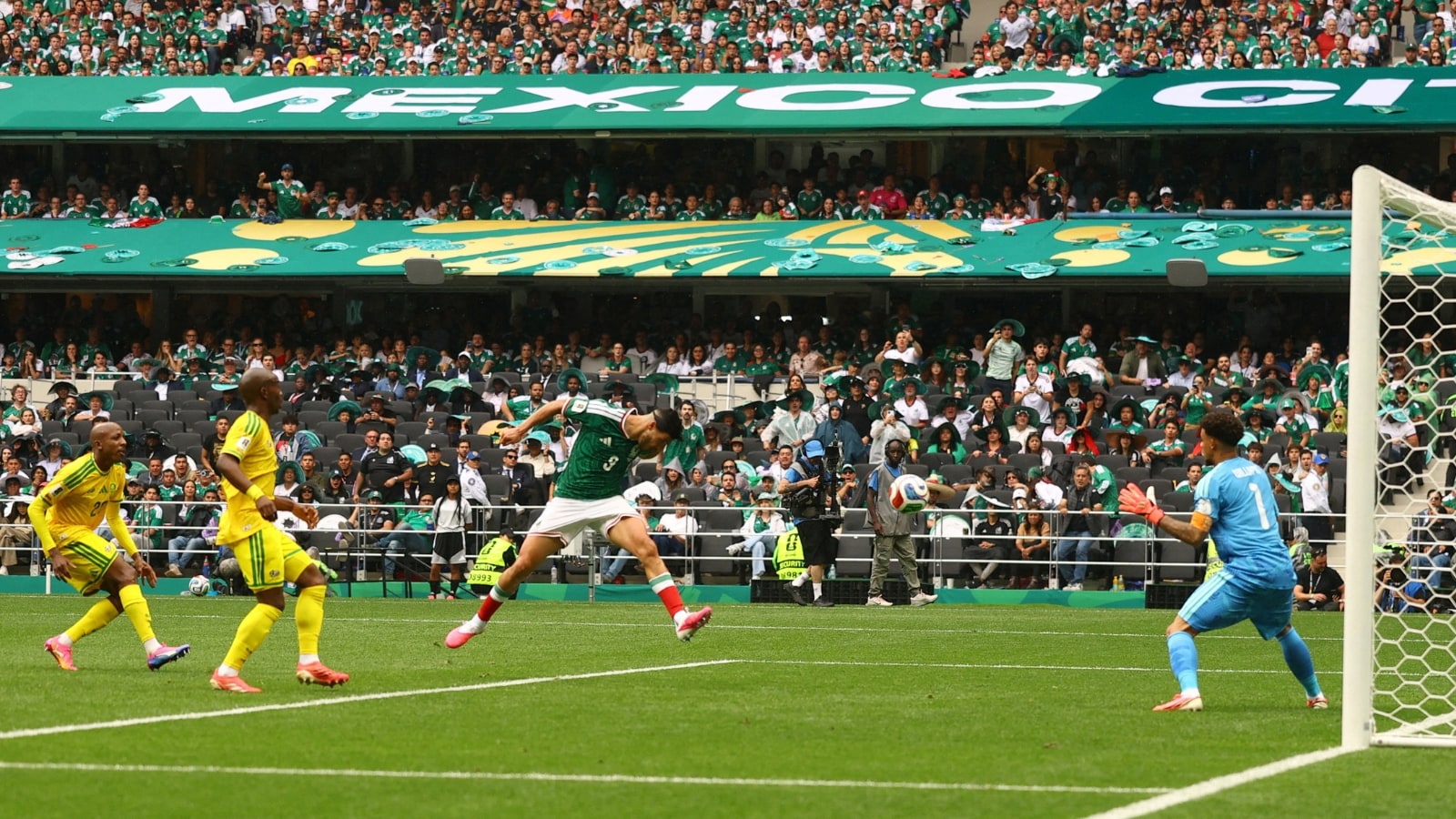
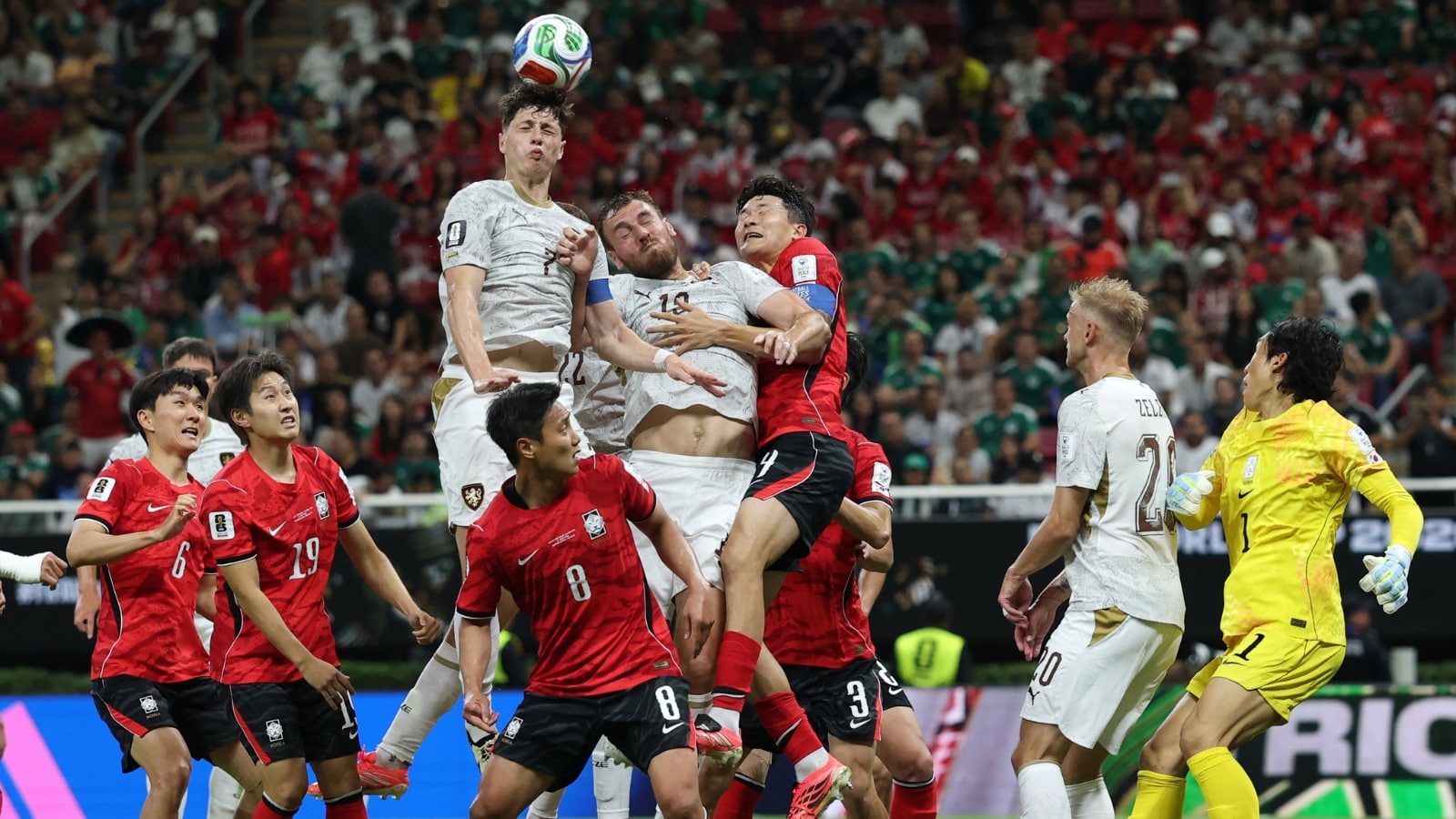
The rain in Mexico City doesn’t just fall. It clears the air, leaving behind a heavy, humid silence that hangs over the Estadio Azteca like a trial. If you have ever stood in that colossal concrete bowl when ninety thousand people are holding their breath, you know that pressure isn’t abstract. It is physical. It presses against your chest. It makes the air thick. For a striker wearing the green jersey of El Tri, that pressure can be suffocating.
Mexico does not merely watch football. It projects its national soul onto eleven men running across grass. When those men fail to score, the silence is deafening. When they succeed, the roar can shake the tectonic plates beneath the valley.
Lately, that roar has belonged to two men whose stories could not be more different, yet whose destinies have become completely intertwined. One is a prodigal son who rebuilt his body and career from the fragments of a horrific injury. The other is an adopted son who had to fight for the right to even claim the jersey as his own. Raul Jimenez and Julian Quinones. To understand why their recent World Cup goals matter so deeply, you have to look past the scoreboard. You have to look at the scars.
The Man Who Conquered the Ghost
Consider a cold November night in North London, miles away from the warmth of Tepeji del Rio, where Raul Jimenez first kicked a ball. It is 2020. A sickening crack echoes through an empty Emirates Stadium. It is the sound of a fractured skull.
For months, the question wasn't whether Jimenez would ever score another goal for Mexico. The question was whether he would live. When he finally returned to the pitch, he wore a protective band around his head, a literal armor against the fragile reality of his profession. But the physical wound healed faster than the public's patience.
Strikers are judged by a brutal, unyielding currency: goals. For a long time, the vault was empty. The fluid, explosive forward who had charmed the English Premier League seemed to have vanished, replaced by a cautious shadow. Fans grew restless. The media, always hungry for a narrative of decline, began to write his footballing obituary. They whispered that he was done, that the fear of another collision had permanently altered his DNA as a competitor.
But they forgot what makes Jimenez distinct. He is a predator of spaces, a man who understands that the game is played in tenths of a second and fractions of an inch.
When he stepped up to take that crucial penalty in the qualifiers, the stadium held its collective breath. A penalty is a psychological horror film masquerading as a sport. It is just you, the goalkeeper, and the weight of your entire life's work. Jimenez didn't blink. He took his characteristic, stuttering run-up—a slow, deliberate march that tortures keepers—and sent the ball home.
Redemption.
It wasn't just a point on a board. It was a declaration that the old Raul was gone, but the new Raul was forged in something far tougher than skull tissue. He proved that survival is a prerequisite for greatness.
The Naturalized Warrior
While Jimenez was fighting the ghosts of his own career, another drama was unfolding in Guadalajara and Mexico City. Enter Julian Quinones.
Quinones was not born into the mythos of the Aztec calendar. He was born in Magüí Payán, Colombia. He arrived in Mexico as a teenager, a raw talent searching for a foothold in a ruthless industry. He found it in the Liga MX, eventually becoming the devastating engine behind Atlas’s historic back-to-back championships, before moving to Club America and cementing his status as the most terrifying attacker in the country.
Then came the choice.
When a foreign-born player decides to represent Mexico, it triggers an existential crisis within the nation's sporting psyche. The debate is always fierce, occasionally ugly. Is he Mexican enough? Does he feel the colors? Will he fight when the chips are down, or is this just business?
Imagine the courage it takes to walk into a dressing room knowing half the country is waiting for you to fail just so they can say, "I told you so."
Quinones didn't ask for permission to belong. He earned it through sweat and sheer, unadulterated power. His style is a contrast to Jimenez’s elegant geometry. Quinones is a thunderstorm. He uses his body like a shield and his pace like a blade. When he drives at a defender, the opposition backline doesn't just retreat; they panic.
His first major goal for the national team was a moment of pure catharsis. It wasn't beautiful, but it was inevitable. He crashed into the penalty box, a force of nature disrupting the status quo, and forced the ball over the line. In that single moment, the debate died. The stadium didn't care where his birth certificate was signed. They only cared about the crest on his chest, damp with sweat, and the fact that he had dragged Mexico back into the fight.
The Architecture of a Partnership
The real magic, however, lies in how these two starkly different narratives collide on the pitch.
Football tactics are often explained through complicated diagrams and sterile arrows, but the relationship between strikers is more like a dance. It is about understanding gravity.
Jimenez is the thinker. He drops deep, dragging central defenders out of position, creating a vacuum in the defensive line. He possesses the vision of a midfielder, capable of threading a pass through a needle.
Quinones is the recipient of that space. He thrives in the chaos that Jimenez creates. When Raul pulls wide, Julian explodes into the center. It is a symbiotic relationship born out of mutual necessity. One man provides the nuance; the other provides the velocity.
Consider what happens next as the road to the World Cup intensifies. The opposition can no longer afford to double-team Jimenez, because doing so leaves a highway open for Quinones. If they drop deep to contain Quinones's speed, Jimenez will pick them apart from the edge of the box with his clinical precision.
This is the hidden strength of the current Mexican squad. For years, El Tri relied on a single focal point, a solitary savior expected to carry the entire offensive burden. That strategy is fragile. If that savior has an off night, or gets injured, the entire system collapses.
Now, the burden is shared.
The Unspoken Truth of the Journey
Let us be honest about what we are witnessing. The beautiful game is rarely just about beauty. It is about endurance.
We watch these men on high-definition screens, their faces beamed into our living rooms, and we forget that they are human beings operating under conditions that would break most people. We see the goals, but we don't see the hotel rooms filled with anxiety, the ice baths at three in the morning, or the relentless, crushing criticism from millions of amateur critics on social media.
Jimenez could have retired. He had won trophies, made millions, and secured his legacy. No one would have blamed him if he chose to protect his health and spend time with his family. Yet, here he is, throwing his head into flying boots, chasing a ball under the burning sun.
Quinones could have chosen an easier path. He could have waited for a call from Colombia, or simply enjoyed his status as a domestic king in Liga MX without the international scrutiny. Yet, he chose the crucible of El Tri.
Their goals in the World Cup cycle are not just statistics to be filed away in an archive. They are chapters in a larger story about what it means to refuse to be defined by your circumstances. One refused to be defined by a tragedy; the other refused to be defined by a border.
The next time El Tri walks out onto the pitch, look closely at them during the anthem. Watch Jimenez, the veteran who stared into the abyss and didn't blink. Watch Quinones, the newcomer who chose this madness because he discovered that home isn't where you start, it's where you stand your ground.
The whistle will blow. The ninety thousand voices will merge into a single, terrifying wave of sound. The pressure will descend, heavy and thick. But as the ball rolls across the grass, you will realize that the green jersey doesn't feel quite as heavy anymore, because it is being carried by two pairs of shoulders that have already proven they can bear the weight of the world.