The rain in the mountains does not care about lines drawn on maps.
When the monsoon swells over the high ridges of the Himalayas, it collects in the sacred basins and carves through ancient valleys with a blind, terrifying fury. It surges past boundary markers and stone pillars, carrying away topsoil, livestock, and homes. For the people who live in the high shadow of the world, the climate crisis is not a distant spreadsheet of rising carbon parts-per-million. It is the roar of brown water at midnight. It is the sudden absence of a bridge where your children crossed to school yesterday.
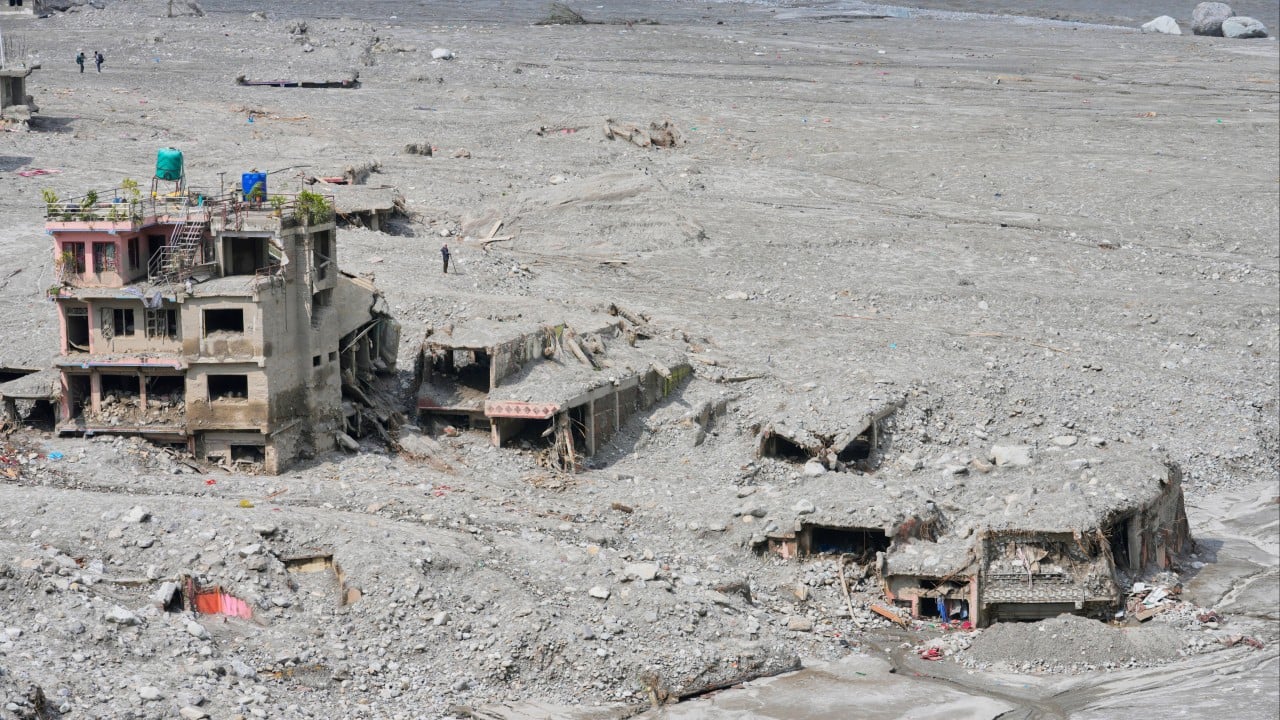
Consider a hypothetical farmer named Ramesh, whose terraced fields have clung to a hillside in rural Nepal for three generations. Ramesh wakes up not to an alarm, but to a low, vibrating hum that rattles the tin roof of his house. That hum is the Trisuli River, swollen three times its normal width, chewing away at the bank fifty yards below his door. By noon, his maize crop—months of patient labor, sun-watching, and sweat—is flattened beneath a slick blanket of grey silt.
Ramesh did not burn fossil fuels by the ton. Nepal contributes a microscopic fraction of global greenhouse gas emissions. Yet, here he stands, ankle-deep in the wreckage of someone else's industrial progress, watching his livelihood wash down toward the plains of India.
Water flows downhill. And right now, catastrophe flows across borders.
This simple, cruel geographic reality is forcing a radical diplomatic reckoning in South Asia. Nepal, battered year after year by catastrophic flash floods, unseasonal cloudbursts, and melting glaciers that threaten to burst their glacial lakes, is changing its posture. It is no longer just asking for international aid handouts from wealthy Western nations who view climate change through the lens of carbon credits and distant summits. Kathmandu is looking sideways, directly at its giant neighbors: India and China.
It is a diplomatic tightrope walk born of sheer desperation.
For decades, relations between these nations have been defined by suspicion, territorial friction, and the quiet chess matches of regional hegemony. India and China eye each other across the Himalayan watershed with eternal vigilance. But floodwaters do not respect a military outpost. When glacial outburst floods destroy multimillion-dollar hydroelectric projects in northern Nepal, the financial and energy shockwaves ripple instantly downstream into India’s northern grids and upstream into Tibet's infrastructure.
Nature has forced an awkward, fragile interdependence.
To understand why this matters, you have to look at the math of survival. Nepal is ground zero for climate volatility. According to scientific assessments, the Hindu Kush Himalayan region is warming at a rate well above the global average. The ice towers that act as the water taps for over a billion people are retreating. When they melt too fast, villages drown. When they are gone entirely, fields turn to dust.
Nepal cannot build walls high enough to stop the sky from falling. It cannot dredge fast enough to keep pace with the sediment load churned loose by destabilized mountain slopes. Protection requires early-warning systems that span international frontiers. It requires real-time hydrological data sharing between Beijing, Kathmandu, and New Delhi before a swollen river breaches a barrier. It requires coordinated regional infrastructure planning that treats the Himalayan river basins not as political buffers, but as shared ecological lifelines.
Yet, diplomacy is painfully slow while rivers run fast.
When Nepali diplomats sit across the table from their counterparts in New Delhi and Beijing, they bring a stark message: inaction is a security threat to everyone. If millions of climate refugees are unmoored from the mountain slopes because their valleys become uninhabitable, where do they go? They move downward. They strain urban centers already gasping for resources. They destabilize a region that is already nuclear-armed and chronically tense.
There is a profound irony here. For years, regional superpowers have fought over rivers for energy—building mega-dams to feed their insatiable industrial appetites. Now, those very same rivers are turning against them, weaponized by a warming atmosphere. The dams that were meant to symbolize national power are increasingly vulnerable to the wrath of unmanaged watersheds.
Walking through the aftermath in a flood-hit village near Sindhupalchowk, the scale of the loss is staggering. You see elders staring blankly at where a community once stood, their expressions hollowed out by grief that has become too routine. They do not talk about geopolitics. They talk about the color of the river. They talk about how the monsoon used to arrive with a predictable rhythm, like a trusted clock, but now strikes like an ambush.
This is the human core of the climate crisis. It is not an abstraction. It is the smell of wet mud inside a schoolhouse. It is the sound of an iron bridge groaning and snapping under the weight of uprooted trees.
If Nepal, India, and China can move past decades of historical baggage to forge a joint climate and water-sharing framework, it will be nothing short of a miracle. It would prove that shared peril can sometimes achieve what decades of peace talks could not. It would mean recognizing that the highest mountains on Earth are not a barrier keeping nations apart, but a roof over a single, shared house.
The storm clouds are gathering again over the peaks. The river is rising. The diplomats are still talking. And somewhere in the dark, the water keeps climbing toward the door.