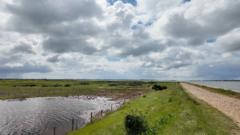
The salt reaches your throat before you even see the waves. It is a sharp, metallic tang that sticks to the back of the tongue, a constant reminder that the North Sea is only ever a few feet away. For decades, the routine was the same. Every morning, a warden would walk the gravel path along the embankment, boot heels clicking against the cold stones, checking the sluice gates. It was a comforting ritual. The timber looked solid. The earth banks looked high.
Then came the morning the wood gave way.
It did not happen with a cinematic roar. There was no cataclysmic storm surge or shattering thunder. Instead, a quiet, insidious rot had done its work over years, eating at the foundations of the sea defences until the pressure of an ordinary high tide simply pushed the barrier aside. A soft hiss of rushing water, the collapse of a mudbank, and a freshwater sanctuary built over centuries began to drown in brine.
We have treated coastal engineering as a war of attrition, a definitive line drawn in the sand where human ingenuity holds back the chaos of the primeval ocean. But out on the marshes, where the wind bends the reeds until they kiss the mud, that illusion is fracturing. When a sea defence fails at a nature reserve, the immediate reporting usually treats it as a minor local tragedy—a bureaucratic headache involving displaced birds and flooded footpaths.
The reality is a terrifying glimpse into our collective future.
The Fragile Miracle of the Fresh Marsh
To understand what is lost when the sea breaks through, you have to understand the delicate physics of a coastal ecosystem. Consider a hypothetical birdwatcher named Thomas. For thirty years, Thomas has come to the same stretch of coastline with a pair of scuffed binoculars and a notebook. He is not a scientist, but he understands the rhythm of the marsh better than most hydrologists.
He knows that a few inches of water level make the difference between life and death for thousands of species.
On one side of the old earthen wall lies the saltmarsh, a brutal, unforgiving environment dominated by tides, samphire, and mud. On the other side lies the freshwater grazing marsh, a lush, fragile paradise fed by lowland streams and protected from the ocean's fury. This is where the avocets breed, their delicate, upturned bills skimming the shallow pools. This is where the bitterns hide in the dense reedbeds, their booming calls echoing like foghorns through the mist.
The separation between these two worlds is razor-thin. It relies entirely on a network of clay banks, wooden piling, and cast-iron tidal flaps designed to let river water out at low tide while blocking the sea from rushing in at high tide.
When those structures fail, the transformation is instantaneous and violent.
Salt is a poison to freshwater life. The moment the sea breaches the wall, the reeds begin to wither. Their roots, adapted for sweet, mineral-rich river water, are choked by sodium. Within days, the vibrant green of the marsh turns a sickly, chemical brown. The invertebrates that form the base of the food chain—the dragonflies, the freshwater snails, the beetle larvae—die in millions. The fish suffocate. For the birds returning from thousands of miles away to nest, the home they knew has vanished, replaced by a sterile, salty lake.
But the real problem lies elsewhere, far beyond the borders of the nature reserve itself.
The Invisible Stakes of a Broken Wall
It is easy for onlookers to dismiss the destruction of a wetland as an isolated ecological mishap. "It’s just a swamp," the argument goes. "Nature will adapt."
That perspective gets the entire equation backward.
A nature reserve is not an isolated museum piece kept behind glass for retirees with binoculars. It is a highly functional piece of green infrastructure. Think of a freshwater marsh as a massive, organic sponge. When heavy winter rains fall inland, rivers swell. If those rivers cannot empty into the sea because the tide is high, the excess water needs somewhere to go. A healthy marsh absorbs that surplus, holding millions of gallons of water safely away from human habitation.
When the sea defences fail, the sponge is already soaked to capacity with saltwater.
Consider what happens next: the next time a severe storm hits the coast, the incoming tide meets a marsh that is already full. The water has nowhere to go but up and out. It spills backward, pushing into the drainage networks of nearby agricultural land, souring the soil of prime wheat fields with salt for generations. It creeps up the foundations of coastal villages, turning basement floors into stagnant pools and cutting off isolated roads.
The failure of a single wooden sluice gate on a remote wildlife refuge is the first falling domino in a collapse that eventually reaches the doorstep of suburban homes.
Why, then, are these vital barriers being allowed to crumble? The answer lies in a bitter mix of shifting priorities, funding gaps, and a hard, scientific truth that no one wants to admit aloud: we are running out of time to fight the tide.
The Math of Retreat
Maintaining sea defences is an astronomical financial burden. A single kilometer of modern sea wall can cost millions to construct and hundreds of thousands of dollars annually to maintain. Historically, government agencies have prioritized urban centers, economic hubs, and industrial ports for funding. Remote nature reserves, despite their immense ecological and protective value, are often left at the bottom of the ledger.
The math simply does not add up anymore.
As global sea levels rise and storm events become more frequent and severe, the pressure on these aging structures is multiplying exponentially. Walls built in the mid-20th century were designed for a climate that no longer exists. They are being pounded by forces they were never meant to withstand.
This has forced conservationists and engineers into an agonizing paradigm shift. For decades, the goal was absolute defense—hold the line at all costs. Now, the conversation has turned to managed realignment.
It is a polite, bureaucratic term for an incredibly painful concept: giving up.
Instead of spending millions to repair a failing wall, authorities are increasingly choosing to deliberately breach it further down the coast, allowing the sea to reclaim the land in a controlled manner. The goal is to create new saltmarshes, which are remarkably efficient at absorbing wave energy, thereby protecting houses further inland.
But for the communities who live alongside these reserves, and for the wildlife that depends on the freshwater habitats, managed realignment feels less like a strategic victory and more like a heartbreaking surrender.
Learning to Live with the Fluid World
Standing on the edge of a breached embankment, the sense of loss is palpable. The water moves with a terrifying indifference. It does not care about the hours volunteers spent building tern rafts, or the decades of careful water-level management required to coax rare orchids into bloom. It simply floods, erases, and resets.
Yet, amid the destruction, a strange kind of resilience begins to emerge.
The freshwater marsh may be gone, but the saltmarsh that replaces it will eventually find its own equilibrium. Mudflats will form. Redshanks and curlews will arrive to feed on the marine worms left behind by the receding tide. The landscape does not die; it changes form.
The real challenge is not teaching nature how to adapt to the water. Nature has been doing that for millennia. The challenge is teaching ourselves.
We have spent generations viewing the line between land and sea as something permanent, something that could be mapped, owned, and defended with concrete and steel. We built our lives, our economies, and our identities on the assumption that the map would never change.
That assumption is drowning.
As the morning sun catches the ripples of the newly formed lagoon, covering the drowned fence posts and submerged paths in a skin of gold, the lesson becomes clear. We cannot engineer our way out of a changing planet with stiffer timber and thicker mud. The water always finds the crack. The water always wins. Our only choice now is to stop fighting the sea, and start learning how to yield.


