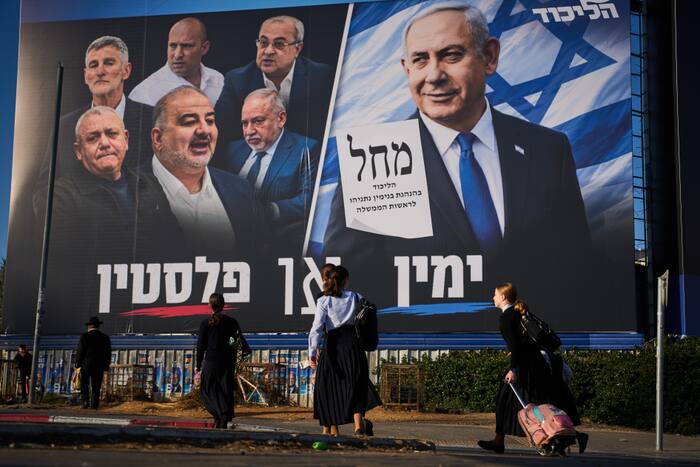
Read any standard election profile of Israel's vote and you get the exact same parade of faces. Benjamin Netanyahu. Gadi Eisenkot. Naftali Bennett. Itamar Ben-Gvir. Mansour Abbas.
Neat. Tidy. Completely misleading.
Conventional pre-election roundups treat Israeli politics like a presidential cage match with a cast of supporting actors. They hand a few hundred words to each prominent politician, recite their biography, mention their stance on Gaza, Iran, or the courts, and pretend that ticking a box next to a familiar name decides the prime minister.
It does not.
Israel uses a closed-list proportional representation system across a single nationwide constituency with a 3.25% electoral threshold. Voters do not cast ballots for a prime minister. They pick a party slate, and then party leaders lock themselves in rooms to horse-trade their way to 61 seats in the 120-member Knesset. Focusing on the top five personalities while ignoring the arithmetic of blocs, surplus-vote pacts, and veto players is like analyzing a poker game by reading the players' horoscopes instead of counting the chips on the table.
The Lazy Consensus Around "Major Candidates"
Standard election guides build their story around a binary clash—Netanyahu versus his chief challenger—and sprinkle in a few colorful figures to keep readers scrolling. Even when those guides nod to coalition math, they still frame the race as a personality contest.
That framing breaks down the moment ballots are counted.
In Israel's October 27, 2026 parliamentary election—the first since the October 7 attacks and the first Knesset since 1988 to run its full four-year term without collapsing into snap elections—voters turned out at roughly 78%, up sharply from 70.6% in 2022. Yet no single party came anywhere near a majority, and no pre-election bloc cleared the 61-seat line on its own. Likud finished first with 27 seats (20.51%), Gadi Eisenkot's Yashar took 21 seats (16.05%), and Naftali Bennett's Together landed 12 seats (9.35%), alongside a surging Arab bloc led by the Joint List (11 seats) and Ra'am (8 seats).
I have watched campaign analysts and political consultants blow millions of dollars and endless air time building "persuasion" narratives around a single charismatic frontrunner in proportional parliamentary systems, only to watch a mid-sized kingmaker or an ideological veto bloc wreck the entire math in forty-eight hours. When a system requires 61 seats, the marginal seat costs far more than the plurality seat. Winning 27 seats feels triumphant on election night. Being stuck at 53 seats as a bloc—eight shy of a majority—is a slow-motion trap.
Political scientists who study proportional representation—from Maurice Duverger on party systems to Arend Lijphart on consensus and majoritarian democracy—have long shown that multi-party parliaments with low-to-moderate thresholds reward coalition brokerage and bloc discipline over raw plurality size. In Israel, the Bader–Ofer seat-allocation method and surplus-vote agreements between allied lists can tip close leftover mandates before a single cabinet post is even discussed. A candidate profile that skips those mechanics tells you who is on the poster, not who holds the keys to the ministries.
Stop Asking Who Won. Start Asking Who Can Reach 61
When people search for information on Israel's major candidates, they usually ask two questions: Who is the frontrunner to be prime minister? and Which party leader has the clearest path to power?
Both questions smuggle in a bad premise.
First, "frontrunner" in a fragmented Knesset is a moving target. Being the largest faction gives a leader political momentum, yet the president tasks the lawmaker who has the best realistic shot at assembling a 61-seat majority—not simply the person with the highest seat count. After the October 2026 vote, President Isaac Herzog handed the mandate to Gadi Eisenkot on November 8 rather than leaving caretaker Prime Minister Benjamin Netanyahu in charge of coalition talks.
Second, "clearest path" assumes every seat is fungible. It isn't. Israeli politics is fractured along fault lines that cut across left and right: secular versus religious, draft exemptions for ultra-Orthodox men, judicial power, post-October 7 accountability, and whether Arab parties belong inside—or outside—the governing equation.
Imagine a scenario where a centrist leader finishes second in seats with 21 mandates, pulls together allies like Naftali Bennett's Together (12) and Yair Golan's Democrats (8), and still sits more than a dozen seats short of 61 without touching far-right or Arab factions. Suddenly, the real power doesn't sit in the prime minister's office. It sits with whoever controls the swing votes or can stomach a taboo partnership—or a minority government backed from the outside. That is precisely the gridlock playing out in November 2026 as Eisenkot's mandate ticks toward its early-December deadline.
Look at the booth in that photo: a simple slip of paper dropped into a box, stripped of presidential names. Every single vote feeds a nationwide ledger where ideological red lines matter just as much as raw percentages.
Four Blind Spots in Typical Candidate Profiles
If you rely on surface-level candidate bios, you miss four structural forces that actually decide how Israel is governed:
- The veto players matter more than the headliners. Hardline ideological factions—whether ultra-Orthodox parties guarding draft exemptions and religious funding or far-right nationalist lists pushing settlement and sovereignty agendas—can hold a coalition hostage over a single bill. A leader with 25 seats can be paralyzed by a partner with 6 or 7.
- Turnout shifts break stale bloc assumptions. Conventional wisdom treats Israeli blocs as static concrete. High turnout—especially when Arab citizens turn out at elevated rates or ultra-Orthodox turnout dips—rewrites the seat map overnight. In October 2026, Arab parties climbed to 19 seats combined, turning a two-bloc stalemate into a three-way arithmetic puzzle.
- Security credentials are a starting line, not a governing plan. Former military chiefs like Gadi Eisenkot bring deep operational credibility—made even sharper by personal family loss in the Gaza fighting—while Netanyahu leans on decades of diplomatic and security experience. Yet commanding troops or negotiating abroad does not automatically solve domestic coalition math, inflation, judicial friction, or Haredi conscription.
- Refusal to partner is a policy choice with a price tag. Campaign pledges to rule out certain parties sound principled in October. By November, when neither a clean majority nor a smooth unity deal materializes, every veto carries a cost: more weeks in limbo, a fragile minority arrangement, or another trip to the polls.
| Analytical Lens | What Standard Candidate Profiles Emphasize | What Actually Drives Coalition Outcomes |
|---|---|---|
| Electoral Math | Individual charisma, campaign slogans, and top-of-ticket polls | 61-seat majority threshold, bloc totals, and surplus-vote agreements |
| Ideological Leverage | Broad labels like "right," "center," or "left" | Non-negotiable red lines on conscription, courts, security, and coalition partners |
| Swing Dynamics | Head-to-head rivalry between the top two contenders | Mid-sized factions, Arab voter turnout, and outside/minority support mechanics |
| Governance Horizon | Election-night victory narratives | Weeks of post-election bargaining before a Knesset confidence vote |
Where This Contrarian Approach Can Trip You Up
Focusing on coalition mechanics and structural incentives is far sharper than reading celebrity-style candidate profiles, but it comes with its own traps.
First, structural analysis can make politics look overly deterministic. Leaders still make choices—and miscalculations. Personal animosities, ego, legal pressures, and sudden security crises can blow up a mathematically viable coalition on paper. Second, zooming out to seat arithmetic can flatten real human stakes. Behind every seat in the Knesset sit families grieving war losses, reservists exhausted by prolonged call-ups, households squeezed by living costs, and communities fighting over basic rights, safety, and representation. Numbers explain how a government forms; they do not capture why voters care so fiercely.
How to Actually Read Israeli Election Coverage
Next time you read a breakdown of Israel's major candidates, skip the bio fluff at the top and run a four-step filter instead:
- Count the bloc, not just the leader. Add up the realistic partners each contender can bring to the table and check the distance to 61. If the gap requires an awkward flip or an outside arrangement, treat any "easy path" claim with skepticism.
- Track the red lines early. Watch what each faction refuses to budge on—draft rules, judicial authority, war inquiries, or specific coalition partners. A party with 7 seats and a hard veto often wields more practical power than a larger party desperate to govern.
- Watch turnout by community. Check overall turnout against previous cycles, and look closely at shifts in Arab and ultra-Orthodox participation. Small percentage swings in turnout can move several seats in a nationwide proportional count.
- Treat election night as halftime. A vote in the Knesset sets the starting lineup; the real test is whether anyone can pass a confidence vote before the mandate clock runs out.
Stop watching the marquee names and watch the 61st seat.