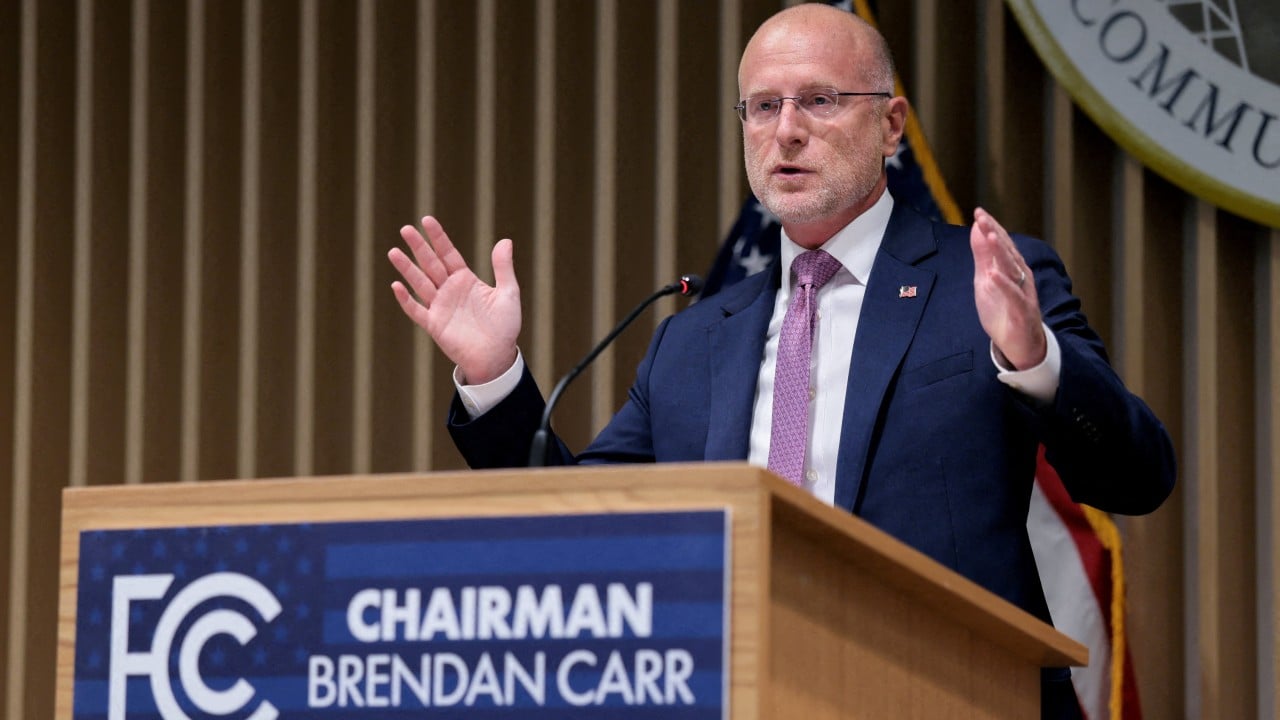
The Federal Communications Commission has moved to strip Chinese state-linked laboratories of their authority to certify electronic devices for the American market. Timed just ahead of high-stakes diplomatic talks between Donald Trump and Xi Jinping, this regulatory strike targets the invisible bottleneck of global hardware trade. Every smartphone, router, baby monitor, and smart thermostat sold in the United States requires an FCC equipment authorization before it can legally clear customs or hit retail shelves. By severing Chinese testing facilities from this approval pipeline, Washington is effectively weaponizing compliance bureaucracy to squeeze Beijing's manufacturing dominance.
Most consumers never think about the tiny FCC logo stamped on the back of their laptop or etched into the settings menu of their phone. That mark represents the final gatekeeper between a factory floor in Shenzhen and a living room in Ohio. For decades, the United States outsourced not just the assembly of consumer electronics, but the regulatory verification of those electronics as well.
How the Certification Chokepoint Actually Works
To understand why a ban on testing laboratories carries such massive weight, you have to look under the hood of the FCC equipment authorization program. The agency does not test every single gadget itself. That would bring the entire global consumer electronics industry to a grinding halt within forty-eight hours. Instead, the FCC relies on a decentralized network of accredited testing labs and Telecommunications Certification Bodies, known in the industry as TCBs.
When a manufacturer designs a new wireless device, it must prove that the product will not emit harmful radio-frequency interference or violate specific absorption rate limits for human exposure. The manufacturer sends prototypes to an FCC-recognized testing facility. Engineers at that lab run the hardware through electromagnetic compatibility chambers, measure signal bleed, and compile a dense technical dossier. That dossier is then handed over to a TCB, which reviews the paperwork and issues the official FCC ID.
Over the past twenty years, hundreds of these accredited testing facilities proliferated across mainland China and Hong Kong. It made pure logistical sense. If Apple, Dell, HP, or a mid-sized American audio brand was already manufacturing its circuit boards and assembling its enclosures in Guangdong province, shipping pre-production prototypes back to North America just for radio-frequency testing added weeks of delay and thousands of dollars in freight costs. Keeping the testing labs next door to the assembly lines made global supply chains faster and cheaper.
It also created a glaring national security blind spot.
Many of the largest testing conglomerates operating inside China are either directly owned by state-backed enterprises, affiliated with the Chinese military-civil fusion apparatus, or legally subordinate to Beijing's national intelligence laws. Under Chinese law, domestic organizations must cooperate with state intelligence gathering when asked. Giving state-aligned entities privileged, pre-market access to the exact technical schematics, firmware architectures, and internal components of every wireless device destined for the United States is a counterintelligence nightmare.
Consider a hypothetical example to see how this vulnerability plays out in practice. Suppose a major American networking company develops a next-generation enterprise router intended for use in corporate offices and municipal buildings. Months before that router is announced to the public, the company must submit unencrypted schematic diagrams, block diagrams, internal photographs, and operational descriptions to a testing lab to obtain its FCC certification. If that lab answers to a foreign adversary, those blueprints are exposed before the first unit ever leaves the factory.
The Diplomatic Timing Behind the Ban
Regulatory rulemaking in Washington usually moves at a glacial pace. Notice-and-comment periods stretch for months, lobbying groups file endless rebuttals, and final orders sit in bureaucratic limbo until everyone forgets why they mattered. When an agency suddenly accelerates a major enforcement action right before a bilateral presidential summit, the timing is never accidental.
Washington is walking into the Trump-Xi meeting looking for asymmetric leverage. Tariffs have become a blunt, familiar instrument. Both sides know the tariff playbook inside and out, and supply chains have spent years routing around standard customs duties through third-party assembly hubs in Vietnam, Malaysia, and Mexico. You can slap a twenty-five percent or sixty percent tariff on a container of routers, and importers will simply pass the cost to consumers or reroute the final screw-driving step through Southeast Asia.
You cannot bypass an FCC authorization.
Without a valid FCC ID, a wireless device is contraband at the American border. Customs and Border Protection agents have the statutory authority to seize entire shipments on the spot if the authorization paperwork does not check out. By targeting the accreditation of Chinese labs, the administration is signaling to Beijing that it is willing to dismantle the administrative infrastructure that keeps Chinese factories connected to American consumers.
This move builds directly on the Covered List framework established under the Secure and Trusted Communications Networks Act. Previously, Washington focused on banning specific companies like Huawei and ZTE from receiving FCC authorizations for their own branded telecom gear. Critics inside Congress and the intelligence community pointed out a massive loophole in that policy. Even if Huawei could not get its own equipment certified, labs tied to Chinese state interests were still inspecting, testing, and certifying millions of devices made by other companies. Closing that backdoor turns a targeted blacklist into a systemic structural decoupling.
Why American Tech Giants Are Quietly Panicking
Publicly, corporate America applauds every measure taken in the name of national security and supply chain resilience. Privately, compliance officers and hardware engineering directors across Silicon Valley and Austin are staring at their product roadmaps with cold sweat on their foreheads.
The global hardware ecosystem cannot replace China's testing capacity overnight. Building an accredited electromagnetic compatibility testing chamber is not like leasing an empty warehouse and setting up folding tables. A single full-scale anechoic chamber lined with radiation-absorbent material costs millions of dollars to construct, requires specialized calibration equipment, and must be staffed by veteran radio-frequency engineers who are already in short supply worldwide.
| Factor | China Testing Ecosystem | Alternative Hubs (US, Taiwan, South Korea, Vietnam) |
|---|---|---|
| Lab Density | Hundreds of accredited labs clustered near assembly lines | Concentrated in specific tech corridors; lower total volume |
| Turnaround Time | 1 to 3 weeks due to proximity and round-the-clock shifts | 6 to 12 weeks due to shipping and existing queue backlogs |
| Testing Costs | Heavily subsidized and fiercely competitive | 40% to 120% higher baseline engineering and chamber fees |
| Supply Chain Friction | Zero customs clearance required for pre-production prototypes | Requires international carnets, export licenses, and shipping |
When you suddenly disqualify a massive chunk of the world's testing capacity, the remaining accredited labs in the United States, Taiwan, South Korea, Europe, and Japan immediately hit maximum capacity. Queue times stretch from weeks to months. For a consumer electronics brand operating on tight seasonal launch windows—where missing the back-to-school rush or the November holiday shopping window can wipe out an entire year's profit margin—a two-month certification bottleneck is catastrophic.
Smaller American hardware startups will feel the pain first and hardest. Tech giants like Apple and Samsung have the financial muscle to book out entire testing facilities months in advance or even build proprietary accredited labs in-house. A mid-sized smart home company or an industrial sensor manufacturer in the Midwest does not have that luxury. Those companies relied on third-party Chinese labs because they offered fast turnaround times at manageable prices. Forcing those smaller players to compete for scarce chamber time in California, New Jersey, or Taipei will drive up compliance costs and delay product launches across the board.
The Myth of Clean Supply Chain Decoupling
Politicians love to talk about decoupling from China as if it were a simple matter of flipping a switch or moving an assembly line from one country to another. Anyone who has actually spent time on factory floors across Asia knows that hardware manufacturing does not work that way.
Even when a company moves final assembly to Vietnam or India to avoid tariffs, the underlying ecosystem often remains anchored in southern China. The tooling engineers, the specialized component suppliers, and the testing laboratories are all concentrated within a fifty-mile radius of Shenzhen and Dongguan. When an engineer runs a pre-compliance test at a local lab and discovers that a device is failing electromagnetic emission limits, they can walk across the street to a component vendor, swap out a shielding gasket or tweak a capacitor, and re-test the unit the very next morning.
Severing the testing phase from the manufacturing phase breaks that rapid iteration loop. If a prototype fails testing at a lab in Taiwan or the United States while the engineering and manufacturing teams sit in mainland China, every minor hardware revision requires international shipping, customs declarations, and weeks of dead time.
There is also the thorny question of corporate ownership and shell structures. Many testing companies operating in China are joint ventures or subsidiaries of European and American inspection giants like SGS, Bureau Veritas, Intertek, and UL Solutions. How regulators draw the line between a wholly Chinese state-owned laboratory and a Chinese subsidiary of a Western testing conglomerate will determine whether this ban is a surgical strike or a blunt-force wrecking ball. If the rules sweep up every facility physically located on Chinese soil regardless of parent ownership, the resulting backlog will paralyze global electronics launches well into next year. If the rules leave loopholes for joint ventures, Beijing will simply route testing volume through compliant corporate wrappers while maintaining operational oversight.
What Happens to Devices Already on Store Shelves
Consumers and retail buyers inevitably ask what this crackdown means for the electronics they already own or plan to buy this season. The short answer is that existing authorizations are not being revoked retroactively en masse, at least not yet.
An FCC ID is tied to a specific hardware configuration at the time of certification. If your smartphone, laptop, or Wi-Fi router was certified last year and is already sitting in a warehouse in California or on a shelf at Best Buy, it remains legal to sell and operate. The immediate shockwave hits new products currently in the pipeline and existing products that undergo hardware revisions.
Under FCC rules, if a manufacturer changes a critical radio component, alters the antenna design, or swaps out a wireless chipset due to supply shortages, the company must file for a Class II permissive change or a brand-new FCC ID. That requires fresh lab testing. As component shortages continue to force engineers to redesign circuit boards on the fly, manufacturers will find themselves trapped between needing new certifications and having nowhere fast to get them tested.
Furthermore, the FCC has increasingly signaled that it is willing to look backward when national security concerns dictate. In recent years, the agency has expanded its authority to revoke previously granted authorizations if it determines that a device poses an unacceptable risk to telecommunications networks. While an immediate recall of millions of consumer gadgets is politically and logistically unfeasible, corporate legal teams are already auditing their historical certification files to see which products passed through high-risk Chinese labs over the past five years.
The Invisible War Over Technical Standards
Zoom out from the immediate drama of the Trump-Xi summit, and this lab ban reveals a much deeper shift in how Washington and Beijing fight for technological supremacy. For the last decade, the battle focused on visible hardware—blocking Huawei 5G base stations, restricting Nvidia AI chips, and slapping tariffs on solar panels and electric vehicles.
Now, the conflict has descended into the foundational plumbing of global trade. Testing protocols, accreditation bodies, technical standards committees, and certification rules are the real terrain of modern economic statecraft. Whoever controls the certification pipeline controls market access.
Beijing understood this long ago. Over the past fifteen years, Chinese state planners poured billions of yuan into subsidizing domestic testing and certification bodies, aggressively expanding China's footprint inside international standards organizations like the International Telecommunication Union and the International Organization for Standardization. The goal was straightforward: make Chinese compliance infrastructure indispensable to global manufacturers so that Western companies would remain structurally tethered to China even if they moved their assembly lines elsewhere.
Washington's move to strip Chinese labs of FCC recognition is a direct counter-punch aimed at breaking that dependency. It forces global electronics makers to build out parallel compliance infrastructure outside Beijing's jurisdiction.
Yet regulatory decrees do not build testing chambers, and executive orders do not train radio-frequency engineers. Until the United States and its allies invest seriously in expanding domestic and allied testing capacity—streamlining accreditation timelines, subsidizing lab construction, and accelerating visa pathways for specialized RF engineers—banning Chinese labs will impose heavy collateral damage on the very Western companies Washington wants to protect.
Hardware executives across the industry are already rewriting their 2027 product launch schedules, shifting prototyping budgets toward Taipei, Seoul, and Austin, and bracing for customs delays at American ports of entry. Whether Trump and Xi strike a temporary truce over dinner or walk away empty-handed, the era of frictionless, China-centric electronics certification is dead.



/Palantir by Hiroshi-Mori-Stock via Shutterstock.jpg)