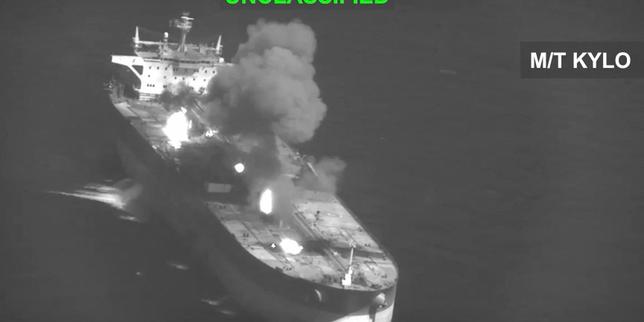
Every time a surface action group lets loose with Harpoons in the Persian Gulf, the cable news industrial complex treats it like the opening act of Armageddon. The headlines scream about targeted warships, flaming petroleum, and the sudden, terrifying escalation of state-backed piracy. We get the usual chorus of retired admirals on television warning about the closure of the Strait of Hormuz and fifty-dollar gallons of gasoline.
It is theater. Expensive, combustible theater that completely misunderstands how modern maritime proxy warfare actually operates. You might also find this connected story interesting: Inside the Rigorous Ascent of Lai Ka-ying and Hong Kongs First Orbit.
When the U.S. military hits three Iranian oil tankers after claims that Navy warships faced inbound missile fire, the immediate consensus from Washington think tanks is simple: deterrence. The narrative says we sent a message. We reminded Tehran that the sea lanes belong to the global order. We demonstrated resolve.
That logic is lazy, outdated, and fundamentally detached from the economic realities of maritime smuggling networks. Sinking a tanker loaded with heavy crude does not cripple the Iranian Revolutionary Guard Corps Navy. It does not stop the flow of illicit revenue. It barely even registers on a balance sheet that has spent decades perfecting the art of sanctions evasion. As reported in recent reports by Reuters, the results are worth noting.
Let us look at the actual mechanics of the shadow fleet. Iran does not rely on modern, single-owner tankers flying clean flags of convenience to move its primary energy exports to refineries in East Asia. The vessels at the bottom of the Gulf today were likely operating under their third false flag of the month, carrying a cargo already sold through shell companies registered in jurisdictions that do not answer subpoenas from the Treasury Department. The insurance is self-funded, the transponders have been dark since they cleared the territorial waters of the Gulf of Oman, and the financial risk is baked into the steep discounts offered to buyers who do not care about Western secondary sanctions.
When you sink one of these hulks, you are not destroying state assets that hurt the regime in Tehran. You are destroying a floating scrap metal liability that has already paid for itself ten times over through clandestine ship-to-ship transfers off the coast of Malaysia or in the open waters of the Indian Ocean. The owners of these vessels are anonymous holding entities that vanish the moment a missile clears the rail of an Arleigh Burke-class destroyer.
The military establishment loves kinetic solutions because kinetic solutions make for great B-roll. They look decisive in a PowerPoint briefing for the congressional armed services committees. They give the illusion of control in a theater where traditional deterrence stopped working the moment the nuclear deal collapsed and the maximum pressure campaign proved that a nation already heavily sanctioned has nothing left to lose.
If you talk to anyone who has actually spent time tracking illicit petroleum flows out of Kharg Island, they will tell you that the real battle is not fought with anti-ship missiles. It is fought in obscure maritime registries, through forensic accounting of opaque maritime insurance pools, and by leaning on the handful of port authorities willing to look the other way when a rust-bucket pulls in with a falsified certificate of origin.
Targeting the tankers after an alleged missile attack is the strategic equivalent of swatting a swarm of hornets with a baseball bat while standing directly under the nest. You might kill a few insects, but you are completely ignoring the queen, and you are guaranteed to get stung again tomorrow.
The missile attacks themselves are rarely about scoring a direct hit on a multi-million-dollar warship. They are probes. They are low-cost, asymmetrical tests of reaction times, radar signatures, and rules of engagement. Tehran wants to map out how fast a carrier strike group or a surface action group transitions from routine patrol to kinetic response. Every time we answer with a massive kinetic strike on a secondary asset, we hand them the exact data points they wanted. We show our hand, burn through expensive precision-guided munitions that take years to replace in our own stockpiles, and validate their entire premise that the United States is easily baited into overreacting.
We need to stop pretending that military strikes in the Gulf are a substitute for a coherent grand strategy. Sinking a phantom tanker is a tactical tick-box exercise designed to appease domestic political optics, not a geopolitical masterstroke. Until Washington realizes that economic warfare requires policing the shadows rather than blowing up the scenery, we will keep fighting the last war against an enemy that stopped caring about surface ships a generation ago.
The next time you see footage of a burning tanker off the coast of the Arabian Peninsula, do not ask how hard we hit them. Ask how much it cost us, how little it cost them, and why we are still falling for the oldest trap in the book.